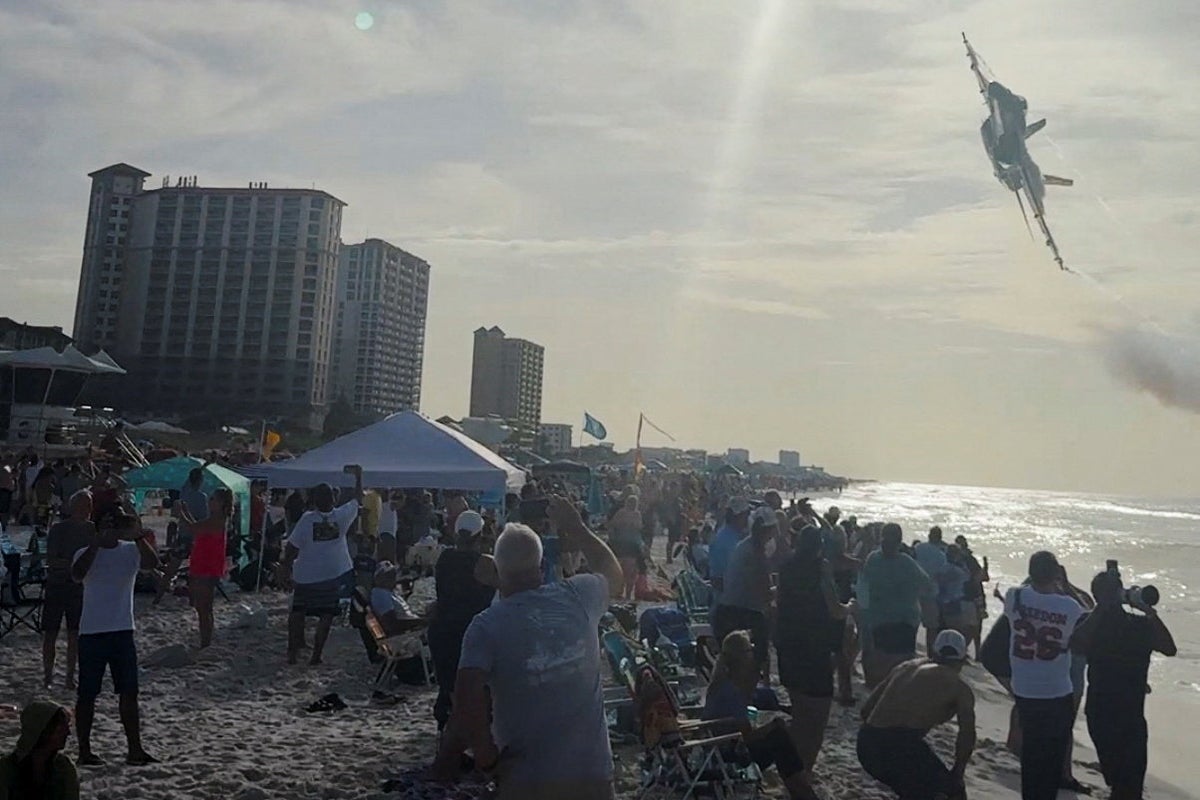
The air over Pensacola Beach usually tastes of salt water, cheap sunscreen, and melting ice cream. But on a humid Wednesday morning during the "Breakfast with the Blues" kickoff event, that familiar air was instantly replaced by the smell of burning JP-8 jet fuel and a pressure wave so violent it felt like a physical blow.
For a fraction of a second, the thousand-odd beachgoers sitting in their lawn chairs didn't hear a sound. Then came the roar.
An F/A-18E Super Hornet, painted in the unmistakable deep blue and gold of the Navy’s elite flight demonstration squadron, tore across the shoreline. It wasn't at the standard, meticulously rehearsed altitude. It was dangerously low. The jet banked sideways, its canopy flashing in the morning sun, ripping a path just feet above the sand. The wake turbulence—a miniature tornado generated by the fighter jet's wings—slammed into the beach.
Heavy canvas tents folded instantly. Heavy-duty beach umbrellas were torn from their anchors, spiraling through the air like javelins. Coolers flipped. Sand blinded hundreds of eyes in a stinging flash. People dove to the ground, some twisting ankles and knees as they scrambled away from what felt, for a terrifying heartbeat, like an impending disaster.
Within hours, the video went viral. And within minutes of that, the internet did what it always does: it stripped away the human reality of the cockpit and turned a dangerous mechanical error into a weaponized political Rorschach test.
The Culture War in the Clouds
To a highly polarized digital audience, the low pass wasn't a flight anomaly. It was a statement.
On one side of the internet, the flyover was cheered as an intentional act of pure, unadulterated American defiance. It was framed as political bravado, a literal manifestation of a new, aggressive military posture aligned with the administration. Washington leadership leaned heavily into this narrative. Acting Secretary of the Navy Hung Cao quickly posted a video of the incident on social media, proclaiming, "No reprimands. No firings. No problem. That's the sound of Freedom!" Defense Secretary Pete Hegseth chimed in with a slogan he had used previously to halt other military safety investigations: "The flyovers will continue until morale improves." Even the official White House social media accounts posted an AI-generated image celebrating the dangerously low pass, implying that questioning the safety of the maneuver was somehow unpatriotic.
On the other side, critics saw the stunt as a terrifying symptom of institutional decay—a reckless display of "cowboy diplomacy" where partisan theater was allowed to override the strict, uncompromising safety regulations governed by the Federal Aviation Administration.
But while the online world screamed about patriotism, bravado, and political alignments, the actual human being sitting at the center of the storm was living a completely different reality.
He wasn't trying to make a political statement. He was just a man who had made a mistake. And in the world of high-performance aviation, admitting a mistake is a heavy, humbling cross to bear.
The Weight Inside the Ready Room
To understand what happened, you have to look past the political theater and inside the mind of an elite naval aviator. The Blue Angels do not recruit average pilots. They are the best the fleet has to offer, individuals who have spent thousands of hours pulling high G-forces, landing on pitching carrier decks in the pitch black of night, and operating with a margin of error measured in inches.
They don't do things for "clout." Every single movement of the stick, every degree of throttle adjustment, is briefed, executed, and debriefed with religious precision.
When Blue Angels Commander Capt. Adam Bryan stood before reporters the morning after the incident, he didn't echo the triumphant rhetoric coming out of the Pentagon. His face was grave.
"The pilot found himself, unfortunately, in a situation that we would deem unsafe over the beach," Bryan said bluntly. "We never intend to fly over the crowd that low."
Behind the scenes, the bravado completely evaporated. Florida State Representative Michelle Salzman, an Army veteran who met with the pilot privately at an airshow event following the incident, captured the profound human toll of the error.
"He didn't make excuses," Salzman shared. "He didn't try to shift blame. He simply talked about a miscalculated turn—something no pilot ever wants to experience, especially one who has dedicated his life to flying at the highest level of precision."
The pilot wasn't celebrating his newfound status as an internet folk hero. According to Salzman, he was visibly shaken, crushed by the knowledge that he had fallen short of the team's incredibly high standards.
Consider the immense psychological pressure of that moment. You are at the absolute pinnacle of your career, representing the United States military before millions of people. You misjudge a radius during an arrival maneuver. The physics of your 30,000-pound fighter jet do the rest, dragging you lower to the ground than you ever intended to be. You survive the pass, but you realize instantly that you have put civilians at risk and potentially damaged the legendary reputation of your squadron.
Then, you step out of the cockpit, only to find the highest leaders in your government using your terrifying near-miss as a political meme.
The Rules of Flight, Written in Blood
Military aviation has an old, morbid saying: the flight manual is written in blood. Every restriction, every altitude floor, and every procedural checklist exists because, at some point in history, a pilot died discovering why it was necessary.
The FAA and the Navy have strict rules forbidding fixed-wing aircraft from flying lower than 500 feet over congested civilian crowds. The Blue Angels operate under special waivers that allow them to fly closer and lower than standard military flights, but even those waivers have hard boundaries. When a pilot breaches those boundaries, the institutional response has traditionally been swift and uncompromising, designed to prioritize safety above all else.
In past years, commanders who pushed the envelope too far were quietly but decisively removed from command to preserve the integrity of the unit. But the political intervention following the Pensacola beach incident threatens a delicate ecosystem. By declaring "No reprimands. No problem," top officials may score quick points on social media, but they inadvertently undermine the rigorous internal accountability that keeps these pilots alive.
The local community in Pensacola understands this balance better than anyone. They love the Blue Angels. They call the deafening roar of the jets the "sound of freedom," and they willingly plan their daily schedules around the flight practices. But that love is built on a foundation of absolute trust. The crowd stands on the sand because they trust the pilot in the cockpit to be perfect. The pilot is able to be perfect because he knows his commanders will hold him ruthlessly accountable for even a fraction of a mistake.
When politics disrupts that feedback loop, the stakes become invisible but incredibly high.
The human story of the Pensacola flyover isn't one of partisan victory or reckless defiance. It is the story of a highly skilled professional who suffered a terrifying lapse in precision, felt the immense weight of his accountability, and had to watch the world twist his mistake into something it never was. The jet blast has settled, the umbrellas have been gathered from the sand, and the political commentators have moved on to the next outrage. But inside the ready room, a pilot is still sitting with the sobering reality of how close a miscalculated turn can come to tragedy.