Silence.
In Kyiv, silence is never really empty; it is merely the inhale before a scream, a taut wire stretched across the dark roofs of Podil and Pechersk while the city waits to see which window will shatter next.
Consider a hypothetical kitchen on the fourth floor of a pre-war apartment block in Kyiv's Solomianskyi district, roughly three miles from the nearest electrical substation. Let us call the woman standing at the counter Olena, though she could be any of the three million residents who still measure their lives in air-raid alerts and kettle boils. At 4:15 in the morning, the air raid siren does not gradually rise; it tears through the drywall like a physical hand gripping the ribs. Olena does not reach for her shoes first. She reaches for the heavy wool coat draped over a dining chair, grabs her seven-year-old son from beneath a duvet printed with faded blue rockets, and steps into the corridor—the only space in the apartment without exterior glass, governed by the grim geometry known locally as the "two-wall rule."
Then comes the sound. Not the distant rumble of an outbound interceptor, which carries a sharp, upward crack like splitting timber, but the low, sub-audible pressure wave of a ballistic descent that rattles the teeth inside your skull before your ears even register the blast.
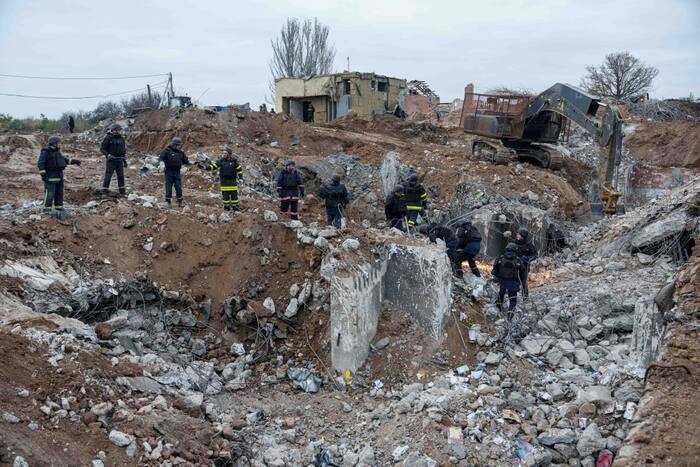
Five people were wounded across the capital in the latest barrage. Five. In the sterile language of wire dispatches and morning briefings, the number five barely registers as a rounding error against years of attrition, shattered concrete, and casualty tallies that have long since numbed the global scroll. Five wounded is a headline you skim while waiting for your espresso to pull. Yet behind each of those five digits is a specific emergency room gurney, a specific shard of double-glazed windowpane embedded in a forearm, a specific family staring at a blown-out balcony frame while frost creeps across the linoleum.
And here is the cruel symmetry that makes this particular morning so suffocating: the missiles fell just as Ukrainian diplomats were packing their briefcases for high-stakes trilateral talks with Russia and the United States.
Diplomacy, from five thousand miles away, looks like mahogany tables, crisp stationery, and carefully calibrated press releases about "de-escalation" and "security frameworks." On the ground in Kyiv, diplomacy feels like a target painted directly onto your roof.
The Arithmetic of Leverage
To understand why ballistic missiles rain down on a sleeping city hours before negotiators sit down with American and Russian counterparts, you have to strip away every polite euphemism used in foreign ministries. This is not random cruelty, nor is it a breakdown in command. It is an ancient, brutal form of arithmetic.
Imagine sitting down to negotiate the boundary of your own backyard while your neighbor stands on your porch holding a lit match over your dry timber. Every word you speak at that table is suddenly weighted not by the fairness of your claim, but by how quickly you want the match extinguished. That is the exact psychological architecture Russia attempts to build every time it launches a strike package ahead of diplomatic engagement.
When Russian forces fire cruise and ballistic missiles at Kyiv on the eve of trilateral discussions involving Washington, they are speaking a dialect that requires no translator. The message is aimed simultaneously at two audiences. To the Ukrainian delegation boarding trains and planes toward the negotiating venue, the strikes say: Your capital remains reachable, your grid remains fragile, and every day you delay concessions carries a physical price paid by your own citizens. To the American intermediaries, the message is subtler, designed to exploit fatigue and caution: Look how volatile this remains; push Kyiv to settle quickly before the escalation spirals beyond anyone's control.
Historically, this pattern is as predictable as winter frost on the Dnipro. During the Korean War armistice negotiations at Panmunjom between 1951 and 1953, artillery barrages and hill battles actually intensified because talks were underway, as both sides bled for marginal ridge lines to harden their bargaining positions. During the Vietnam peace talks in Paris, bombing campaigns were repeatedly dialed up or paused as direct punctuation marks to diplomatic proposals. War and diplomacy are rarely sequential phases where one politely exits the stage before the other enters. More often, they are twin levers pulled by the same hand.
Yet knowing the historical precedent does nothing to steady your hands when the drywall dust is falling into your hair.
What Five Wounded Actually Costs a City
We have developed a dangerous habit of measuring military strikes solely by fatality counts. If the dead number zero, or if the injured number five, distant observers exhale and file the event under "contained."
That metric completely misunderstands how modern urban warfare breaks a society.
A ballistic missile strike that wounds five people in Kyiv does not just harm five bodies; it detonates inside the nervous system of three million people simultaneously. When a residential block takes blast damage, when ambulances wail down boulevards slicked with black ice, and when air defense batteries light up the pre-dawn sky, the entire city loses four hours of REM sleep. Tomorrow morning, surgeons at the trauma center operate on two hours of rest. Teachers stand in front of classrooms where half the children flinch whenever a heavy truck hits a pothole outside. Power grid engineers—men and women who have spent years patching transformers with salvaged parts—climb back onto cherry pickers in freezing wind to restore voltage before the water pipes freeze solid.
Think about the invisible tax levied on a country trying to conduct complex statecraft under those conditions.
Negotiating with the United States and Russia requires immense cognitive clarity. Ukrainian officials must weigh territorial realities, long-term security guarantees, air defense replenishment timelines, economic reconstruction, and domestic political survival. They have to read the shifting moods of Washington—where domestic pressures, budget debates, and strategic bandwidth constantly reshape American priorities—while simultaneously decoding Moscow's maximalist demands.
Now imagine trying to hold that intricate chess game in your mind while receiving encrypted messages on your phone showing photographs of a burning apartment stairwell in your own neighborhood, knowing your spouse and children spent the night in a concrete stairwell.
It is terrifying. Honestly, even from the outside, watching the sheer density of variables converging on this moment feels overwhelming. Anyone who claims to know with certainty how these trilateral talks will unfold—whether they represent a genuine off-ramp, a tactical pause for rearmament, or a diplomatic trap—is selling certainty they do not possess. The fog here is thick enough to choke on.
The Three Chairs at the Table
If you walk into the room where Ukraine, Russia, and the United States prepare to talk, you are not looking at three equal partners trying to solve a shared problem. You are looking at three fundamentally incompatible theories of time.
For Russia, time is treated as an inexhaustible weapon. Moscow's leadership operates on the conviction that democracies suffer from short attention spans, electoral cycles, and low tolerance for sustained economic friction. By absorbing staggering human and material losses while maintaining steady pressure on Ukrainian cities, the Kremlin bets that Washington will eventually grow weary of underwriting the defense and Kyiv will eventually run out of air-defense interceptors and manpower. In Moscow's view, launching missiles into Kyiv right before talks is simply a reminder that the clock is ticking in Russia's favor.
For the United States, time is measured in strategic bandwidth and political capital. Washington sits at the table carrying the weight of global commitments, domestic skepticism over endless foreign entanglements, and an urgent desire to prevent a frozen conflict from mutating into a direct confrontation between nuclear powers. American negotiators want stability, predictability, and a durable settlement that allows the United States to pivot attention elsewhere without presiding over a catastrophic collapse of European security. That creates a subtle, persistent tension: Washington wants a deal that holds, while Kyiv knows a flawed deal is merely a countdown to the next invasion.
For Ukraine, time is measured in blood and sovereignty. Every month without a decisive security guarantee means another wave of missiles, another cohort of young men and women buried beneath yellow-and-blue flags, another winter spent rationing electricity. Yet signing an agreement that leaves Ukraine disarmed, neutral without real protection, or stripped of defensible territory is not peace—it is simply handing the attacker a quiet intermission to rebuild his arsenals.
Listen closely to that friction. When people ask why Ukraine doesn't simply "make a deal" to stop the missiles, or conversely, why Ukraine would even sit in the same room with Russia while missiles are still falling on Kyiv, the answer lies right inside that trap.
Kyiv cannot afford to refuse talks, because refusing talks risks alienating Washington—the very partner whose intelligence, financial lifelines, and air defense munitions keep the sky over Kyiv from collapsing entirely. At the same time, Kyiv cannot afford to accept peace on terms dictated by incoming warheads, because history has already shown what happens when aggression is rewarded with territory and paper promises.
The Phantom of Past Promises
Walk through the center of Kyiv, past the sandbagged monuments and the plywood-covered storefronts, and you will realize why the phrase "diplomatic assurances" leaves a metallic taste in Ukrainian mouths.
In 1994, Ukraine surrendered the world's third-largest nuclear arsenal—thousands of strategic warheads inherited from the Soviet collapse—in exchange for the Budapest Memorandum, signed by Russia, the United States, and the United Kingdom. That document explicitly committed its signatories to respect Ukraine's independence, sovereignty, and existing borders, and to refrain from the threat or use of force against it.
Twenty years later, Russian troops seized Crimea without insignia. Eight years after that, columns of tanks rolled toward Kyiv.
That history lives inside the bones of every Ukrainian official entering trilateral talks with Moscow and Washington. When American diplomats speak of monitoring mechanisms, buffer zones, or phased sanctions relief, Ukrainian negotiators hear the echo of 1994—and of the Minsk agreements of 2014 and 2015, which froze the front lines only long enough for a far larger war to be prepared.
This is the core dilemma that no bullet-pointed briefing can capture: How do you negotiate a ceasefire with a party whose signature has repeatedly served as camouflage for the next offensive?
Without concrete, enforceable security architecture—weapons deliveries that continue uninterrupted, air defense networks integrated into Western systems, and automatic consequences for violations—a piece of paper signed in a European hotel lobby will not stop a single ballistic missile from leaving its launch rail in Bryansk or Crimea.
Inside the Interceptor's Shadow
Let us return to that hypothetical fourth-floor corridor in Kyiv, because the physical mechanics of survival there explain the diplomatic stakes better than any white paper ever could.
When a ballistic missile arcs down toward Kyiv, air defense crews have roughly ninety seconds to two minutes from radar detection to impact. Unlike slower drones that buzz across the countryside for hours, giving families time to walk down into metro stations with thermoses and folding chairs, ballistic missiles fall at hypersonic terminal speeds. There is no margin for error. An interceptor launched from a Patriot or SAMP/T battery must hit an incoming warhead—an object moving miles per second—with kinetic precision, like striking a rifle bullet with another rifle bullet in pitch darkness.
Even when the intercept succeeds, physics refuses to vanish. Tons of twisted aluminum, unburned rocket fuel, and shrapnel fall back toward the earth under gravity's indifferent pull. That falling debris punches through roofs, ignites parked cars, shatters glass across four city blocks, and sends five civilians to the hospital with lacerations and concussions.
In other words, even Ukraine's victories hurt.
And every single interceptor fired into the night sky costs millions of dollars and takes months to manufacture in factories across the United States and Europe. Russia knows this inventory math down to the decimal point. Every barrage launched at Kyiv ahead of diplomatic talks forces Ukraine to burn through scarce, irreplaceable air-defense missiles—missiles that can only be replaced if Washington remains firmly committed to Kyiv's defense.
Look at how tightly the loop closes:
- Russia launches missiles at Kyiv to rattle civilian morale and deplete air defenses.
- Ukraine relies on American-supplied interceptors to keep the casualty count at five instead of five hundred.
- Washington then uses its leverage as primary supplier to bring Kyiv to the negotiating table alongside Moscow.
- Russia points to the ongoing strikes as proof that Kyiv must bend to end the pain.
It is a closed circuit of coercion, and the human beings living inside Kyiv are the copper wire carrying the current.
The Quiet Defiance of 8:00 AM
Yet if you walk down Khreshchatyk Street at eight o'clock the morning after the sirens fade, you witness something that consistently confounds military planners and cynical commentators alike.
The glass is swept up before the streetlamps even turn off.
Municipal workers in neon vests push wide brooms across the wet asphalt, scraping shattered storefront panes into neat silver piles. Two doors down, a barista runs a portable generator on the sidewalk, its rhythmic chug mingling with the hiss of a steam wand as commuters line up for flat whites before catching the metro. Nobody looks heroic. Nobody is delivering speeches for television cameras. People look exhausted, pale-eyed, and irritable—the universal expression of human beings who were woken at four in the morning by explosions and still have to file quarterly tax reports by noon.
There is a profound lesson hidden inside that mundane morning routine, one that outsiders routinely miss when they view Ukraine strictly as a geopolitical chessboard or a humanitarian crisis.
Resilience is not the absence of fear; it is the refusal to let fear reorganize your schedule.
When Kyiv residents sweep up shattered glass and open their bakeries three hours after a missile strike, they are performing a quiet act of counter-negotiation. They are stripping the incoming warheads of their intended psychological yield. A missile can blow out a window frame; it cannot sign away a city's will.
Still, resilience is not infinite, and romanticizing human endurance is its own form of cruelty. People can carry an impossible weight for four years, five years, or more—until a tendon snaps. Every family in Kyiv knows someone who has quietly broken under the cumulative strain: the child who no longer speaks above a whisper, the veteran who stares blankly at traffic lights, the elderly neighbor who refuses to leave her bed during alerts because her knees can no longer manage the stairs.
That is why the upcoming talks with Russia and the United States carry such agonizing weight. Everyone in Ukraine wants the sirens to stop. Nobody loves war except those who profit from it or watch it safely through high-definition screens. The divide is never between those who want peace and those who want war; the divide is between those who want a peace that lets their children grow up free, and those willing to accept a quiet surrender that merely postpones the next funeral.
The Heavy Pen
Somewhere right now, in a climate-controlled conference room far removed from the smell of cordite and wet concrete, staffers are aligning nameplates on a polished table.
One nameplate reads Ukraine. One reads United States. One reads Russia.
Bottles of still water are being placed precisely six inches to the right of each notepad. Lighting technicians are testing the brightness for the inevitable handshake photographs. Translators are clearing their throats in glass booths, reviewing the exact phrasing for words like sovereignty, ceasefire, monitoring, and guarantees—words so smooth and bloodless on paper that you would never guess they are forged out of shattered glass and emergency room sutures.
Back in Kyiv, Olena—and thousands of real mothers, fathers, doctors, and mechanics just like her—will tape heavy plastic sheeting over a blown-out window frame tonight so the wind does not freeze the pipes. They will check the charge on their power banks. They will set two bottles of water beside the bed. And when they close their eyes, they will listen, even in sleep, for the first low tremble in the glass.