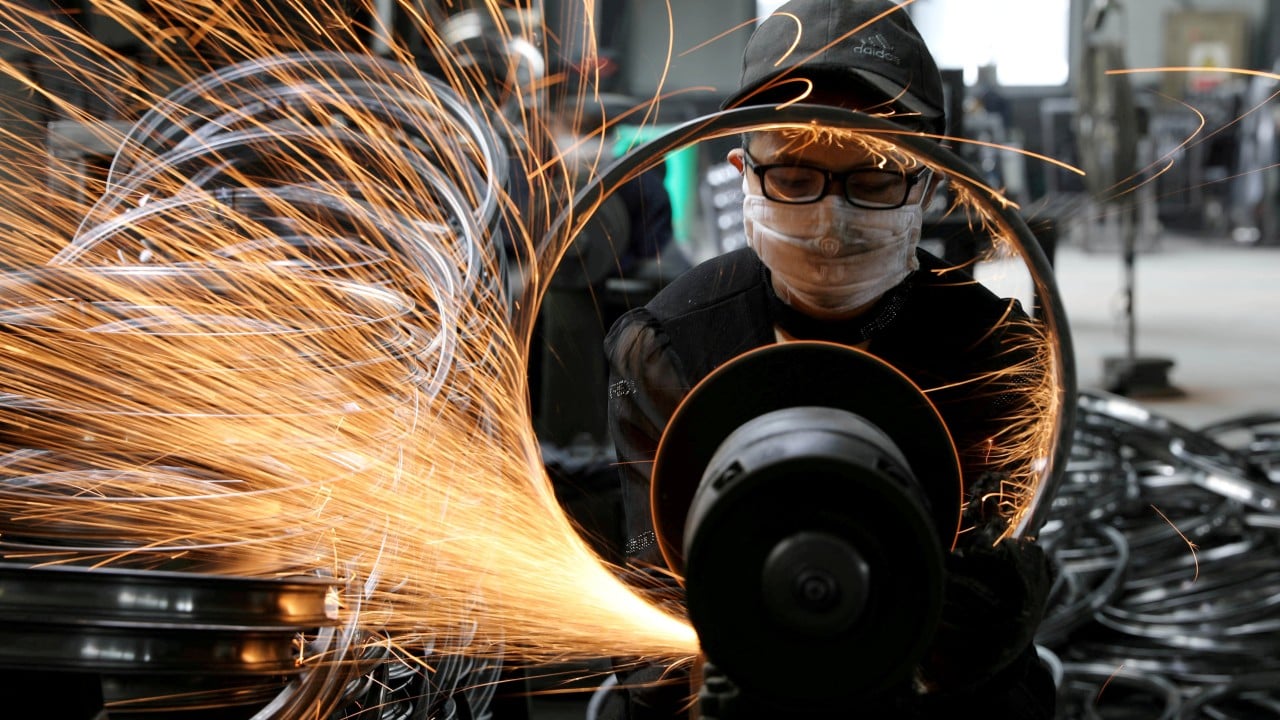
You never forget the smell of a working steel mill.
It is a distinct, heavy concoction of sulfur, hot oil, and scorched earth. It settles in the back of your throat and coats the roof of your mouth. For generations of men and women in places like Pennsylvania, Ohio, and Indiana, that acrid metallic taste was the flavor of security. It meant the blast furnaces were running. It meant the shifts were full, the union dues were paid, and the local diners were packed at dawn.
Then came Black Monday.
On September 19, 1977, the Youngstown Sheet and Tube Company announced the abrupt closure of its Campbell Works in Ohio. Five thousand jobs vanished in a single afternoon. Over the next decade, tens of thousands more followed across the region as other mills fell like dominos. The furnaces went cold. The skies, notoriously thick with smog for a century, finally cleared. But the clean air was a cruel mockery, breathing life into a dying region. The economic engine of the American century sputtered and cracked.
We all know what happened next. The storefronts boarded up. The tax base evaporated. Schools crumbled. A creeping, generational despair took root in the hollowed-out centers of American industry, eventually breeding political realignments and social crises that we are still trying to untangle today. The "Rust Belt" was born.
Half a century later, thousands of miles across the Pacific, the most powerful political apparatus in the world is staring at the history of the American Midwest with unblinking, terrified obsession.
Beijing is watching the rust. And they are determined not to let it spread to their shores.
The Dragon’s Forge
To understand the sheer gravity of China's current dilemma, you have to comprehend the scale of their industrial miracle. The numbers defy standard human intuition.
For the last two decades, China has produced more than half of the world's steel. They pour roughly a billion tons of it every single year. To put that into perspective, in just a few years during the height of its construction boom, China consumed more concrete and steel than the United States used in the entire twentieth century.
This was the architecture of an economic hyper-boom. Every new megacity, every high-speed rail line bridging impossible ravines, every towering apartment complex sprouting in second-tier cities required an insatiable diet of steel.
Let us picture a hypothetical worker. We will call him Wei.
Wei is a third-generation steelworker in Tangshan, a sprawling, heavily industrialized city in Hebei province, just a few hours from Beijing. Tangshan alone produces more steel than the entire United States. Wei’s grandfather melted scrap to build the early socialist republic. His father forged the girders for the 2008 Olympic stadiums. Wei, for the last ten years, has been churning out rebar—the ribbed steel rods that serve as the skeletons for concrete buildings.
For a long time, the unwritten contract between Wei and the state was simple: Work the furnace, endure the heat, and your life will materially improve every single year.
But the music has stopped.
The colossal Chinese real estate sector, which previously devoured vast percentages of Wei's rebar, has hit a wall. Giants of property development have defaulted on their debts. Millions of pre-sold apartments sit unfinished. The cranes have stopped moving in the provincial capitals.
The demand for basic, construction-grade steel is collapsing. The furnaces in Tangshan are suddenly churning out a product that no one wants to buy.
This is the exact, precarious cliff edge where the American steel industry stood in the late 1970s.
The Siren in the Pages of Qiushi
The anxiety in Beijing is not a whispered rumor. It is being broadcast openly, if you know how to read the signals.
Recently, Qiushi—the leading theoretical journal of the Chinese Communist Party—published a stark, uncharacteristic warning. The publication is typically reserved for dense ideological treatises. But this time, the message was intensely practical and urgently historical.
The journal pointed directly at the deindustrialization of the Western world. It specifically highlighted the hollowing out of the US manufacturing heartland, noting the severe social and political decay that followed the collapse of the American steel sector. The mandate from the highest echelons of the party was crystal clear: China’s steel sector must restructure, it must modernize, and above all, it must avoid the fate of the American Rust Belt.
The stakes here are not merely economic. They are existential.
The foundational compact of the Chinese government relies on maintaining strict social stability. A few thousand laid-off tech workers in Shenzhen might cause a ripple of economic anxiety. But hundreds of thousands of unemployed, disgruntled blue-collar men in the heavy-industry provinces of the north? That is the ultimate nightmare scenario for the party leadership. Idle hands in rust-belt cities are the historical kindling for social unrest.
They know that when a steel town dies, it doesn’t just lose a factory. It loses its gravity.
Young people flee to the coasts. The secondary economy—the restaurants, the mechanics, the logistics companies—withers and dies. The state loses revenue right when it needs to increase social spending. This is the anatomy of regional collapse. Beijing has studied the ghost towns of Ohio and Pennsylvania. They know exactly how the disease progresses.
The Brutal Math of the Pivot
So, how do you prevent the rust? You cannot just keep making rebar for phantom cities.
The official strategy from Beijing is a massive, forced evolution up the value chain. They want to move away from low-grade construction steel and pivot entirely toward specialized, high-tech metallurgy.
The modern world does not just need steel; it needs smart steel. It needs ultra-thin, highly magnetic electrical steel for the motors inside electric vehicles. It needs advanced, high-strength alloys to withstand the torque of massive offshore wind turbines. It needs lightweight, heat-resistant metals for aerospace components and advanced manufacturing.
This is the transition the party journal is demanding. They want to shutter the old, heavily polluting blast furnaces and replace them with electric arc furnaces. They want to turn the Tangshans of the country from brute-force foundries into high-tech metallurgical laboratories.
It is a brilliant plan on paper.
But the transition requires facing a brutal, unavoidable mathematical truth.
Producing one million tons of basic rebar requires a massive, sweating army of laborers. Producing one million tons of specialized aerospace alloy requires a fraction of that workforce, operating highly automated, computerized equipment.
The "high-quality development" that Beijing is pushing inherently means massive job losses in the traditional sector. There is simply no way around it. Even if China successfully captures the global market for high-end green steel, they will not need Wei’s grandfather’s workforce to do it. They will need a handful of engineers in clean rooms.
This is the invisible tightrope the state is currently walking. They must shrink the bloated, low-end steel sector fast enough to stop bleeding money and avoid catastrophic overcapacity, but slowly enough to prevent a sudden, violent spike in regional unemployment.
It is a managed demolition. And managed demolitions are incredibly dangerous. If the explosives are placed even slightly off-center, the entire structure collapses on the surrounding neighborhood.
The Global Shockwaves
When a domestic market of a billion people stops consuming its own industrial output, the rest of the planet feels the shockwave.
Because domestic demand has cratered, Chinese steelmakers are desperate to offload their excess supply. They are shipping it overseas at rock-bottom prices. In recent months, Chinese steel exports have surged to levels not seen in years, flooding markets from Southeast Asia to Latin America and Europe.
This is triggering a fierce, global defensive reaction.
Countries terrified of their own domestic industries being wiped out by a tsunami of cheap Chinese metal are slapping tariffs and anti-dumping duties on incoming shipments. The geopolitical friction is heating up. If Beijing cannot manage its internal transition quietly, it will inevitably export its crisis, igniting brutal trade wars across multiple continents.
The world is watching to see if China can perform an economic miracle they have never attempted before: shrinking a massive, legacy industry without sparking a depression.
The Weight of the Future
In the end, macroeconomics always trickles down to the dirt. It comes down to the individual human lives caught in the gears of historical shifts.
The story of the US Rust Belt is a tragedy of hubris. American steel executives in the mid-20th century believed their dominance was a permanent law of nature. They failed to modernize. They failed to anticipate the rise of foreign competition. When the collapse came, it was swift, devastating, and entirely unexpected by the people on the factory floor.
China does not have the luxury of ignorance. They can see the cliff. Their leading journals are publishing maps detailing exactly where the cliff is located.
But seeing the danger and avoiding it are two entirely different things.
In the industrial heartlands of northern China, the air is getting a little cleaner. The heavy, sulfurous smog that choked cities like Tangshan for decades is beginning to thin out. Environmental regulations and the idling of older furnaces are slowly changing the sky from bruised gray to a pale, uncertain blue.
A generation ago, in the American Midwest, clear skies were the first terrifying omen that the money had stopped flowing.
The great question of the next decade is whether China’s clearing skies represent a triumphant transition to a green, high-tech future, or the quiet, suffocating dawn of a brand new Rust Belt. The furnaces are cooling. The metal is hardening. And the ghosts of Youngstown are watching closely, waiting to see if history will rhyme.