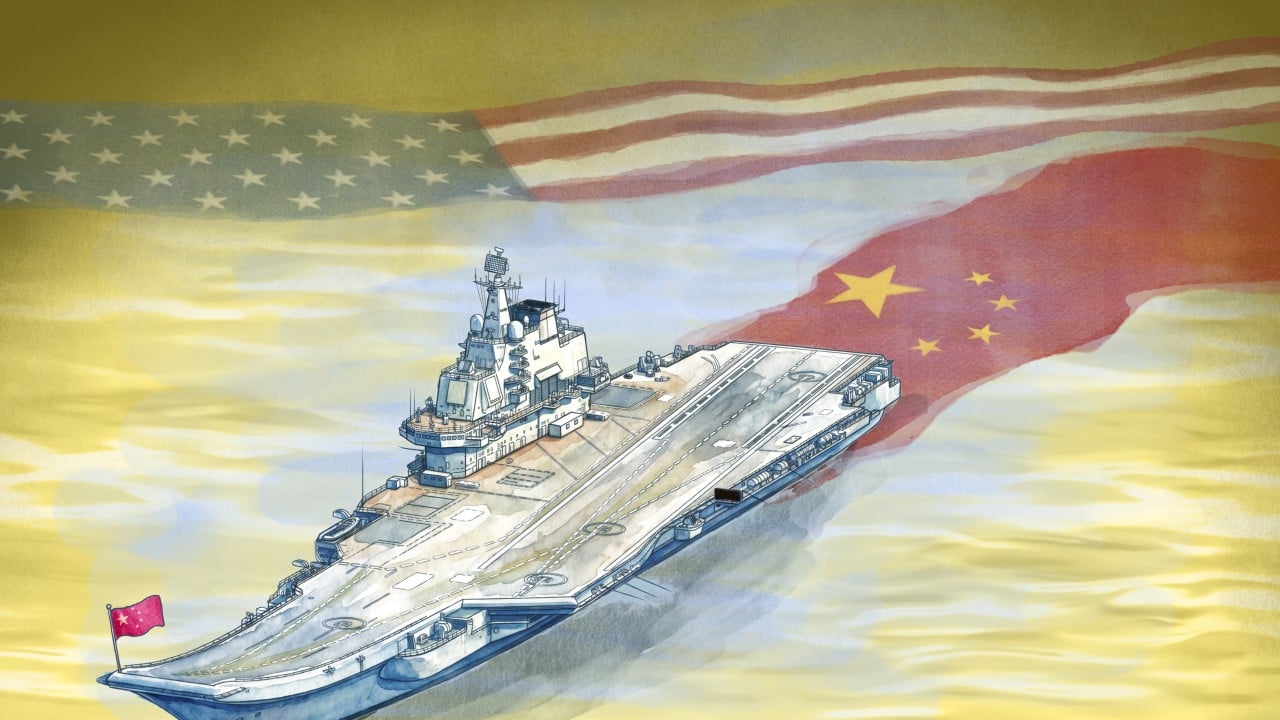
Salt crusts on the steel. It always starts with the salt.
Standing on a flight deck when the wind whips off the South China Sea, you taste the ocean long before you see the gray hulls breaking the horizon. For decades, naval analysts in Washington and London stared at satellite photos through the lens of a single, comforting mirror. They saw flat tops, angled flight decks, and steam catapults, and they told themselves a reassuring story. They told themselves that Beijing was simply playing catch-up. They believed the dragon was learning to dance the American waltz. Meanwhile, you can explore related events here: Why Domestic Extremism Remains Our Most Dangerous Blind Spot.
They were wrong.
To understand the modern Chinese carrier force, you have to stop looking at the silhouette of the ship and start looking at the hands of the sailors. You have to look at the doctrine. You have to understand that what looks like imitation is actually an entirely different creature waking up in the dark. To explore the complete picture, check out the detailed analysis by The New York Times.
The Mirage of the Mirror
Commander Zhang adjusts his collar inside the air-conditioned combat information center of a Type 003 aircraft carrier. He is a composite persona, built from interviews with defense attachés, open-source military journals, and strategic white papers. He represents the new generation of People's Liberation Army Navy leadership. He does not wear the salt-stained khakis of a salty American destroyer captain who spent thirty years chasing sea stories. Zhang is an engineer in uniform.
He looks at the tactical display, and his mind does not drift toward Trafalgar or Midway. He thinks in nodes. He thinks in integrated networks.
When western observers first saw the Fujian slide into the water, the headlines wrote themselves. China builds its own Ford class. The analysts pointed to the electromagnetic aircraft launch system, the clean island superstructure, the massive displacement. They nodded sagely. See? They want to rule the Pacific the way we do.
That is the trap. We judge foreign power by our own reflection.
The United States Navy built its carrier empire around the concept of power projection. These floating islands of sovereign territory are designed to sail halfway across the globe, insert themselves into a distant theater, and break things until the geopolitical weather clears. They are self-contained ecosystems. They carry their own fuel, their own ordnance, their own repair shops, and a floating city of five thousand souls who can operate independently for months thousands of miles from the nearest friendly port.
China is building something else entirely.
The Gravity of the Coastline
Imagine a giant elastic band anchored to the mainland. No matter how far it stretches, it never lets go of home.
That is the operational reality of the Chinese carrier fleet. While American carriers are designed for global reach, Chinese carriers are designed for regional denial and defensive depth. They operate within what military planners call the first and second island chains. They are never truly alone. Above them fly land-based early warning aircraft like the KJ-500. Behind them stand anti-ship ballistic missiles capable of hitting a moving target a thousand miles out. Around them swarm diesel-electric submarines, coastal defense batteries, and a maritime militia disguised as fishing fleets.
An American carrier is a lone knight charging deep into enemy territory. A Chinese carrier is the heavy anchor of a vast, interlocking iron net.
Listen to the sound of the engine rooms. On a US Nimitz-class ship, you hear the raw, guttural roar of nuclear reactors—a masterpiece of atomic engineering designed to keep a ship moving at thirty knots for twenty years without refueling. On China's Liaoning and Shandong, and even on the conventionally powered Fujian, you hear the hum of modern marine gas turbines and advanced diesel-electric integration. Why? Because nuclear power is astronomically expensive, notoriously difficult to maintain, and fundamentally unnecessary if your primary theater of operations is within a few days' sail of your own heavily defended supply depots.
They didn't skip nuclear propulsion because they couldn't figure it out. They skipped it because it didn't fit the math of their geography.
The Weight of the Past
To know where a navy is going, you have to look at the graves it left behind.
In 1894, at the Battle of the Yalu River, the Imperial Qing Navy faced the rising might of Japan. The Chinese fleet possessed massive, heavily armored battleships purchased from European shipyards. They were floating fortresses. They looked invincible on paper. But they lacked ammunition, they lacked standardized parts, and above all, they lacked a unified operational doctrine. The Japanese fleet, smaller and faster, ran circles around the lumbering behemoths, turning the pride of China into burning wrecks.
That humiliation still haunts the corridors of military academies in Beijing. It created an institutional obsession with self-reliance and systemic integration.
When the modern PLA Navy began its dramatic expansion under modern reforms, its leaders knew they could not afford to be a museum of imported hardware. They built shipyards that make Western industrial capacity look like a rusted bicycle shop. While American shipyards struggle with maintenance backlogs and skilled labor shortages, Chinese dry docks hum twenty-four hours a day, turning out destroyers, amphibious assault ships, and carriers with assembly-line precision.
It is easy to mock the early years. Remember the Liaoning? It was purchased as a rusted hulk from Ukraine, a floating skeleton of a Soviet-era design that many experts dismissed as a floating casino or a training toy.
They laughed too soon.
That floating skeleton became the classroom where a generation of naval aviators learned how to catch a wire. It was never meant to fight a war. It was meant to buy time. And while the West chuckled at the clumsy training exercises, the engineers were taking notes, redesigning the arresting gear, rewriting the flight deck manuals, and laying the groundwork for indigenous designs that would make the original Soviet blueprints look like ancient history.
The Human Element
Step back into the skin of a young technician working below deck on the Fujian.
Her name is Lin. She grew up in a inland province thousands of miles from the ocean. Her grandfather had never seen a warship in real life. Today, she sits before a bank of glowing monitors, monitoring the power flow to the electromagnetic catapult tracks.
She does not share the romantic sea-dog culture of the British Royal Navy or the rebellious individualism of the US sailor. Her culture is corporate, disciplined, and relentlessly institutional. The training pipeline is brutal, selective, and wired directly into the country's top technological universities. The people maintaining these ships are not just sailors; they are software engineers, data analysts, and electrical wizards who treat a carrier battle group as a distributed computing network.
When we talk about the size of the Chinese fleet—the raw number of hulls that outcount the US Navy on paper—we miss the human story. Numbers are cold. But behind every hull is a massive state apparatus that has transformed maritime warfare into a high-tech science project.
Consider how they train. Because they lack decades of real-world combat experience—the salt-water institutional memory that comes from fighting continuous small wars across the globe—they overcompensate with simulation, wargaming, and artificial intelligence integration. They use massive data loops to run thousands of virtual engagements before a single ship leaves port.
Is it a substitute for actual combat? Ask any veteran, and they will tell you no. Bullets have a way of disrupting the best-laid plans. But dismiss it at your peril. The PLA Navy is building an institutional reflexes system designed to process tactical information faster than a human brain can blink.
The False Choice
The debate in Washington usually falls into two lazy extremes.
One camp insists that China's carriers are paper tigers, clumsy imitations doomed to fail against the seasoned might of the US Pacific Fleet. The other camp panics, painting a picture of an unstoppable armada ready to sweep American power out of Asia overnight.
Both camps are selling a lie.
The truth is much stranger, and much more uncomfortable. China is not trying to build a better US Navy. They are building something that renders the traditional definition of a carrier fleet obsolete.
By tying their carriers into a land-based umbrella of anti-access and area-denial systems, they have changed the rules of the game. You do not need to defeat the US Navy in a classic Trafalgar-style slugfest if you can simply make the cost of coming within striking distance too high for any rational government to bear. You do not need to project power globally if you can secure your own backyard so thoroughly that the global balance of power tilts in your direction by default.
Look out over the water again.
The sun is sinking behind the gray steel of the flight deck. Commander Zhang watches the last J-15 fighter jet catch the wire, its tailhook sparking against the deck in a brief, violent flash of orange light. The jet powers down. The deck crew swarms over the machine like ants, efficient, silent, synchronized.
They are not copying anyone. They are writing a new chapter in the history of the sea, and the ink is still wet.