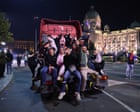
The chairs are empty. Not physically, of course, because the plush leather seats inside Belgrade’s parliamentary backrooms are very much occupied, creaking under the weight of career politicians, party operatives, and weary diplomats. The emptiness is structural. Across the polished mahogany table from Serbia’s entrenched political establishment sits a movement that refuses to give them a throat to choke, a hand to shake, or a single face to plaster on a tabloid front page.
They call it the Student List. And right now, they are preparing for talks to form a government without a clear leader. Discover more on a similar subject: this related article.
Pause. Let that sink in.
In a region where politics has been defined for decades by the cult of the strongman—where a single charismatic figure absorbs the state, the media, and the national psyche—a decentralized cohort of twenty-somethings has hacked the operating system. They walked out of lecture halls in Belgrade, Novi Sad, and Niš, armed with nothing more than cardboard signs, encrypted messaging apps, and an allergy to corruption. Now, they hold the keys to the next Serbian coalition. Yet when the old guard asks who is in charge, the answer comes back like static on a dead radio frequency. More reporting by The New York Times explores comparable perspectives on the subject.
Nobody. Everybody.
To understand why this terrifies the traditional political class, you have to understand the smell of a late-night Belgrade café in November. It is a thick, stinging soup of cheap Turkish coffee, wet wool coats, and unfiltered cigarettes. Picture—purely as a composite sketch of the thousands walking those cobblestones—a twenty-two-year-old architecture student named Luka. Luka does not want to be a minister. He does not have a bespoke suit, a PR handler, or a Swiss bank account. Three months ago, his biggest worry was passing structural mechanics and scraping together enough dinars for a bus ticket home to Kragujevac. Today, Luka is sitting in a university plenum, raising his hand to vote on whether his generation should enter coalition talks with opposition veterans who have been losing elections since Luka was in diapers.
This is not a standard political story. It is an anatomical shift in how power behaves when the people holding it refuse to wear the crown.
The Architecture of a Faceless Revolt
Traditional politics operates like a pyramid. You build a wide base of voters, stack loyal lieutenants in the middle, and balance one heavy, unmistakable capstone at the top. If you want to destroy a pyramid, you do not chip away at the bottom stones. You take a sledgehammer to the apex.
For years, Serbian political life followed this exact blueprint. Opposition movements would rise, find a singular figurehead—a former mayor, a retired general, a fiery orator—and watch as the state-aligned media apparatus went to work. Within weeks, that leader’s private life, tax returns, and distant cousins would be dissected on evening television until the public grew exhausted and cynical. The pyramid collapsed. The status quo survived.
The Student List looked at that wreckage and decided to build a mycelium network instead.
Think of the underground fungal networks that connect a forest floor. There is no central brain. No single mushroom dictates where the nutrients go. If you stomp on one cap in a clearing, the organism barely notices; it simply reroutes energy three meters to the left and pushes up somewhere else. That is how the Serbian student plenums operate. Decisions are debated in crowded amphitheaters, voted on via direct democracy, and rotated among anonymous delegates who lose their mandate the second they try to turn their face into a brand.
When news broke that the Student List was preparing for government-formation talks, pundits across Europe scratched their heads. How do you negotiate a ministerial portfolio with a rotating committee? Who signs the coalition agreement? Who takes the midnight phone call from Brussels or Moscow when a crisis erupts in the Balkans?
The anxiety is palpable, and frankly, it is entirely justified. I have watched enough Balkan political transitions to know that power abhors a vacuum, and chaos rarely favors the idealist. There is a genuine, terrifying fragility to what is happening in Belgrade. You can feel it in the hesitation of seasoned opposition leaders who want the students' moral authority and massive street turnout, yet break into a cold sweat when they realize they cannot cut a backroom deal over plum brandy with a twenty-one-year-old who has to run every comma past four hundred peers in a gymnasium.
What Happens When Nobody Wants the Crown
Consider what happens next when a leaderless movement enters a room built exclusively for egos.
In any parliamentary system, forming a government is a brutal exercise in horse-trading. You give me the Ministry of Infrastructure; I give you the state energy board. You bury that investigation into last year's tender; I deliver the votes for your budget. It requires secrecy, speed, and a central authority capable of enforcing discipline on the ranks.
The Student List has none of those tools—and they view that deficiency as their greatest armor.
Let us step back into our hypothetical scenario with Luka, the architecture student, during a mock negotiation prep session in a freezing faculty hallway. Across from him sits an older opposition strategist—let’s call her Elena—who has spent twenty years fighting the machine from the inside. Elena knows where the bodies are buried in the state bureaucracy. She knows that if they take power on a Tuesday, the outgoing administration will have already shredded the files and emptied the treasury by Monday afternoon.
"Who is going to be the Prime Minister?" Elena asks, tapping a pen against a legal pad. "The president won't give a mandate to a ghost. The European Union won't wire development funds to a Telegram channel."
Luka rubs his eyes. He has slept four hours in two days. "We aren't picking a savior, Elena. We're picking a technician. Someone with a six-month expiration date whose only job is to unlock the institutions, clean the voter rolls, and hand the keys back."
Here lies the core tension that makes this moment historic. The establishment views government as a prize to be won and held. The students view government as a clogged drain that needs to be snaked before they can go back to studying for their finals.
Critics argue—and they are not wrong to worry—that this radical anti-leadership stance could fracture the moment real pressure is applied. What happens when the first hard economic choice hits the desk? When inflation bites, or geopolitical pressure mounts over Kosovo, or a strike paralyzes the rail network, a rotating plenum cannot make a split-second executive decision. Without a clear leader to absorb the blame and rally the public, a governing coalition built on consensus can evaporate overnight.
The Invisible Stakes of the Belgrade Experiment
Why should anyone outside Serbia care about a bunch of stubborn undergraduates refusing to elect a spokesperson?
Because every democracy on earth is currently choking on the same poison. From Washington to Warsaw, from Paris to Buenos Aires, citizens are trapped in a binary loop: choose between a charismatic strongman who promises to burn the system down, or a hollow technocrat who promises to keep the broken machine humming. People have lost faith in political parties because parties have become personal vanity projects.
Serbia’s youth stumbled onto a third door.
Their movement did not start with an ideological manifesto written in an ivory tower. It started with grief and raw physical danger—a visceral refusal to accept a society where public infrastructure collapses, where institutional accountability is a punchline, and where the brightest young minds are forced to choose between buying a one-way ticket to Vienna or selling their dignity for a low-level municipal job. According to regional demographic studies, tens of thousands of young, educated Serbs leave the country every single year, draining the nation of its future before it even has a chance to vote.
The students who stayed decided that if they were going to inherit a ruined house, they were not going to hire the same arsonists to renovate it.
By refusing to anoint a leader, they immunized themselves against the two oldest tricks in the authoritarian playbook: bribery and character assassination. You cannot buy off a movement when the person sitting across from you has no authority to sell anything. You cannot smear the leader on the evening news when tomorrow morning a completely different student steps up to the microphone, wearing the same faded hoodie, repeating the exact same three demands.
It is maddening for journalists looking for a soundbite. It is agonizing for diplomats who like clean org charts. And it is absolute poison for politicians whose entire career relies on knowing exactly whose palm to grease.
Inside the Rooms Where the Future Is Drafted
As the talks to form a government edge closer to reality, the friction is shifting from the streets to the rulebooks. How do you actually translate direct democracy into parliamentary governance?
The mechanisms being discussed behind closed doors in Belgrade are as unconventional as the protests that birthed them. Instead of a traditional cabinet stacked with party loyalists, the Student List is pushing the concept of a strictly bounded transitional administration. Picture a government stripped of glamour: independent experts vetted by university faculties, bound by a public, line-by-line contract with the electorate, operating under the constant, suffocating scrutiny of the very plenums that put them there.
Think of it like putting a cast on a broken bone. A cast is rigid, uncomfortable, and utterly useless for running a marathon. You do not wear it forever. You put it on solely to hold the shattered pieces in alignment while the body heals itself enough to bear weight again.
Yet even the fiercest supporters of the Student List admit the nights are getting longer and the doubts are creeping in. Trustworthiness in moments like this requires admitting what nobody knows. Nobody knows if a leaderless coalition can survive a single parliamentary session without being outmaneuvered by seasoned sharks who know every procedural loophole in the Serbian constitution. Nobody knows if the unity forged in the freezing rain of street blockades will hold up under the fluorescent lights of budget committees.
There is a very real possibility that the old guard will smile, nod, agree to the students' terms, and then slowly suffocate the new government in red tape until the public grows frustrated and begs for the strongmen to return. History is littered with revolutions that won the square and lost the bureaucracy.
The Empty Chair
Still, walk past the university buildings in Belgrade tonight, and you will see something that no amount of cynical political analysis can erase.
Through the tall, drafty windows of an auditorium built in the nineteenth century, warm yellow light spills onto the wet asphalt. Inside, hundreds of young people are sitting on wooden benches, on the floor, on the radiators. There is no podium draped in velvet. There is no giant banner bearing the airbrushed face of a savior. There is just a whiteboard covered in erasable marker, a cheap microphone passed from hand to hand, and an argument over the precise wording of an anti-corruption clause.
Tomorrow morning, two of those students will put on clean shirts, take the tram downtown, and sit across from men who have ruled Serbia for a generation. The politicians will lean forward, searching the students' faces for the leader—the one person they need to flatter, intimidate, or break.
And sitting right between them, invisible and immovable, will be that empty chair.