When a diaspora community's national soccer team qualifies for the FIFA World Cup after a multi-decade absence, standard sports journalism framed around athletic achievement fails to capture the true dynamics at play. Haiti’s return to the 2026 World Cup—marking its first appearance since 1974—cannot be understood purely through tactical formations or athletic metrics. Instead, the team's opening group match against Scotland at Gillette Stadium in Foxborough serves as a case study in how international sporting events intersect with systemic immigration constraints, hyper-inflated secondary markets, and the structural resilience of an exiled population.
For the Haitian diaspora in Greater Boston, which represents approximately 4% of Boston’s population and forms the third-largest Haitian community in the United States, this tournament highlights a stark friction. The physical manifestation of Haitian sovereignty on the pitch directly collides with the legal and financial vulnerabilities faced by its domestic fan base. To evaluate this phenomenon, we must analyze the structural barriers limiting community access, the operational mechanics of the national team's qualification, and the socio-economic framework of diaspora engagement under regulatory stress. If you liked this article, you might want to check out: this related article.
The Three Pillars of Diaspora Exclusion
While the presence of Les Grenadiers in New England offers immense cultural capital, the actual consumption of the live event by the local population faces systemic bottlenecks. The friction preventing local fans from filling stadium seats can be categorized into three distinct operational barriers.
1. Macro-Level Visas and Global Mobility Restrictions
A strict U.S. travel ban and highly restrictive visa issuance protocols for foreign nationals from volatile regions create an absolute barrier to entry. While international tournaments typically rely on an influx of traveling fans, the regulatory reality means that fans residing in Haiti are effectively barred from traveling to the United States for these matches. This shifts the entire burden of stadium attendance onto the domestic diaspora. For another look on this event, check out the recent coverage from The Athletic.
2. Micro-Level Immigration Enforcement and Status Vulnerability
The domestic diaspora itself is subject to acute legal precarity. Massachusetts is home to roughly 45,000 Haitian residents living under Temporary Protected Status (TPS), a designation established after the 2010 earthquake that remains a focal point of federal executive and judicial scrutiny.
With a pending U.S. Supreme Court case evaluating the federal government's authority to terminate TPS for Haitian nationals, the community operates under heightened regulatory stress. The threat of targeted immigration enforcement—whether real or perceived—creates a significant deterrent effect.
[Federal Policy Uncertainty] ➔ [Perceived Risk of Stadium Enforcement] ➔ [Sub-Optimal Ticket Demand from Core Base]
This structural anxiety suppresses attendance among those without permanent legal status, as large-scale public gatherings with high security profiles represent an unacceptable risk vector.
3. Secondary Market Hyper-Inflation
The pricing mechanics of the secondary ticket market create an economic barrier that decouples the local community from the event. With entry-level resale tickets hovering around $600 during the weeks leading up to the match, the cost function of attending a single match exceeds the discretionary capital allocation of average working-class households.
When a multi-ticket purchase for a family requires a capital outlay of $1,200 to $1,800, the event transitions from a community celebration into an exclusive corporate commodity, altering the demographic composition of the stadium crowd.
The Operational Mechanics of Home-Field Deprivation
The athletic achievement of the Haitian men's national team is structurally unique due to the complete absence of a domestic operational base. Due to sustained political instability, civil unrest, and security deficits within Haiti, the team was forced to play 100% of its qualifying matches on neutral, foreign territory. This reality alters the standard sporting narrative in two major ways.
- The Loss of Sovereign Home Advantage: In international soccer, home-field advantage yields a statistically significant divergence in win probability, driven by familiar environmental conditions, minimal travel fatigue, and overwhelming crowd support. Haiti bypassed this structural benefit entirely, operating effectively as a permanent touring squad.
- Logistical and Financial Overhead: Managing a national team strictly through international hubs requires complex coordination of player release windows, neutral-venue leases, and fragmented training camps (such as utilizing university facilities in New Jersey). The operational overhead is significantly higher than that of federations operating within stable domestic borders.
The culmination of this migratory qualification path occurred on November 18, when Haiti secured its World Cup berth with a 2-0 victory over Nicaragua. The historical alignment of this date with the anniversary of the Battle of Vertières in 1803—the final battle of the Haitian Revolution—serves as a psychological anchor for the diaspora. It converts a purely athletic milestone into an extension of historic sovereignty, balancing out the logistical disadvantages the team faced.
Structural Resilience as a Strategy
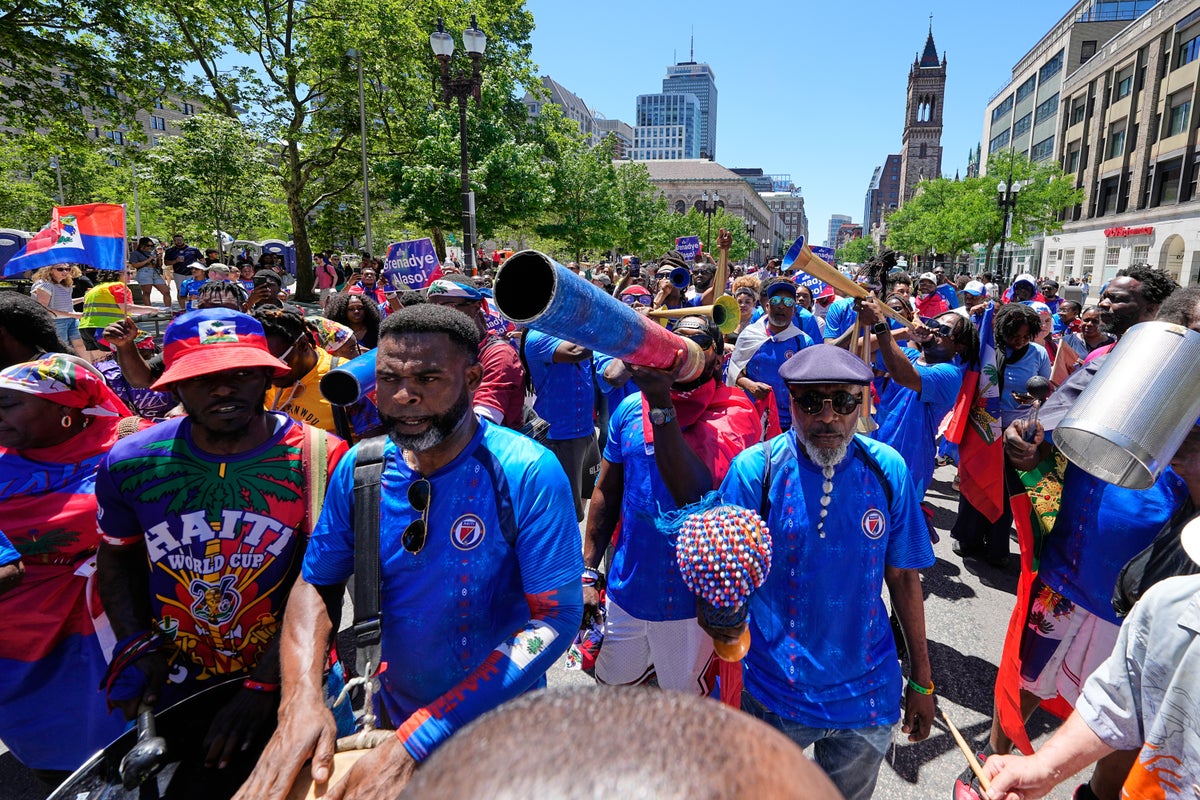
When traditional access to a sporting mega-event is restricted by legal and financial bottlenecks, diaspora communities deploy decentralized alternative networks to capture the cultural value of the event. Rather than relying on official stadium access, the community in Greater Boston utilizes a multi-tiered engagement strategy.
| Layer | Mechanism | Operational Objective |
|---|---|---|
| Public Viewing Infrastructures | City Hall Plaza, regional hubs (Worcester, Everett) | Bypasses ticket costs; provides low-risk, high-density community aggregation. |
| Commercial Micro-Hubs | Local bakeries, cafes, and restaurants | Generates localized economic activity through merchandise sales and food preparation. |
| Decentralized Delegations | Organized carpools from neighboring states (Rhode Island) | Offsets individual travel costs and forms collective, visible fan presence outside the stadium gates. |
These localized systems ensure that the cultural equity generated by the team's World Cup appearance is retained within the community, even when the physical seats inside Gillette Stadium are occupied by corporate ticket holders or opposing fans.
Defensive Tactical Forecasting
From a pure sports-performance perspective, the long-term outlook for Haiti's national football infrastructure depends entirely on converting this tournament appearance into structural capital. The team's opening 1-0 loss to Scotland demonstrates that while the squad possesses elite athletic talent—led by forwards capable of competing at the European club level—the lack of a stable, domestic developmental ecosystem creates a definitive ceiling.
The strategic imperative for the Haitian Football Federation involves leveraging the international revenue distributions from this tournament appearance to fund secure, neutral-site youth academies abroad, specifically targeting diaspora talent pools in North America and France. Relying on sporadic golden generations emerging from a disrupted domestic landscape is a mathematically unsustainable strategy. To maintain a presence on the international stage, the federation must formalize its nomadic reality into a highly organized, transnational talent development system.