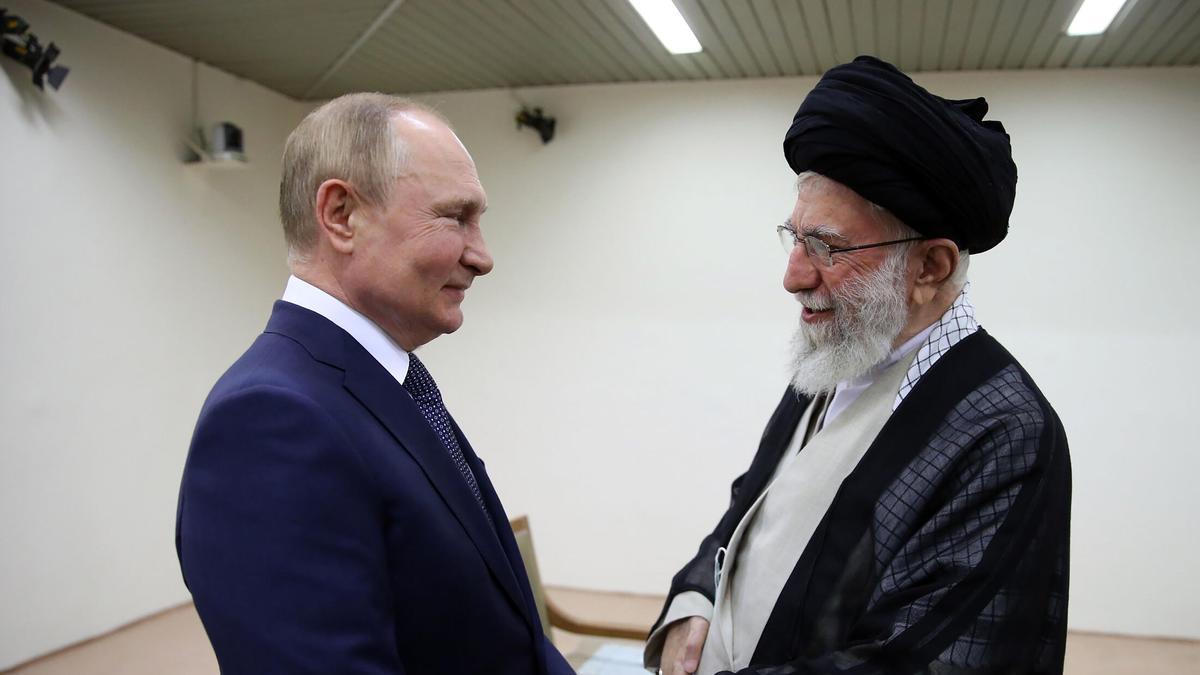
The targeted killing of Iran’s Supreme Leader Ali Khamenei has shattered the fragile equilibrium of the Middle East, forcing a violent recalibration of global power dynamics. While the world watches the smoke rise over Tehran, Vladimir Putin’s immediate condemnation of the act as a "cynical violation of human morality" serves as a calculated maneuver to cement Russia’s role as the primary arbiter of anti-Western sentiment. This isn’t about ethics. It is about the sudden disappearance of the anchor holding the "Axis of Resistance" together and the frantic scramble to fill the resulting power vacuum.
The strike against the highest authority in the Islamic Republic represents a total failure of deterrence. For decades, the assumption was that the Supreme Leader was untouchable, protected by a layer of religious sanctity and the threat of regional Armageddon. That assumption is dead. By removing the ultimate decision-maker, the attackers—widely assumed to be Israeli forces with at least tacit American approval—have gambled that the Iranian state will crumble under the weight of internal succession battles rather than unite in a coherent retaliatory strike. You might also find this similar article insightful: Strategic Asymmetry and the Kinetic Deconstruction of Iranian Integrated Air Defense.
The Kremlin’s Strategic Hypocrisy
Vladimir Putin’s choice of words—invoking "human morality"—is a masterclass in diplomatic theater. Coming from a leader currently embroiled in a grueling war of attrition in Ukraine, the irony is thick enough to choke on. However, analyzing this through the lens of hypocrisy misses the strategic point. Putin is not speaking to the West; he is speaking to the Global South.
By framing the assassination as a lawless act of Western-backed barbarism, Moscow positions itself as the defender of national sovereignty and the established international order. Russia needs Iran. Tehran has become a vital supplier of drone technology and ballistic hardware for the Russian campaign in Eastern Europe. If the Iranian regime descends into a chaotic civil war or a protracted leadership struggle, Putin loses his most reliable military warehouse. As discussed in latest articles by The Washington Post, the results are significant.
The Mechanics of the Axis of Resistance
To understand why this hit matters, one must look at the structural integrity of Iran’s proxy network. Khamenei was the ideological glue.
The "Axis of Resistance"—comprising Hezbollah in Lebanon, the Houthis in Yemen, and various militias in Iraq and Syria—operates on a model of decentralized execution but centralized inspiration. Without Khamenei’s final word, the following entities face an identity crisis:
- Hezbollah: Now forced to decide if they risk total war with Israel without a clear mandate from Tehran.
- The IRGC (Islamic Revolutionary Guard Corps): Internal factions may now compete for control over the country’s vast economic and military assets.
- The Houthi Movement: Potentially orphaned in their Red Sea campaign, leading to unpredictable, rogue escalations.
The Succession Trap
Iran’s constitution dictates that a temporary council must organize elections for a new leader within fifty days. But the reality of Iranian power is never that tidy. The Assembly of Experts, the body responsible for picking the successor, is a den of aging clerics and hardline ideologues.
Before this event, Mojtaba Khamenei, the Supreme Leader’s son, was frequently mentioned as a potential heir. However, a hereditary succession in a revolutionary republic is a hard sell, even for the most devout. The alternative is a move toward a more "collegial" leadership or, more likely, a silent coup by the IRGC. If the military wing takes the reins, the religious character of the state becomes a facade for a standard military dictatorship. This shift would make Iran more predictable in some ways, but far more aggressive in its immediate survival tactics.
Intelligence Failures and the Internal Breach
An assassination of this magnitude does not happen without catastrophic internal rot. You don't get to the Supreme Leader without help from the inside. This suggests that the Mossad or other intelligence agencies have successfully "turned" high-ranking members of the Iranian security apparatus.
The paranoia now rippling through Tehran is perhaps more damaging than the strike itself. Every general is looking at his deputy with suspicion. Every communication channel is assumed to be compromised. When a state’s security elite stops trusting its own shadows, the ability to project power abroad vanishes. This internal paralysis is exactly what the architects of the strike were banking on.
The Nuclear Wildcard
There is a terrifying counter-argument to the idea that this strike brings stability. Deprived of their "Great Helmsman" and facing an existential threat, the remaining Iranian hardliners may decide that the only way to ensure the survival of the Islamic Republic is to sprint for a nuclear weapon.
Until now, the religious fatwa against nuclear weapons—issued by Khamenei himself—provided a thin layer of theological restraint. With him gone, that restraint is moot. If the IRGC believes the "Zionist entity" will stop at nothing to dismantle the regime, they may see a nuclear test as the only way to prevent a total ground invasion or further decapitation strikes.
Chokepoints and Global Markets
The immediate reaction in the oil markets was a sharp spike, though not the explosion many predicted. Traders are betting on a measured Iranian response, but that is a dangerous gamble. Iran’s most potent weapon remains the Strait of Hormuz.
If the leadership in Tehran feels backed into a corner, they can effectively shut down 20% of the world’s oil supply. This would not be a military victory, but a global economic suicide bombing. Putin knows this. A global energy crisis benefits Russia by driving up the price of its own Urals crude, even as it publicly laments the "immorality" of the conflict.
The Failure of Western Diplomacy
The Biden administration’s "de-escalation" strategy in the Middle East is now officially a relic of a bygone era. For months, Washington attempted to balance support for Israel with a desire to keep Iran in a box. That box has been smashed with a sledgehammer.
The U.S. now finds itself in a position where it must defend against an Iranian retaliation it may not have fully authorized. This is the nightmare scenario for American diplomats: being dragged into a regional war triggered by an ally’s unilateral action. The "cynical violation" Putin speaks of is, in his view, the final proof that the U.S.-led order is incapable of maintaining peace and only capable of targeted destruction.
Beyond the Mourning Period
As the funeral processions fill the streets of Tehran, the real work begins in the backrooms of the Kremlin, the Pentagon, and the Prime Minister’s Office in Jerusalem. The world is not just waiting to see who replaces Khamenei; it is waiting to see if the state he built can survive his absence.
History shows that decapitation strikes rarely kill the movement. Usually, they just radicalize the survivors. The "morality" of the act is a debate for theologians and UN rapporteurs. For the men with their fingers on the triggers, the only question that matters is who fires next.
The era of shadow wars is over. We have entered the era of the direct hit. Every leader in the region is now looking at the sky, wondering if they are next on the list.
Check the flight paths of the long-range tankers over the Eastern Mediterranean tonight.