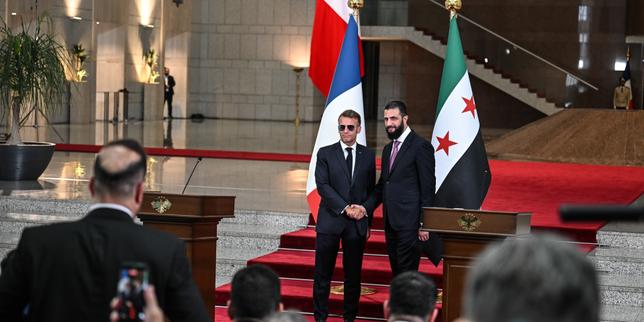
Emmanuel Macron’s declaration in Damascus that a "new era is opening in Syria" represents a calculated pivot in French foreign policy, shifting from an ethics-based isolation strategy to a realpolitik framework of conditional engagement. This transition cannot be understood merely through political rhetoric; it requires a cold calculation of the strategic variables that have rendered the previous decade of Western containment obsolete. The shift reflects a recognition that regional stability, migration control, and counter-terrorism objectives can no longer be achieved by treating the Syrian state as a geopolitical vacuum.
The Western policy of absolute diplomatic isolation has reached its structural limits. By analyzing this diplomatic pivot through a systematic framework, we can map the exact mechanisms driving this transition, the strategic trade-offs involved, and the structural bottlenecks that France and its European partners must navigate.
The Triad of Realpolitik Drivers
The re-evaluation of French policy toward Syria is driven by three interconnected operational variables. Each variable exerts specific pressures on European domestic security and regional influence.
1. The Security and Counter-Terrorism Bottleneck
The primary operational driver is the intelligence asymmetry caused by a lack of direct diplomatic infrastructure. Western intelligence agencies require granular, on-the-ground data to monitor remnants of Islamic State factions and other non-state actors operating in the Levant. Attempting to manage these threats through proxy forces or remote electronic surveillance yields diminishing returns. Direct communication channels with the centralized authority in Damascus, however distasteful, offer a mechanism to coordinate high-level threat mitigation and manage the repatriation or containment of foreign fighters.
2. The Demographic and Migration Cost Function
European domestic politics are highly sensitive to migratory pressures. The continued economic collapse of Syria acts as a permanent push factor for displaced populations. The European Union's previous strategy relied on funding third-party transit states, such as Turkey and Jordan, to absorb these demographic flows. This model has introduced severe geopolitical leverage against Europe, as transit states can weaponize migration flows to extract concessions. Normalization, paired with targeted infrastructure rehabilitation, represents an attempt to stabilize the population within Syrian borders and establish a framework for orderly repatriation.
3. The Regional Realignment Equilibrium
The geopolitical landscape of the Middle East has decoupled from Western consensus. The Arab League's reinstatement of Syria, alongside normalization tracks accelerated by regional powers like the United Arab Emirates and Saudi Arabia, forced France into a tactical choice. Maintaining an absolute embargo risks total exclusion from the future economic and security architecture of the Levant. By establishing a presence in Damascus, France attempts to claw back diplomatic leverage and prevent regional competitors from monopolizing reconstruction contracts and trade corridors.
The Strategic Leverage Framework
To execute this "new era" without signaling unconditional capitulation, French diplomacy relies on a framework of transactional conditionality. This strategy operates on three distinct levels of leverage.
[European Capital Injection] ----> Conditional on ----> [Security & Diplomatic Concessions]
            |                                                        |
            v                                                        v
   Reconstruction Funds                                    Iranian Containment / Safe Return
Economic Reconstruction vs. Political Concessions
Syria requires hundreds of billions of dollars to rebuild its destroyed infrastructure, a capital requirement that its main military allies, Russia and Iran, cannot provide due to their own economic constraints. Europe holds the ultimate financial leverage through its control over reconstruction funds and sanction relief via the European Union framework.
The French strategy treats capital injection not as a humanitarian gesture, but as a phased reward system. Funding for critical infrastructure—such as electrical grids, water treatment plants, and transport networks—is structurally tied to verifiable political milestones, such as inclusive governance reforms and institutional guarantees for returning dissidents.
The Iranian Containment Trade-off
A core objective of French and regional diplomacy is the reduction of Iranian influence in the Levant. The hypothesis driving this approach is that the Syrian state prefers strategic autonomy over total dependence on Tehran's paramilitary networks. By offering an alternative path to international legitimacy and financial stabilization, Western negotiators aim to create a wedge between Damascus and Iran. The limitation of this strategy lies in the deep institutional penetration of Iranian-backed forces within the Syrian military apparatus, making decoupling a high-risk, slow-moving endeavor.
The Institutional Safe-Passage Mechanism
For migration repatriation to be politically viable in Europe, the Syrian government must formalize legal frameworks that guarantee the safety, property rights, and exemption from conscription of returning citizens. The French diplomatic mission serves as a monitoring mechanism to verify compliance with these guarantees. Without third-party oversight on the ground, any mass return of refugees would trigger severe domestic political backlash in Europe if returning populations faced state retribution.
Operational Risks and Systemic Bottlenecks
The transition to conditional engagement is fraught with structural vulnerabilities that could undermine French credibility and yield zero net-positive outcomes.
- The Moral Hazard and Credibility Deficit: Normalizing relations with a regime associated with systemic human rights violations weakens the normative authority of Western foreign policy. It signals to other authoritarian regimes that international isolation is merely a temporary holding pattern that can be outlasted through sheer persistence.
- The Sanctions Overlap Imbroglio: While France may wish to ease certain diplomatic and economic restrictions, the United States maintains a strict, legally binding sanctions regime via the Caesar Act. European corporations and banks will remain highly risk-averse, fearing secondary American sanctions. This creates an operational bottleneck where French diplomatic intent cannot be easily backed by economic execution.
- The Principal-Agent Problem: The Western strategy assumes the Syrian government acts as a rational utility-maximizing agent that values economic reconstruction above absolute political control. If the regime perceives that opening up the political system or allowing independent monitoring threatens its core survival, it will reject the economic incentives, choosing stagnation over vulnerability.
The Definitive Strategic Play
France must abandon the illusion of a grand bargain and instead execute a granular, transaction-by-transaction diplomatic strategy. The optimal path forward requires bypassing sweeping diplomatic declarations and focusing entirely on localized, scalable pilots.
The immediate tactical step must be the establishment of a Joint Security and Stabilization Taskforce in Damascus, focused exclusively on two verifiable metrics: the cooperative eradication of specific drug-trafficking networks (specifically Captagon trade routes impacting the Mediterranean) and the creation of a single, internationally monitored "Safe Zone" for refugee return in a specific governorate.
Funding must be released in micro-tranches, strictly escrowed and audited by international bodies, directly tied to the successful execution of these limited objectives. If the Syrian state fails to meet the compliance metrics within a twelve-month window, France must trigger an automatic snapback of diplomatic isolation. This shifts the burden of proof entirely onto Damascus, protecting European strategic credibility while actively testing the viability of the "new era."


