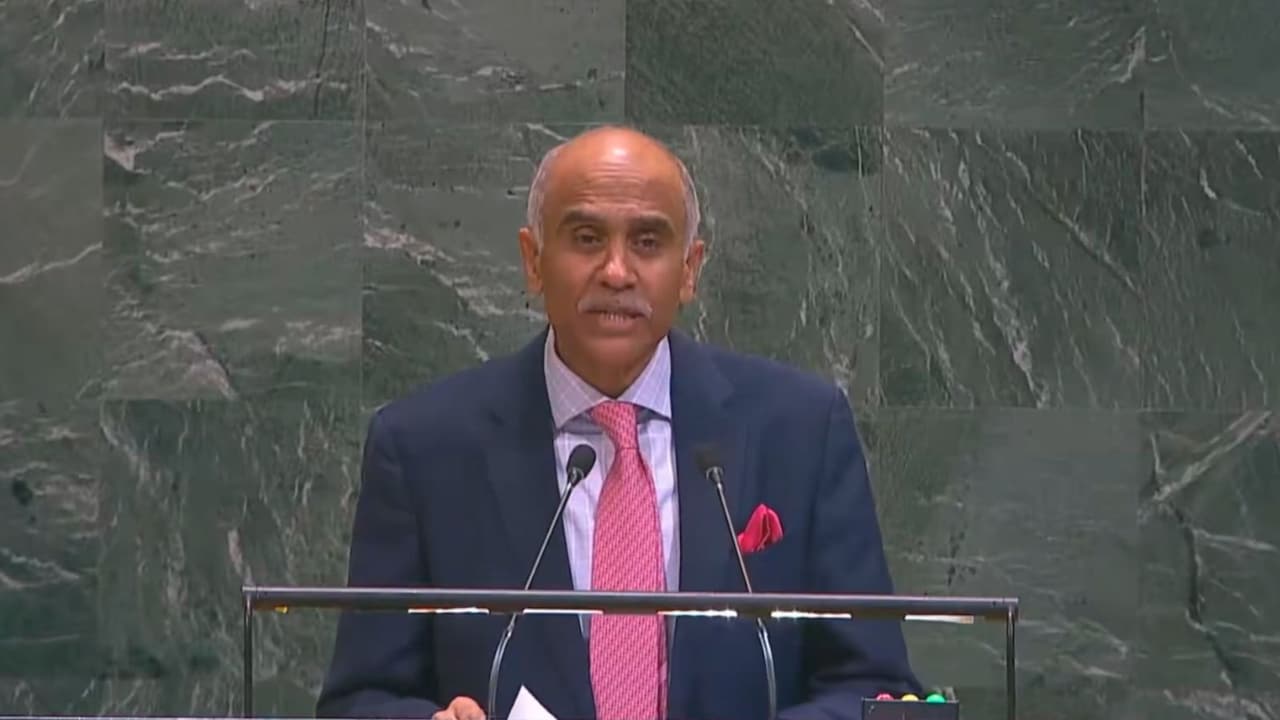
The diplomatic confrontation between New Delhi and Islamabad at the United Nations General Assembly highlights a structural friction point in South Asian multilateral strategy. The exchange between India's Permanent Representative Parvathaneni Harish and Pakistan's envoy Asim Iftikhar Ahmad during the debate on the UN Security Council Annual Report follows a broader pattern of narrative competition. This pattern carries quantifiable transaction costs for both states.
By analyzing the mechanics of this diplomatic interaction, we can map the structural logic, systemic inefficiencies, and strategic outcomes that define current bilateral dynamics.
The Structural Framework of Strategic Asymmetry
The recurring debate over Jammu and Kashmir at multilateral forums is often framed as a simple rhetorical standoff. However, analyzing it as a structural framework reveals two distinct, competing strategic objectives.
       [Multilateral Forum: UNGA / UNSC]
                 /            \
                /              \
  [India's Defensive Vector]   [Pakistan's Internationalization Vector]
  - Cost Minimization          - Information Arbitrage
  - Jurisdictional Insulation  - Legalistic Leverages (UNSC Resolutions)
  - Domestic Stability Lock    - Resource-Constrained Diplomacy
The Internationalization Vector
For Islamabad, utilizing its temporary or permanent presence on UN platforms to raise the status of Jammu and Kashmir serves a distinct strategic function. This approach relies on information arbitrage. It attempts to leverage historical UN Security Council resolutions to offset a growing deficit in conventional economic and military power relative to India.
By introducing the dispute into broader discussions, such as the review of the Security Council's annual report, the strategic goal is to increase the diplomatic management costs for New Delhi. This keeps the territorial dispute on the active international ledger.
The Defensive Vector
New Delhi's counter-strategy focuses on cost minimization and jurisdictional insulation. The foundational premise relies on two legal and operational principles:
- Complete Jurisdictional Exclusivity: Treating the political status of Jammu and Kashmir as a domestic matter under Article 2(7) of the UN Charter, which limits intervention in internal affairs.
- Bilateral Containment: Relying on the framework established by the 1972 Shimla Agreement, which specifies that outstanding disputes must be resolved through bilateral channels. This approach systematically invalidates third-party or multilateral mediation.
This asymmetry creates a predictable diplomatic routine. The exchange functions as an institutionalized mechanism where both sides seek to reinforce their positions for domestic and international audiences.
The Diplomatic Cost Function and Institutional Inefficiency
Maintaining this diplomatic position creates real resource allocations and opportunity costs for both nations' foreign policy frameworks. This dynamic can be understood through a multi-variable diplomatic cost function.
$$C_{\text{dip}} = f(R_{\text{alloc}}, O_{\text{cap}}, N_{\text{comp}})$$
Where:
- $R_{\text{alloc}}$ represents the direct allocation of diplomatic and institutional resources.
- $O_{\text{cap}}$ represents the opportunity cost of depleted diplomatic capital that could be used for other strategic goals.
- $N_{\text{comp}}$ represents the expenditure required to manage and counter competing international narratives.
Resource Allocation ($R_{\text{alloc}}$)
The immediate operational cost involves spending institutional time, speech allocations, and lobbying efforts on iterative debates. During sessions like the UNGA plenary, time spent on old bilateral disputes reduces the capacity to lead on broader global issues. These issues include digital public infrastructure, global governance reform, and global supply chain reconfigurations.
Opportunity Cost of Capital ($O_{\text{cap}}$)
For India, the primary opportunity cost is the friction these disputes introduce into its campaign for a permanent seat on a reformed UN Security Council. When New Delhi has to counter statements from neighboring states, it consumes diplomatic capital that could otherwise be used to build coalitions for structural UN reforms.
For Pakistan, using its elected term on the Security Council to focus on regional disputes can limit its ability to position itself as a broader voice for the Global South. This focus can narrow its diplomatic influence to a single geopolitical issue.
Narrative Management ($N_{\text{comp}}$)
The third component is the cost of managing international narratives. This involves monitoring and responding to joint communiqués or statements from third-party blocs, such as regional organizations or international partners. Foreign ministries must continuously deploy diplomatic personnel to maintain narrative consistency across multiple international forums.
Post Crisis Realities and Tactical Anchors
The diplomatic friction at the UN reflects concrete security dynamics on the ground. The current strategic landscape is shaped by long-term structural changes and recent historical markers that guide how both nations approach these discussions.
The 2019 Structural Shift
The reorganization of Jammu and Kashmir in August 2019 altered New Delhi’s approach to international messaging. By changing the state's administrative status into Union Territories, India set a clear domestic policy benchmark. This administrative shift was designed to signal to the international community that the region's governance structure is non-negotiable, moving the focus away from older international frameworks.
The May 2025 Military Flashpoint
The diplomatic arguments in mid-2026 are heavily influenced by the sharp, four-day military escalation in May 2025. Following a security incident in Pahalgam in April 2025, India launched cross-border missile strikes under the name Operation Sindoor, which targeted militant infrastructure. Pakistan responded with counter-strikes named Operation Bunyan-un-Marsoos.
[April 2025: Pahalgam Security Incident]
                   │
                   ▼
[May 2025: India's Operation Sindoor (Missile Strikes)]
                   │
                   ▼
[May 2025: Pakistan's Operation Bunyan-un-Marsoos (Counter-Strikes)]
                   │
                   ▼
[May 2025: DGMO Hotline Activation & Immediate Ceasefire]
                   │
                   ▼
[2026: Institutionalized Armed Coexistence & Diplomatic Friction]
Although an immediate ceasefire was brokered through Director General of Military Operations (DGMO) hotlines, the 2025 crisis left lasting strategic effects:
- Lowered Escalation Thresholds: The use of precision stand-off weapons and drones by both sides established a pattern of rapid, high-intensity kinetic responses. This changed the calculated risks of cross-border security incidents.
- Airspace and Communication Friction: Long-term flight path restrictions and diminished diplomatic channels have institutionalized a state of tense, armed coexistence.
- The Gilgit-Baltistan Electoral Standoff: The mid-2026 diplomatic friction is further complicated by political maneuvers over contested areas. India's official protests against Pakistan's June 2026 legislative elections in Gilgit-Baltistan show that the dispute extends across the entire length of the Line of Control.
This history explains why the language used at the UN remains intense. The rhetoric serves as a diplomatic signal to reinforce deterrence boundaries after a recent military crisis.
The Strategic Path Forward
The diplomatic deadlock at the UN highlights the limitations of using international forums to resolve deep-seated bilateral disputes. The current pattern of public confrontation followed by quiet crisis management preserves a basic level of stability, but it creates a persistent drag on the economic and geopolitical potential of South Asia.
Breaking out of this high-friction equilibrium requires shifting from public narrative battles to concrete, stabilizing measures.
Establishing Institutional Guardrails
Given the lowered escalation thresholds seen in the 2025 crisis, the most urgent priority is building stronger institutional guardrails. Relying solely on military-to-military DGMO hotlines during a crisis leaves open the risk of miscalculation.
Expanding communication channels to include reliable, non-public political and diplomatic links can help manage incidents before they lead to military deployment or public ultimatums.
Separating Functional Concerns from Territorial Disputes
Progress depends on a shared strategy to separate specific, functional challenges from long-term territorial disagreements. Issues like water security, cross-border environmental management, and climate resilience in the Indus River basin affect the population of both countries.
Structuring technical dialogues on these shared challenges under existing mechanisms, like the Indus Waters Treaty, allows both states to address mutual risks without requiring prior consensus on larger sovereignty claims.
Shifting Focus to Transregional Economic Integration
The long-term cost of this bilateral friction is the economic isolation of South Asia, which remains one of the least integrated regions globally in terms of intra-regional trade.
While comprehensive trade agreements are politically difficult, focusing on narrow, sector-specific links—such as energy transit corridors, cross-border electricity grids, and simplified regulatory frameworks for third-country transit—presents a realistic alternative.
Focusing on these concrete economic interests can alter the strategic calculations of both states, gradually shifting the relationship away from zero-sum diplomatic competition toward a more stable model of regional co-existence.
.jpg)