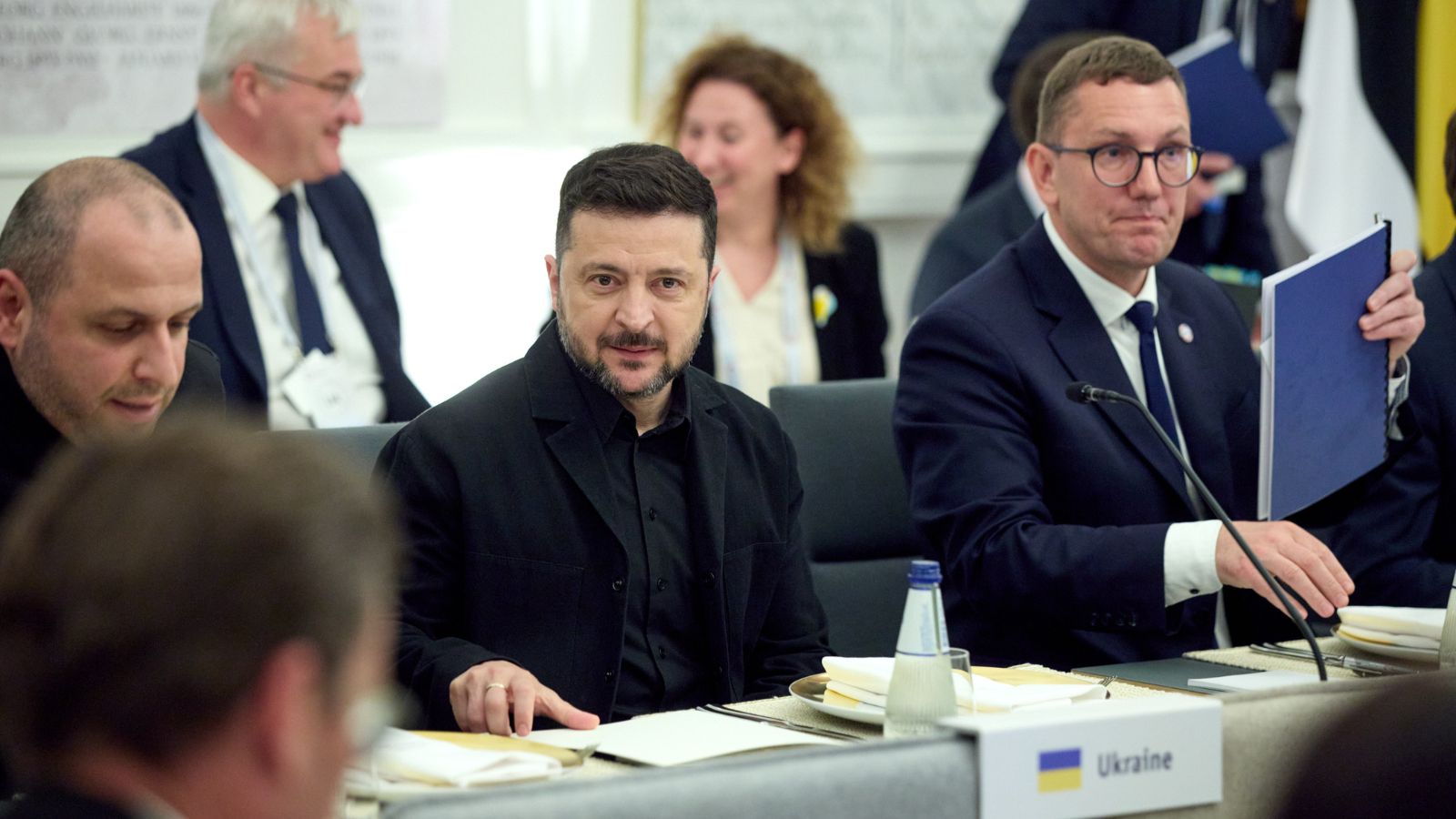
The bilateral defense agreement signed between Ukrainian President Volodymyr Zelenskyy and Latvian Prime Minister Andris Kulbergs in Tallinn establishes a precedent where operational combat data functions as a primary currency of international diplomacy. Formally structured as a ten-year defense pact with an initial €110 million commitment from Riga over the first 24 months, the accord codifies the transition of unmanned aerial vehicle (UAV) and counter-UAV (C-UAV) technology from localized tactical innovations into an institutionalized security export.
This transaction resolves distinct strategic deficits for both parties. For Latvia, it bypasses the protracted timelines of conventional Western defense procurement to address immediate airspace vulnerabilities along NATO's eastern flank. For Ukraine, it monetizes battlefield lessons to secure long-term defense-industrial capital, structural funding, and co-production facilities outside the immediate kinetic range of Russian strike assets.
The Operational Impatulence of NATO's Eastern Flank
The strategic vulnerability driving Riga to bypass orthodox procurement mechanisms is rooted in an unfavorable cost-exchange ratio when countering low-altitude, low-radar-cross-section airborne threats. The structural limits of existing Baltic air defense networks were exposed by successive airspace incursions, culminating in the collapse of the previous Latvian cabinet over air defense failures and the subsequent June 2026 interception of an inbound drone from Russian territory by a French Rafale jet operating under the NATO Air Policing mission.
Employing a multi-million-dollar fourth-generation fighter aircraft or a traditional surface-to-air missile to neutralize an attritable, mass-produced UAV creates an unsustainable cost asymmetry. The economic and kinetic friction of this dynamic can be calculated using a basic cost-to-kill ratio:
$$R_{cost} = \frac{C_{effector} + C_{sortie}}{C_{target}}$$
Where $C_{effector}$ represents the cost of the intercepting missile, $C_{sortie}$ is the operational cost per hour of the aircraft, and $C_{target}}$ is the production cost of the invading drone. When standard air defense relies on Western interceptors costing upwards of €1 million to down a platform valued under €20,000, the defense faces structural exhaustion during a sustained, high-volume saturation campaign.
The immediate deployment of Ukrainian anti-drone combat specialists to Latvia reverses this calculus. The integration of Ukrainian doctrine yields three distinct operational modifications:
- Acoustic Sensor Densification: Deploying regional networks of passive acoustic sensors—derived from Ukraine's domestic airspace monitoring networks—to provide early-warning telemetry without relying on high-energy, easily jammed active radar systems.
- Mobile Interceptor Teams: Establishing decentralized ground-based units equipped with thermal optics, electronic warfare (EW) directional jammers, and high-caliber kinetic weapons optimized for low-altitude intercepts.
- First-Person View (FPV) Interceptors: Transitioning air-to-air engagement profiles to low-cost, high-speed kinetic drones designed specifically to ram or detonate near incoming reconnaissance and strike UAVs, driving $C_{effector}$ down to parity with $C_{target}$.
Institutionalizing the Tech-Sharing Architecture
The agreement moves beyond standard defense procurement by standardizing an iterative feedback loop between live combat zones and external manufacturing hubs. This structure addresses the primary bottleneck of contemporary military industries: the latency between software-defined battlefield adaptations and hardware assembly lines.
+--------------------------------------------------------+
|                 UKRAINIAN BATTLESPACE                  |
|  - Real-time Russian Electronic Warfare Signature     |
|  - Micro-frequency hopping variations discovered       |
+---------------------------+----------------------------+
                            |
                            | Real-time Telemetry & Data
                            v
+--------------------------------------------------------+
|              LATVIAN MANUFACTURING HUBS               |
|  - Rapid firmware updates compiled                      |
|  - Hardware modifications built into production line   |
+---------------------------+----------------------------+
                            |
                            | Optimized UAV Platforms
                            v
+--------------------------------------------------------+
|             FRONT-LINE SYSTEM DEPLOYMENT               |
|  - Immediate operational feedback loop completed      |
+--------------------------------------------------------+
This operational architecture functions as a defense-industrial pipeline designed to outpace automated EW adaptations. When Russian forces deploy updated electromagnetic countermeasures on the frontline, Ukrainian electronic intelligence units capture the signal profiles. Under the tech-sharing framework, this diagnostic data is transferred directly to Latvian research institutes, such as Riga Technical University, and local defense contractors.
The resulting firmware updates or hardware modifications are integrated into the assembly lines of the Baltic-led Drone Coalition, which has expanded to include 20 participant states. This pipeline eliminates the standard multi-year acquisition cycles typical of Western defense frameworks, reducing the deployment time of modified subsystems to weeks.
The Micro-Economics of Co-Production
The €110 million allocated by the Latvian state for the initial 24-month phase acts as seed capital designed to subsidize a highly resilient, distributed supply chain. The allocation follows a strict dual-track economic framework:
Capital Diversification
Approximately 45% of the capital is designated for direct procurement from Latvian drone manufacturers, expanding production scale for platforms like the high-speed interceptor systems tested at the Selija Military Training Area. The remaining 55% finances joint ventures and production facilities located inside Latvia but staffed and engineered via Ukrainian technical direction.
Geopolitical De-Risking of Production
By establishing co-production lines inside a NATO member state, Ukraine secures its production capacity against kinetic degradation. Manufacturing facilities within Ukraine are subject to structural interruption from missile strikes and electrical grid instability. Transferring the physical manufacturing component to Latvia preserves production continuity while utilizing Ukraine’s direct design updates based on immediate battlefield performance.
The collaboration also addresses a critical vulnerability in the Western supply chain: dependency on non-allied components for electronic speed controllers, brushless motors, and optical sensors. By leveraging the Drone Coalition’s broader initiative to establish secure component lines in the West, the Latvia-Ukraine axis builds an industrialized infrastructure decoupled from East Asian supply monopolies.
Strategic Limitations and Geopolitical Friction
The architecture of this tech-sharing agreement is not without systemic limitations. The transfer of defense intellectual property and the deployment of active combat specialists into a NATO border state introduces distinct operational and political vectors of friction.
The first limitation involves the integration of non-standardized technology into NATO’s rigid Command and Control (C2) structures. Ukrainian drone ecosystems rely heavily on commercial off-the-shelf software, decentralized data networks, and rapidly modified radio frequencies. Merging these ad-hoc, software-defined platforms with the highly regulated, encrypted architectures of NATO Air Policing networks requires substantial technical reconciliation. It risks creating electronic interference patterns with existing allied assets.
The second friction point is geopolitical. The presence of Ukrainian anti-drone specialists and joint military-industrial production lines less than 300 kilometers from the Russian border escalates the hybrid warfare dynamic in the Baltic region. The Kremlin has already initiated information operations claiming that offensive drones are launched from Latvian soil.
This environment increases the probability of non-kinetic retaliation, including high-intensity GPS spoofing, distributed denial-of-service (DDoS) attacks against Latvian infrastructure, and industrial sabotage targeting the co-production facilities.
The final constraint is structural funding scaling. While Latvia’s defense expenditure is projected to reach 4.73% of GDP in 2026, the absolute capital volume of a nation with 1.83 million residents is inherently finite. The long-term viability of this tech-sharing model depends on its ability to serve as a blueprint for larger European economies.
The agreement with Riga represents the sixth iteration of this format, following similar arrangements with nations including Saudi Arabia. To achieve true strategic scale, the mechanisms established in the Ukraine-Latvia framework must be replicated across larger industrial bases with greater capital depth.
Projected Defense Alignment
The implementation of the Ukraine-Latvia drone agreement will likely catalyze a structural reorganization of airspace defense across Eastern Europe. The operational realities of low-altitude asymmetric threats will force neighboring frontline states—specifically Estonia, Lithuania, and Poland—to adopt identical decentralized, low-cost interception frameworks to supplement standard NATO air defense architectures.
As a direct consequence of this shift, the traditional demarcation between hardware manufacturing and real-time operational feedback will dissolve, rendering continuous software iteration the baseline requirement for continental defense procurement.
The successful execution of this initial capital deployment will transform Latvia from a consumer of Western security into a primary production and training nexus for autonomous warfare systems within Europe. This shift establishes a benchmark for how mid-tier powers can leverage localized technical expertise to counter mass-scale asymmetric threats.
For a deeper dive into the tactical applications and live field trials of these systems, the video analysis of the Latvia-Ukraine Drone Partnership and Airspace Interception Capabilities outlines the operational deployment timelines and the strategic integration of interceptor platforms on NATO's eastern flank.