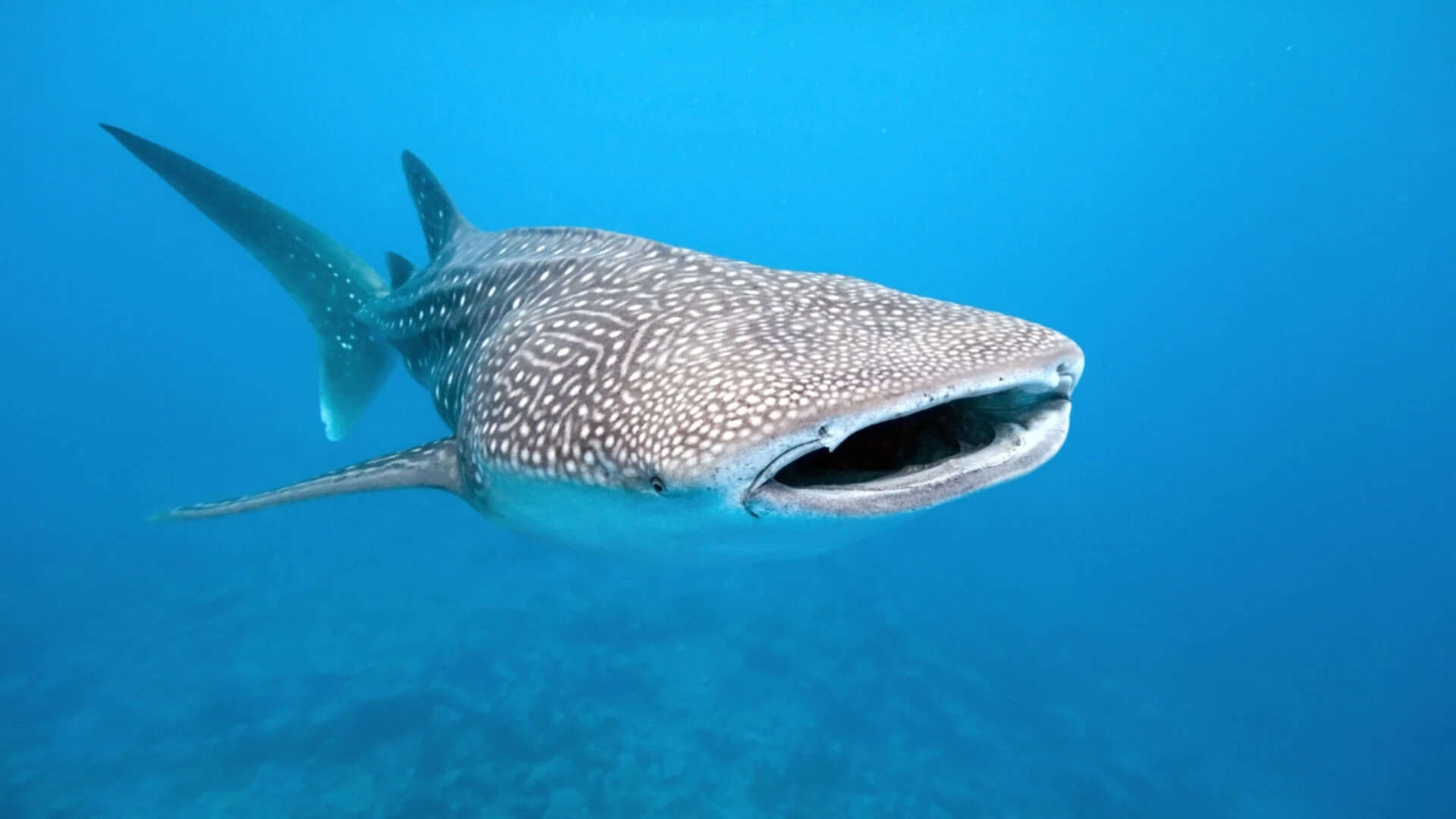
The water was pitch black, thick with the heavy humidity of a late midnight off the coast of Ningaloo Reef. A lone marine biologist, soaked to the bone and shivering despite the tropical heat, leaned over the edge of a battered rubber dinghy. Below the hull, a shadow moved. It was larger than a city bus, glided without a sound, and left barely a ripple on the surface.
For decades, these massive creatures have existed right at the edge of human knowledge. We knew they were there. We saw them gathering in specific coastal bays, scooping up billions of microscopic plankton with mouths wide enough to swallow a sofa whole. Yet, the moment they swam off the shallow continental shelves, they vanished into thin air. Or, more accurately, into dark water.
Where do they go when the tourists leave? How do they mate? Where do they give birth?
Until recently, the world’s largest fish was a complete ghost.
[Image of whale shark underwater]
The Phantom of the High Seas
Think about the sheer scale of a whale shark. A full-grown adult can stretch forty feet long and weigh upwards of twenty tons. Imagine trying to hide a semi-truck inside a crowded parking garage. Now imagine trying to hide that same semi-truck in an open field. It sounds impossible.
Yet the ocean is vast enough to swallow whole fleets, let alone a fish.
Scientists used to rely on visual sightings from fishermen and eco-tour guides. A spotter plane would fly over the coast, mark a coordinates dot on a map, and hope for the best. It was like trying to map the migration patterns of birds by looking out a single kitchen window once every three weeks. You see a few sparrows, maybe a hawk, but you miss the entire journey across continents.
The frustration among researchers was real. Millions of dollars spent, thousands of hours logged on rough seas, and the grand total of our knowledge amounted to a few scattered dots on a coastal chart. We knew where they ate lunch. We had zero clue where they spent the rest of their lives.
Then, the technology shifted.
A Tiny Satellite on a Giant Back
The breakthrough didn’t come from a massive breakthrough in vessel design or deep-sea submarines. It came from miniaturization. Researchers began attaching state-of-the-art satellite tagging devices directly to the thick, rubbery skin just behind the whale shark's dorsal fin.
Imagine affixing a tracking device to a wandering elephant, except the elephant periodically dives two thousand feet underground where radio signals cannot travel.
These tags had to be tough. They had to survive crushing water pressure, freezing deep-water temperatures, and the abrasive force of ocean currents. More importantly, they had to be smart. The tags recorded depth, water temperature, and light levels every few seconds. When the shark finally surfaced for air or to feed in the warm upper layers, the tag burst its stored data up to satellites orbiting hundreds of miles above the Earth.
When the first full datasets trickled back to laboratories in Australia, Mexico, and the Galapagos, the room went quiet.
The data didn't show simple, lazy swimming back and forth along the coast. It revealed epic, transoceanic pilgrimages. These heavy, slow-moving creatures were crossing entire ocean basins, navigating thousands of miles of featureless ocean with pinpoint accuracy.
Into the Twilight Zone
Consider the sheer physical strain of what these tags revealed.
A whale shark doesn't just cruise near the surface soaking up sunlight. They dive. Deep.
They plunge past the sunlit upper ocean into the mesopelagic zone, often called the ocean's twilight zone, reaching depths exceeding three thousand feet. Down there, the water temperature hovers just above freezing, and the water pressure is enough to collapse human lungs instantly.
Why would a cold-blooded giant swim down into a freezing, pitch-black abyss?
The answer lies in the deep vertical migration of the ocean’s food web. By day, vast layers of tiny shrimp, fish, and squid hide in the dark depths to escape predators. By night, they rise toward the surface to feed. Whale sharks time their dives perfectly, plunging into the dark to feast on dense layers of prey before returning to the warm surface waters to heat their bodies back up, acting almost like living solar panels.
It is a delicate balance of thermodynamics and hunting strategy, perfected over millions of years.
The Human Threat in the Dark
Understanding where these giants go isn't just an academic exercise. It is a race against time.
For years, marine conservationists struggled to explain why whale shark populations were declining in certain regions despite strict local protections near the coast. A country could pass laws protecting the sharks within twelve miles of its shore, but the moment the sharks swam into international waters, those protections dissolved.
The satellite tracking data exposed a chilling overlap.
The long-distance migration corridors used by whale sharks run directly through some of the busiest shipping lanes on the planet. Massive cargo ships, traveling at high speeds, plow through the exact same waters where whale sharks spend hours basking near the surface to warm up.
Unlike smaller fish that dart away at the sound of an engine, whale sharks evolved in a world where nothing was big enough to threaten them. They don't move out of the way. Strike records, combined with satellite tracking, revealed that vessel strikes are likely a primary, invisible killer of these ocean wanderers.
When a ship hits a giant fish in the middle of the Pacific Ocean, there is no sound, no alarm, and no record. The animal simply sinks to the seafloor.
Mapping the Future of the Ocean
Armed with this new picture of the ocean, the strategy has changed completely.
Instead of creating small, isolated marine parks near popular beaches, international coalitions are using real-time tracking data to establish dynamic protected areas. These are movable conservation zones that shift based on where the sharks are actually swimming in any given month. High-seas shipping lanes are beginning to be rerouted around critical migration hotspots during peak seasons.
The mystery of the whale shark is far from fully solved. We still have never witnessed a whale shark give birth in the wild. We still don't fully understand how newborn pups survive their first few years in the open ocean.
Every tagged shark that surfaces to beam its location to a satellite brings us one step closer to understanding the vast, interconnected systems that keep our oceans alive. The massive, spotted shadows that once vanished into the blue are finally writing their stories, showing us that even the quietest giants leave a trail worth following.


/i.s3.glbimg.com/v1/AUTH_51f0194726ca4cae994c33379977582d/internal_photos/bs/2025/i/r/awbO2yQqaKlcaE88EbfQ/saveinsta.to-487450509-18505253173001043-4348954377809315877-n.jpg)