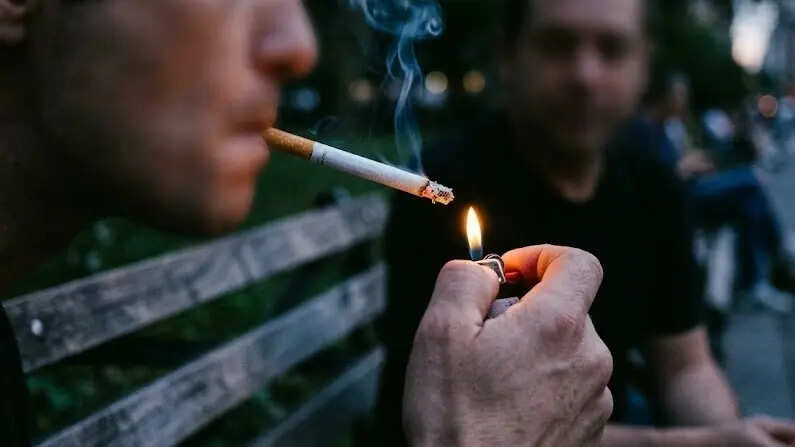
The air in a London pub usually carries a specific weight. It’s a mix of spilled ale, damp wool, and the faint, ghostly memory of tobacco that seems baked into the Victorian wood panels. But if you watch the crowd closely, you’ll notice a invisible line being drawn right through the center of the room. On one side are the veterans of the habit, the ones who remember when "light up" was a social punctuation mark. On the other side is a group of teenagers and young adults who are becoming the first humans in centuries to be legally locked out of an addiction.
They were born in 2009. While the rest of the world was reeling from a global financial crisis, these infants were sleeping in cribs, entirely unaware that they would eventually become the protagonists of a radical social experiment. Under the UK’s Tobacco and Vapes Bill, anyone born after 2008 will never reach the legal age to purchase cigarettes. Not next year. Not when they turn twenty-one. Not when they are eighty-five and gray.
The law doesn’t just raise the age; it chases the calendar. Every year, the legal limit creeps up by twelve months. The gap between the "haves" and the "never-wills" is now permanent.
The Invisible Glass Wall
Consider Leo. He is fifteen today, living in a world where the blue haze of a cigarette is something he mostly sees in old movies or clutched in the shaking hands of his grandfather. Leo is the face of the "Smokefree Generation." To him, the concept of buying a pack of twenty is becoming as foreign as buying a telegram or a suit of armor.
But there is a friction here that statistics often miss.
We are witnessing the birth of a two-tier adulthood. Imagine Leo at twenty-five, standing in a convenience store with his friend Marcus, who happens to be two years older. Marcus can buy a pack of Marlboros. Leo, under the eyes of the law, remains a perpetual minor in this one specific corridor of commerce. The clerk checks their IDs. One is granted the right to ruin his lungs; the other is protected from himself by the state.
It is a bizarre, legislative glitch in the matrix of growing up. Usually, age limits are a threshold you cross—a door you walk through. This law turns the door into a treadmill. No matter how fast Leo ages, he can never catch up to the "legal" side of the line.
The Anatomy of a Dying Breath
The UK government isn’t doing this to be eccentric. They are doing it because they’ve looked at the ledger, and the ledger is bleeding. Tobacco remains the single greatest cause of preventable death in the country. It accounts for eighty thousand deaths a year. It is the silent engine behind one in four cancer deaths.
But those are just numbers. The reality is the sound of a portable oxygen concentrator whirring in a quiet living room while a sixty-year-old struggles to walk to the kitchen. It is the "smoker’s cough" that isn't a cough at all, but the body desperately trying to clear out a tar-lined basement.
The logic of the ban is rooted in the "addiction window." Data shows that the vast majority of smokers start before they hit twenty-five. If you can bridge that gap—if you can keep a person’s lungs clean until their mid-twenties—the odds of them ever picking up the habit drop to near zero. The government isn't just banning a product; they are trying to outrun the human brain's susceptibility to nicotine during its most formative years.
The Great Vaping Pivot
If cigarettes are the crumbling empire, vapes are the insurgent army.
Walking through any British high street, you aren't met with the smell of burning leaves, but with a sickly sweet cloud of "Blueberry Ice" or "Watermelon Chill." This is where the narrative gets messy. While the law aims to decapitate the tobacco industry, it is also wrestling with the neon-colored monster of disposable vapes.
The new rules aren't just about age; they are about aesthetics. The government is moving to restrict flavors that seem designed by a candy shop and packaging that looks like a toy. They realized, perhaps a bit late, that they were winning the war against the "ash" only to lose the peace to the "vapor."
For Leo and his peers, the temptation isn't a filtered cigarette. It’s a sleek, plastic stick that tastes like dessert and delivers a hit of nicotine more efficient than anything a 1950s ad executive could have dreamed of. The legislation tries to treat both, but the cultural momentum of vaping is a much harder beast to cage. It is portable, discreet, and smells like a fruit bowl.
The Cost of Forbidden Fruit
History is littered with the remains of things we tried to ban. Prohibition in the United States didn't stop the drinking; it just gave the keys to the city to the mob.
Critics of the UK ban point to the "underground" as the inevitable destination. If Leo wants a smoke at twenty-one and the shopkeeper says no, he doesn't just give up. He finds a "shoulder-tapper"—an older friend who can legally buy the goods. Or he turns to the black market, where products aren't regulated, taxes aren't paid, and the tobacco might be cut with things far worse than what the big companies use.
There is a psychological phenomenon called "reactance." When you tell a human being they are the only ones specifically forbidden from doing something their elders can do, that thing becomes infinitely more alluring. By making smoking a "forbidden rite" for a specific birth year, the government risks turning a dying habit into a rebellious statement of identity.
A Quiet Revolution in the Bloodstream
Yet, there is something profoundly hopeful about this legislative stubbornness.
For the first time in modern history, a nation has decided that the "freedom" to sell a lethal addiction is not a freedom worth protecting. We are watching a slow-motion divorce between a culture and its most toxic companion.
If this works, the UK will eventually reach a point where the only people smoking are the very old, a shrinking demographic of the past. The hospitals will start to change. The wards currently filled with the victims of COPD and lung cancer will slowly breathe a sigh of relief. The billions of pounds currently siphoned off to treat tobacco-related illnesses will, in theory, be redirected to the next frontier of medicine.
The stakes aren't actually about "rules" or "ID cards." The stakes are the invisible hours being added back to people's lives. It’s the extra decade a father gets to spend with his daughter because he never had the chance to buy that first pack at sixteen. It’s the quietness of a chest that doesn’t wheeze.
The Last Cigarette
One day, decades from now, a man will stand on a corner in Manchester or Birmingham. He will be the last person in the country who can legally buy a pack of cigarettes. He will be an anomaly, a living museum piece of a bygone era.
Behind him will be millions of people who grew up in a world where the "choice" to smoke was never offered, and consequently, never missed. They won't feel oppressed. They won't feel like they lost a right. They will simply look at a cigarette the way we look at lead paint or asbestos: a strange, lethal relic that our ancestors were once convinced they couldn't live without.
The law is a gamble that we can legislate our way out of our own weaknesses. It assumes that if you make the barrier to entry high enough and the timeline long enough, the human craving for nicotine will eventually starve to death.
Leo might complain today. He might feel the sting of being "the generation that can't." But thirty years from now, when he is hiking up a hill without the fire in his lungs that haunted his father, he might finally realize that the "tough new rule" wasn't a cage, but a clean, unobstructed path forward.
The blue haze is clearing. And for the first time, we can see exactly what it was hiding.