The strategic divergence between Ukraine’s deep-strike aerial campaign and Russia’s localized frontline pressure highlights a fundamental mismatch in how both state actors define victory, utilize resources, and absorb damage. Media accounts typically view these events as a series of isolated events: a long-range drone strike hitting an energy hub near St. Petersburg, contrasted against a Kremlin announcement claiming the seizure of a small, depopulated frontline village. This binary view fails to capture the underlying economic and operational mechanics.
Evaluating the true impact of these operations requires looking past immediate headlines and analyzing the structural trade-offs of this conflict. This means analyzing the unit economics of deep air denial, the operational reality of marginal territorial gains, and how strategic resource allocation ultimately influences long-term military endurance. If you found value in this post, you should check out: this related article.
The Strategic Geometry of Long-Range Interdiction
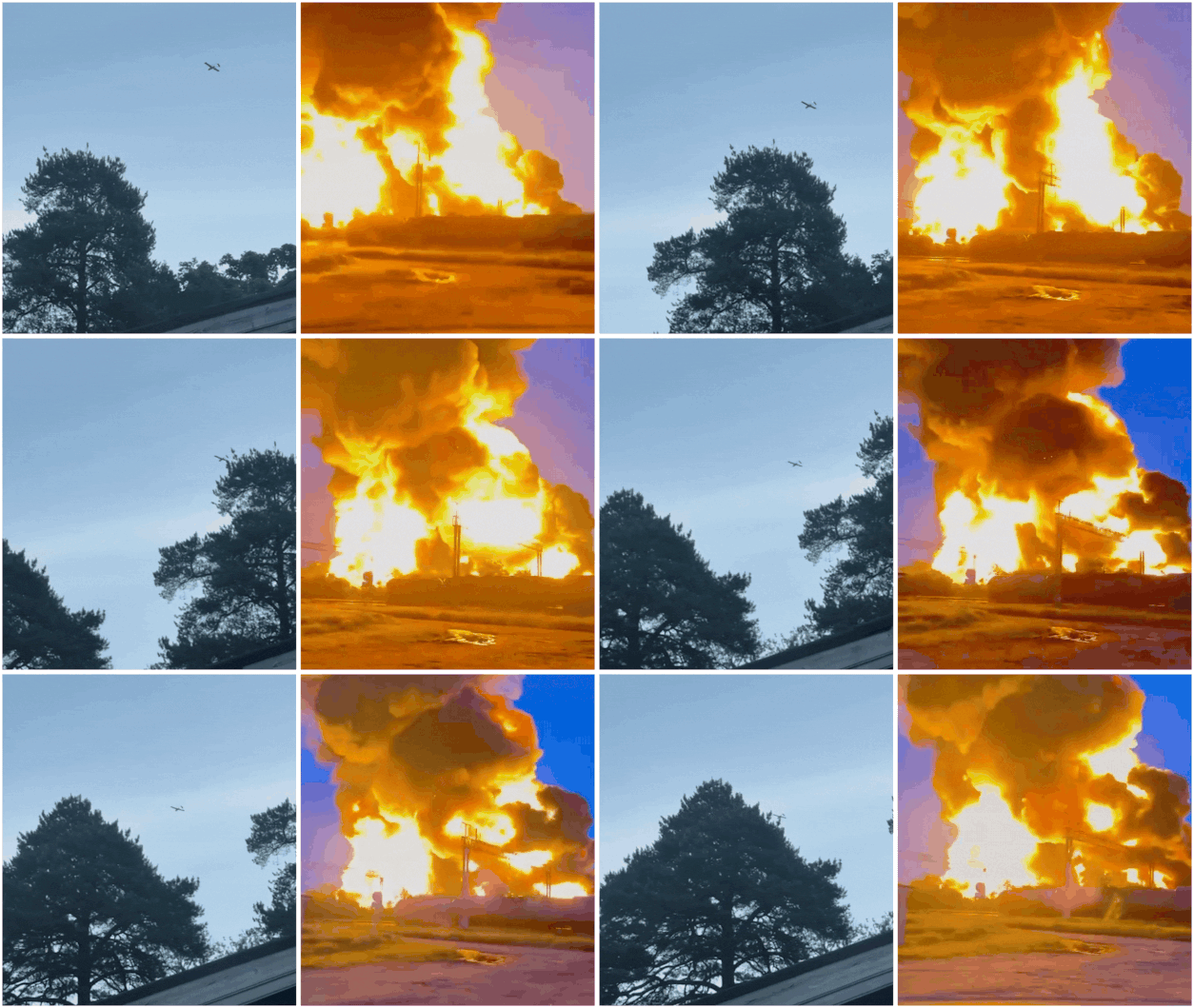
The deployment of Ukrainian long-range unmanned aerial vehicles (UAVs) against infrastructure in the Leningrad region, specifically targeting the St. Petersburg Oil Terminal, is a clear example of asymmetric cost-imposition. This operation is not merely symbolic; it relies on a calculated geographic leverage point. By launching strikes that travel over 1,100 kilometers from the Ukrainian border, the Unmanned Systems Forces exploit holes in Russia's domestic air defense network, which is naturally optimized to protect frontline sectors and high-value political centers.
[Ukraine Production Base] ---> (1,100km Low-Altitude Flight Path) ---> [St. Petersburg Oil Terminal]
                                                                                  |
                                                     [Economic Disruption: Port Interdiction / SPIEF Shadowing]
This deep-strike methodology relies on three distinct operational layers: For another angle on this development, refer to the recent update from Al Jazeera.
- Primary: Revenue Disruption. The St. Petersburg Oil Terminal serves as Russia’s primary Baltic transshipment hub, featuring an annual throughput capacity of 12.5 million tonnes. Forcing this facility to shut down or reduce operations directly limits the Kremlin's ability to monetize energy exports, which fund its defense budget.
- Secondary: Air Defense Redistribution. Protecting high-altitude storage tanks and sensitive refining equipment deep within Russian territory requires moving mobile air defense assets, like S-400 and Pantsir-S1 systems, away from the contact line. This reallocation exposes frontline military logistics hubs to tactical strikes.
- Tertiary: Political Risk Magnification. Executing these strikes right as the St. Petersburg International Economic Forum (SPIEF) begins undermines Moscow's efforts to project economic stability to international investors. It demonstrates that crucial industrial infrastructure remains vulnerable despite official security guarantees.
The economic math behind this approach favors the attacker. A mass-produced, long-range Ukrainian drone made of composite materials and powered by a basic internal combustion engine costs between $20,000 and $50,000. In contrast, a single Russian interceptor missile costs anywhere from $500,000 to over $2 million. Even if air defense systems down 90% of an incoming drone swarm, the financial burden of defending the airspace remains unsustainably high. When a drone gets through and strikes a vital distillation column or storage tank, the financial damage multiplies. The target suffers from lost production, high repair costs, and long-term equipment bottlenecks due to international trade sanctions.
The True Cost of Frontline Village Claims
While deep strikes target Russia's economic foundations, the Russian military continues to focus on tactical territorial attrition along the Donbas arc. The Kremlin frequently highlights the capture of small villages to demonstrate offensive momentum. However, a closer look at these operations reveals a steep cost for very marginal gains.
The operational reality of these village captures can be broken down into three main structural phases:
Exhaustion via Mass Artillery
Before ground troops advance, Russian forces deploy heavy artillery and glide bombs to flatten all standing structures in a targeted settlement. This eliminates any defensive cover for Ukrainian troops, but it also destroys the tactical value of the objective. The captured area becomes a barren, exposed crater field that offers no shelter or logistical advantages to the advancing forces.
The Problem of Extended Logistics
Securing a ruined settlement pushes Russian forward positions deeper into a destroyed landscape, lengthening their supply lines. This makes advancing units highly vulnerable to Ukrainian first-person view (FPV) drones and precision artillery, turning a newly claimed position into a dangerous logistical bottleneck.
Unsustainable Attrition Rates
Military intelligence reports indicate that Russian territorial advances in 2026 have slowed significantly, dropping to less than 5 square kilometers per day across the entire theater. Achieving these minimal gains requires a high expenditure of armored vehicles and personnel. This dynamic creates a distinct imbalance: Russia trades valuable military equipment and human capital for non-strategic, ruined geography.
Operational Realities and System Bottlenecks
Evaluating this conflict requires moving past simplistic territory maps and looking at the core systems that keep both militaries functioning. The interplay between deep strikes and frontline operations reveals critical vulnerabilities for both sides.
The Limits of Defensive Saturation
The Russian Defense Ministry frequently reports downing hundreds of drones during large-scale attacks. While these numbers point to highly active air defense networks, they also highlight a growing supply problem. No military maintains an infinite stockpile of surface-to-air missiles. Frequent saturation attacks force defenders to make tough choices: they must decide whether to protect critical economic assets like energy terminals, or shield frontline troop concentrations.
The Naval Base Vulnerability
The reported strikes on the Kronstadt naval base, which damaged a Baltic Fleet missile corvette undergoing repairs, reveal how deep-strike campaigns can affect traditional naval power. When a repair facility is hit, it creates a backlog for fleet maintenance. Ships remain out of service longer, reducing Russia's naval presence and regional influence without requiring direct ship-to-ship engagement.
Collateral System Disruptions
The tactical impact of a drone strike extends far beyond the immediate blast radius. For instance, shutting down regional airspace or delaying commercial flights during an alert disrupts regional supply chains. This forces local industries to redirect transport routes and adapt to rolling power outages, adding friction to the broader wartime economy.
The Strategic Outlook
The current state of the conflict is defined by two competing strategies: Ukraine's targeted, high-leverage long-range strikes against economic infrastructure, and Russia's resource-intensive ground assaults along the frontline.
+------------------------------------+       +------------------------------------+
|       Ukraine Strategic Play       |       |        Russia Strategic Play       |
+------------------------------------+       +------------------------------------+
| * Asymmetric Long-Range UAV Swarms |       | * Localized Frontline Attrition    |
| * Focus: High-Value Infrastructure |       | * Focus: Marginal Territorial Gains|
| * Goal: Industrial/Revenue Denial  |       | * Goal: Tactical Political Victories|
+------------------------------------+       +------------------------------------+
                  |                                            |
                  +---------------------+----------------------+
                                        |
                                        v
                    [Systemic Friction & Resource Depletion]
This divergence creates a critical endurance test. Ukraine's long-range campaign aims to degrade Russia's industrial capacity and export revenue faster than Moscow can replace its losses. Conversely, Russia's strategy relies on using its superior numbers to wear down Ukrainian defensive lines before domestic economic strains become unmanageable.
As this cycle of strikes continues, the decisive factor will not be the capture of individual villages or single successful drone attacks. Instead, the outcome will depend on structural endurance: which side can better manage its supply lines, protect its core infrastructure, and maintain economic stability under constant pressure. The conflict has evolved into a complex engineering and logistical puzzle, where success is measured by industrial resilience and the calculated management of attrition.