France is tired of holding onto secrets that don't belong to it. For decades, the Louvre and other major French institutions have lived with a quiet, dusty burden. Thousands of artworks stolen by the Nazis during the occupation of Paris sat in storage or hung on gallery walls with vague labels. Now, the Musée d'Orsay and the Louvre are shifting from a passive "wait and see" approach to an active hunt for the rightful owners. It's about time.
The recent opening of dedicated galleries for these works in Paris isn't just about aesthetics. It's a public confession. These pieces are classified as Musées Nationaux Récupération (MNR). That’s a fancy bureaucratic term for "we found this after the war, we think it was stolen from Jewish families, but we haven't found the heirs yet."
For a long time, the burden of proof was on the families. You had to prove the painting over your great-grandfather’s mantle was the same one sitting in a French basement. That's changing. The French government is now proactively researching the provenance of these works. They're hiring more researchers. They're using DNA of the paper and archives of the Gestapo to bridge the gap.
The scale of the theft in Paris
Hitler’s dream of a "Fuhrermuseum" in Linz depended on the systematic stripping of French private collections. Between 1940 and 1944, the Einsatzstab Reichsleiter Rosenberg (ERR)—the Nazi unit dedicated to art looting—processed tens of thousands of items through the Jeu de Paume gallery. It was basically a high-end clearinghouse for stolen genius.
When the war ended, about 60,000 works were returned to France from Germany. Most were claimed quickly. But about 2,000 pieces remained in a legal limbo. These are the MNR works. They aren't owned by the state. The museums are just "holding" them. But let's be real. Holding a stolen painting for 80 years feels a lot like owning it.
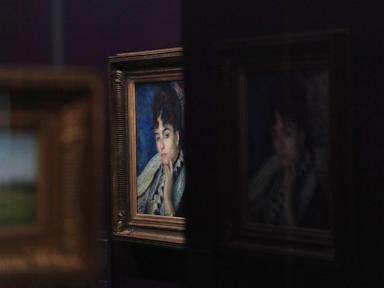
The new galleries in Paris change the optics. Instead of hiding these works in administrative offices or scattered throughout massive wings, they're grouped together. The labels don't just say who painted them. They say who they were taken from. They describe the theft. They invite the public to look closer. Maybe someone recognizes a landscape from a grainy black-and-white family photo. It happens more often than you'd think.
Why returning art is still a legal nightmare
You’d think "it was stolen, give it back" would be a simple rule. It’s not. French law is famously rigid about the "inalienability" of national collections. Once an object enters a public museum, it’s legally part of the state forever. To get around this for Nazi-looted art, the French Parliament had to pass a special law in 2023.
This law allows for the restitution of works from public collections without needing a separate act of parliament for every single sketch or statue. It streamlines the process. Before this, returning a single painting could take years of political maneuvering.
The human cost of the delay
Think about the families. We aren't just talking about billionaires with sprawling estates. Many of these items were family heirlooms from middle-class Jewish households. Silverware. Small sketches. Clocks. These were the things people left behind when they were forced to flee or were deported to camps.
When a museum "reckons" with its history, it isn't just checking boxes. It’s acknowledging a crime. For years, the French art world was accused of "museum-washing"—putting these works on display to keep them in the public eye while doing the bare minimum to actually find the owners. The new transparency in Paris suggests that era is ending.
Spotting the MNR label in the wild
If you visit the Louvre or the Musée d'Orsay today, look at the small text next to the frames. If you see MNR followed by a number, you're looking at a ghost.
I’ve seen people walk right past these works without realizing they’re standing in front of a crime scene. These paintings are often high-quality—works by Delacroix, Constable, or lesser-known masters of the 18th century. They were chosen by Nazi "experts" because they had value.
The current push involves a dedicated commission called the CIVS (Commission for the Compensation of Victims of Spoliation). They don't just wait for people to call. They dig through auction catalogs from the 1940s. They cross-reference names from the Rose Valland archives. Valland was the heroic curator who secretly tracked Nazi shipments during the war. Without her notes, we’d be completely in the dark.
How the process is actually changing
The old way was defensive. Museums didn't want to lose their masterpieces. The new way is investigative.
- Digital Transparency: The "Rose Valland" database is now online. Anyone can search it. If you suspect your family lost art in France, start there.
- Proactive Genealogy: The Ministry of Culture is now working with professional genealogists. They find the heirs before the heirs find them.
- Physical Visibility: By putting these works in high-traffic galleries, the museums are admitting they don't own them. It’s a permanent "Lost and Found" sign.
It’s messy. Sometimes, multiple heirs emerge and fight over the piece. Sometimes, the heirs don't even want the art—they want it sold so the proceeds can be split. Other times, they want the painting back on the museum wall, but with their family name finally attached to it. Every case is a unique tragedy.
What you can do if you have a claim
Don't wait for a museum curator to knock on your door. If your family lived in France or moved through Paris during the 1940s and lost property, there are steps you can take.
Check the Ministère de la Culture website under the "Bien Nationaux Récupérés" section. You don't need a lawyer to start the search, though you might need one if the case gets complex. Search by family names, but also by the descriptions of the items. Many things were documented by the Nazis with chilling precision.
The Paris museum scene is finally growing up. It’s moving past the post-war ego of building "great collections" at any cost. It's realizing that a museum’s integrity is worth more than a stolen canvas. If you’re in Paris, go to the Louvre. Find the MNR works. Look at them not just as art, but as evidence.
The search continues because the debt hasn't been paid. France is just finally admitting how much it owes. If you think you have a connection to a lost piece, contact the CIVS directly through their portal. Silence was the old policy. Noise is the new one. Use it.