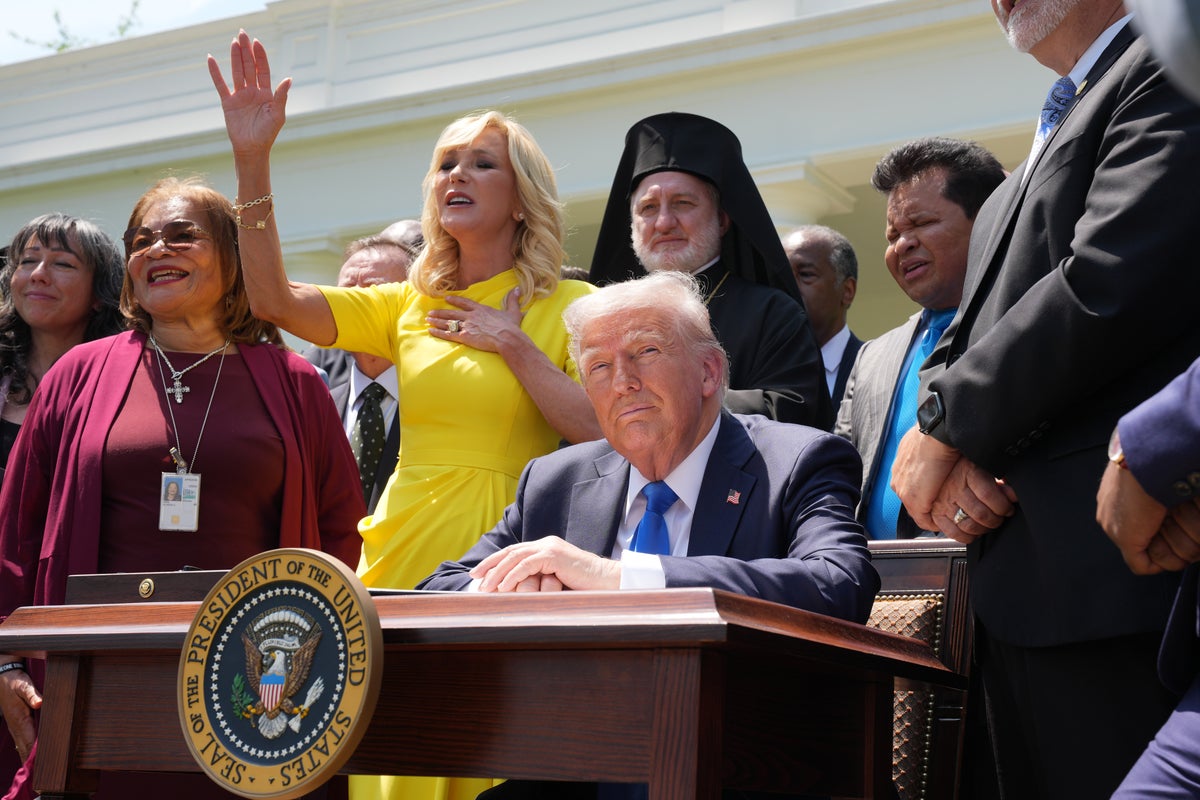
The modern federal workforce operates under a governing paradox: employees are mandated to execute the will of the state with absolute neutrality while serving under leadership that may increasingly view policy through a prism of private conviction. When religious messaging enters the federal workspace, it is not merely a cultural friction point; it is a structural failure of the boundary between personal belief and institutional function. This tension creates a specific type of operational inefficiency where the chain of command begins to transmit signals that are legally and culturally incompatible with the Establishment Clause of the First Amendment.
To understand the current friction, we must look at the Tripartite Framework of Institutional Secularism. This framework defines how a neutral bureaucracy maintains stability through three distinct vectors:
- Jurisdictional Separation: The clear divide between private conscience and public duty.
- Professional Homogeneity: The expectation that internal communications focus exclusively on mission-critical technical or strategic data.
- The Non-Coercion Protocol: The prohibition of implicit social or professional pressure to align with a superior’s non-secular worldview.
When these vectors are compromised, the result is a breakdown in the federal "merit system," where perceived alignment with a leader’s faith starts to function as a shadow currency for career advancement or psychological safety.
The Mechanism of Professional Encroachment
The shift from secular to faith-infused federal leadership does not typically occur through overt policy changes, which are easily challenged in court. Instead, it manifests through Incremental Norm Erosion. This process follows a predictable sequence of behavioral shifts within the executive tier of an agency.
The first stage is Symbolic Signalling. This involves the introduction of religious iconography or rhetoric in non-mandatory settings, such as email signatures, office décor, or "optional" morning reflections. While seemingly benign, these symbols serve as a high-fidelity signal to the workforce regarding the leader's internal values. In a hierarchical organization like the federal government, where performance reviews and promotions are subject to the discretion of superiors, subordinates often interpret these symbols as "preferred behaviors."
The second stage is Rhetorical Integration. Leaders begin to frame secular policy goals—such as environmental protection, border security, or social welfare—using theological justifications. By replacing data-driven rationale with moral or religious imperatives, the leader effectively bypasses the peer-review and evidence-based standards that define federal bureaucracy. This creates a logical bottleneck: how does a career scientist or policy analyst provide a dissenting data-driven opinion against a superior who claims their position is divinely ordained?
The Cost Function of Religious Signaling
Integrating religious messaging into the federal workplace carries quantifiable risks to organizational performance. We can model this through the Bureaucratic Friction Index, which measures the loss of efficiency when non-essential variables are introduced into the workflow.
Divergent Cognitive Load
When a supervisor uses religious language, employees of different faiths—or no faith—are forced to perform a "translation" step. They must mentally separate the professional directive from the religious delivery. This creates an unnecessary cognitive tax. For a workforce of over two million people, even a 1% decrease in focus due to internal cultural alienation results in the loss of thousands of productive man-hours daily.
Talent Attrition and the "Brain Drain" Variable
Federal agencies compete with the private sector for top-tier specialized talent in fields like cybersecurity, epidemiology, and economics. High-performing professionals generally prioritize environments characterized by objective meritocracy. When an agency develops a reputation for religious favoritism or "faith-based leadership," the most mobile and highly skilled individuals are the first to exit. This leaves the agency with a "loyalty-biased" workforce rather than a "skill-biased" one.
Legal and Liability Overheads
The federal government is not a private corporation. While the Supreme Court’s recent jurisprudence—specifically cases like Kennedy v. Bremerton School District—has expanded the rights of public employees to engage in personal religious expression, it has not granted supervisors the right to proselytize to subordinates. The ambiguity of current legal standards creates a high-risk environment for litigation. Every instance of perceived religious coercion triggers Internal Affairs investigations, Equal Employment Opportunity Commission (EEOC) complaints, and federal lawsuits, all of which consume taxpayer-funded legal resources.
The Collision of Free Exercise and Establishment
The core of the conflict lies in the tension between two clauses of the First Amendment: the Free Exercise Clause (the right of the leader to practice their faith) and the Establishment Clause (the prohibition of the government favoring one religion).
In a federal context, a leader is the "government." When a Department Head speaks at an agency-wide town hall, they are not speaking as a private citizen; they are speaking with the delegated authority of the Executive Branch. The power imbalance is absolute. The "Choice Architecture" for the employee is flawed because the employee cannot easily quit or move to a different "branch" of the same company.
The current legal landscape is shifting toward a "Historical Practices and Understandings" test. This means courts now look at whether a specific religious expression has a historical precedent in American public life. However, this test is notoriously difficult to apply to modern workplace communication tools like Slack, MS Teams, and mass-email distributions. The speed and reach of digital communication amplify the impact of religious messaging, turning a single comment into a permanent, agency-wide cultural directive.
Structural Mitigation and the Path to Stability
To stabilize an agency facing religious polarization, leadership must move away from personal charisma and toward Procedural Neutrality. This is not about suppressing the individual faith of leaders, but about enforcing a strict "Operational Interface."
The Operational Interface dictates that all communications passing through government-owned channels (email, official meetings, memos) must adhere to a Technocratic Standard. If a statement does not directly support the technical execution of a statute or the strategic management of personnel, it is extraneous and potentially disruptive.
The Neutrality Audit
Agencies should implement a periodic "Neutrality Audit" conducted by independent ethics offices. This audit does not police belief; it measures the impact of leadership rhetoric on subordinate morale and promotion parity. If data shows that employees who share the leader’s faith are being promoted at a statistically higher rate than those who do not, the agency has a structural failure that must be corrected through blind hiring and promotion protocols.
Decentralized Decision-Making
Concentrating power in the hands of a few political appointees increases the risk of religious "top-down" influence. By decentralizing decision-making and empowering career Senior Executive Service (SES) members—who are bound by long-term professional norms—the agency creates a buffer against the ideological volatility of shifting political administrations.
The survival of the federal bureaucracy as a trusted, objective entity depends on its ability to remain the "Neutral Arbiter" of the public interest. When the boundary between the pulpit and the podium dissolves, the state loses its primary asset: the appearance of impartial justice. The immediate strategic requirement for federal managers is the re-establishment of the Secular Professionalism Boundary. This requires a move back to "Mission-First" communication, where the success of the agency is measured by the delivery of services to 330 million diverse citizens, regardless of the private prayers of the person at the top.
The final strategic play for any federal leader is the recognition that the strongest expression of personal faith in a public role is the disciplined restraint of that faith in deference to the constitutional rights of those they lead. Failure to exercise this restraint does not just invite litigation; it dissolves the social contract that allows a pluralistic society to be governed by a single, unified bureaucracy. Managers must prioritize the "Subordinate's Experience of Neutrality" over the "Leader's Experience of Expression." This shift is the only way to prevent the fragmentation of the civil service into ideological silos.