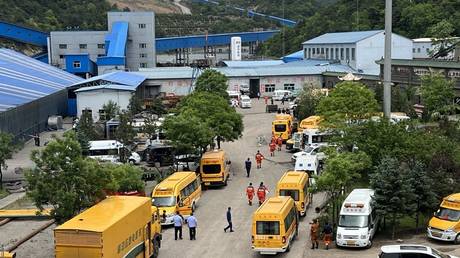
Western media covers Chinese coal mine disasters with a predictable, copy-paste script. A tragic explosion occurs. Dozens of miners lose their lives. The narrative immediately shifts to an indictment of Beijing’s "lax safety standards," "reckless pursuit of growth," and "outdated infrastructure." It is a lazy consensus that serves a geopolitical narrative while completely missing the structural reality of global energy markets and industrial automation.
The mainstream press views Chinese mining through a 1990s lens. They paint a picture of impoverished laborers hacking away at coal faces with pickaxes under the watchful eye of negligent bureaucrats. This perspective is dangerously obsolete. It blinds us to a brutal economic truth: China’s mine safety crisis is no longer a failure of regulation or technology. It is a crisis born of hyper-regulation, aggressive decarbonization targets, and the unintended consequences of the world's most rapid industrial automation push.
If we want to understand why miners are still dying in Shanxi, Shaanxi, and Inner Mongolia, we have to stop looking for mustache-twirling corporate villains and start analyzing systemic supply-chain choke points.
The Automation Paradox: Why Smart Mines Aren't Safer Yet
The prevailing myth is that Chinese mines are primitive. The reality is that China is currently leading the world in the deployment of 5G-enabled, autonomous underground mining systems. Telecom giants like Huawei have spent the last five years partnering with state-owned energy firms to build "smart mines." They deploy autonomous drilling rigs, unmanned haulage trucks, and AI-driven subterranean imaging.
Logically, removing humans from the coal face should eliminate casualties. But it introduces a new, highly volatile risk factor: The Automation Paradox.
When you automate the predictable elements of underground extraction, you do not eliminate risk; you displace it. I have spent years analyzing industrial supply chains and infrastructure deployment. What Western analysts fail to grasp is that high-tech systems require highly specialized maintenance. When an automated shearer stalls or a robotic conveyor system glitches deep within a shaft, it creates a high-pressure bottleneck.
To maintain production quotas dictated by the central government, human technicians are sent into volatile environments to fix complex digital hardware under extreme time constraints. They are entering zones where traditional, analog sensory cues of structural failure—the shifting of timbers, the specific scent of releasing gases—have been replaced by digital sensors that can be miscalibrated or blinded by localized interference.
The explosion isn't happening because the mine is primitive. It is happening because the integration of bleeding-edge automation with legacy geological realities creates unpredictable thermal and atmospheric friction points that analog safety protocols cannot catch.
The Decarbonization Squeeze Play
The lazy critique blames China's insatiable appetite for dirty energy for these fatalities. This ignores the regulatory vice grip that Beijing has placed on the domestic coal sector.
In its push to hit peak carbon emissions before 2030 and achieve carbon neutrality by 2060, the Chinese government has shut down thousands of small, privately owned, legally compliant coal mines. On paper, consolidating production into massive, state-run mega-mines sounds like a victory for safety and oversight.
In practice, it creates a dangerous supply-and-demand distortion.
[National Decarbonization Targets] -> Restricts Permitted Coal Capacity
                                           |
                                           v
[Industrial Grid Demand Spikes]     -> Creates Severe Energy Shortfalls
                                           |
                                           v
[Emergency Production Mandates]     -> Forces Mega-Mines to Over-Exert Infrastructure
When regional power grids face shortages due to extreme weather or manufacturing surges, Beijing does not tell factories to power down. It issues emergency mandates to the remaining mega-mines to ramp up production to maximum capacity overnight.
Consider the mechanics of a coal mine explosion. It is rarely a simple matter of someone lighting a match. It is almost always a failure of ventilation. When a mine is forced to operate at 120% of its rated capacity to meet an emergency state quota, the rate of coal extraction outpaces the capacity of the ventilation shafts to dilute methane gas and suppress coal dust.
The State Bureau of Mine Safety has incredibly strict rules on methane thresholds. But when the local political apparatus demands coal to keep the lights on in Shanghai, mine managers face a fatal choice: pause production to clear gas and face political ruin, or bypass the sensors and pray the ventilation catches up.
The disaster is not a lack of rules. It is a conflict of absolute mandates: the mandate to decarbonize versus the mandate to power the economic engine. The miners are caught in the gears of that structural contradiction.
Dismantling the "Cheap Life" Premise
Western reporting frequently implies that Chinese authorities simply view miners as disposable cogs in a machine. This ignores the massive economic liability a mining death now represents in China.
Let’s look at the actual math of a mining disaster in the modern Chinese regulatory framework.
- Direct Fines: The revised Work Safety Law allows for fines up to 100 million RMB ($14 million USD) for egregious failures resulting in multiple deaths.
- Criminal Liability: Mine managers and local officials face immediate criminal prosecution and long-term imprisonment, not just corporate slaps on the wrist.
- Shutdown Costs: An explosion triggers an immediate, mandatory suspension of all operations not just for the affected mine, but often for every mine in the entire province for comprehensive safety audits lasting weeks or months.
The financial and political cost of a single major accident can bankrupt a regional energy firm and end the careers of every local official in the jurisdiction. To suggest that operators are cutting corners on safety to save a buck is a fundamental misunderstanding of their self-preservation instincts.
They are not cutting corners because they want to save money. They are cutting corners because the geopolitical realities of energy isolation force their hands. China imports massive amounts of coal and liquid natural gas, but under global trade tensions and sanctions regimes, energy self-reliance is viewed by Beijing as a matter of national survival. A mine manager overriding a safety protocol isn't doing it for profit; they are doing it because they are operating under a wartime mentality regarding energy security.
The Flawed Questions We Ask About Industrial Safety
If you look at public forums and international commentary regarding these disasters, the questions asked are fundamentally broken.
Why doesn't China just import safer Western mining equipment?
This question assumes Western equipment is superior or even compatible with the scale of Chinese extraction. The United States and Europe have largely abandoned deep, high-yield underground coal mining in favor of surface mining or natural gas transition. China is mining at depths and volumes that Western manufacturers have zero experience handling. China is forced to invent its own deep-mining safety tech because the West simply doesn't build it anymore.
Why doesn't the Chinese government allow independent labor unions to monitor safety?
While independent unions are a proven vector for safety enforcement in Western history, the assumption that their absence is the sole point of failure ignores the role of the state-run All-China Federation of Trade Unions (ACFTU). The ACFTU has immense legal authority to halt production. The breakdown occurs because local union representatives are embedded within the political structure of the state-owned enterprise itself. The failure is institutional capture, not a lack of safety inspectors or legal rights on paper.
The Harsh Reality Ahead
The uncomfortable truth that no energy analyst wants to voice is that industrial fatalities in the transition phase of energy revolutions are structural, not accidental.
When Great Britain shifted to coal in the 19th century, thousands died. When the West built its electrical grids and nuclear plants, workers paid the price. China is attempting to execute the largest, fastest energy transition in human history—shifting an economy of 1.4 billion people from legacy fossil fuels to a digital, automated, green grid, all while maintaining a manufacturing monopoly.
This transition requires an unprecedented volume of raw materials, extracted at blistering speeds, under a regulatory regime that changes its priorities month to month. One week the priority is cutting emissions; the next week it is emergency coal production to prevent blackouts; the week after that it is total automation.
This whiplash is the real killer.
The hardware cannot adapt as fast as the policy shifts. The digital sensors fail. The ventilation systems choke. The human operators, caught between conflicting digital alerts and absolute state mandates, make fatal errors.
Stop reading the superficial coverage that blames corrupt local bosses or primitive conditions. The bodies pulled from the shafts are the collateral damage of a high-tech, hyper-regulated energy engine running at redline speeds to satisfy both the global demand for Chinese goods and the domestic demand for green prestige. Until the world acknowledges that hyper-paced industrial transitions create their own distinct, systemic lethality, the digital dashboards of the world's smartest mines will keep flashing red.