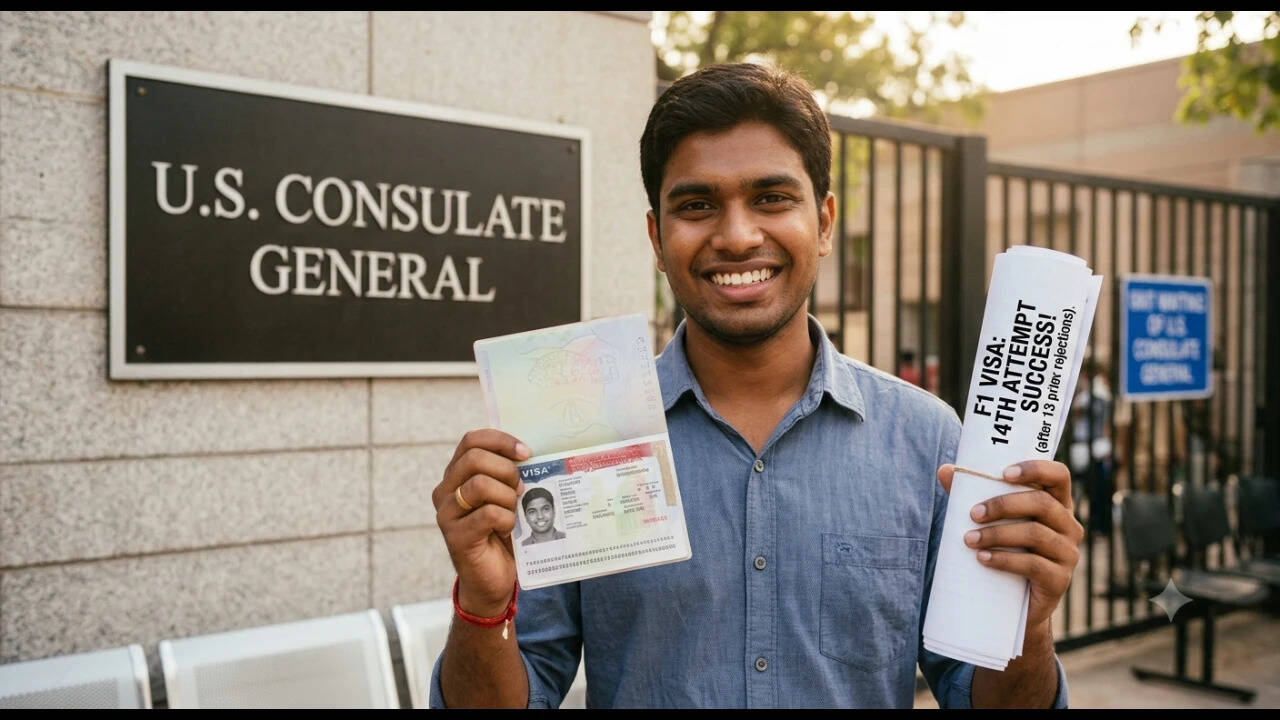
Fourteen consular interviews across Mumbai, Hyderabad, Delhi, Kolkata, and Chennai—thirteen refusals followed by a fifty-minute approval session on the final attempt—expose a fundamental flaw in how many applicants treat nonimmigrant visa adjudication. Viral accounts of an Indian civil engineering applicant named Prasanth eventually securing an F-1 student visa in Hyderabad after being asked to plan a twenty-storey residential building read like a triumph of grit. Viewed through a decision-theoretic and institutional lens, however, the story highlights the friction between applicant persistence and statutory screening rules.
Human-interest coverage of viral visa stories typically strings together anecdotes in chronological order: early rejections, rising frustration, odd consular questions such as constructing the Burj Khalifa or planning a twenty-storey building, a dramatic fifty-minute wait, and final approval. That narrative structure entertains readers, yet it obscures the underlying adjudication mechanics. It treats consular officers as capricious quizmasters rather than adjudicators operating under statutory presumption, time constraints, and record review. In other developments, take a look at: The Quiet Room Where Interest Rates Go to Hide.
To understand what actually happens across repeated F-1 visa interviews, applicants need a structured framework separating verified account details from educated hypotheses, mapping the true cost function of repeat applications, and diagnosing why high-frequency retakes often compound risk rather than resolve it.
Facts Versus Educated Hypotheses in Viral Visa Accounts
Rigorous analysis begins by separating what is reported in public accounts and statutory law from what remains unverified or inferred. Public reporting on the October 2026 viral post states that an Indian civil engineering applicant completed fourteen F-1 interviews across multiple Indian consular posts—including Mumbai, Hyderabad, Delhi, Kolkata, and Chennai—faced repeated refusals, answered technical questions about civil engineering and building construction, and received approval after a roughly fifty-minute interview in Hyderabad. Under U.S. immigration law, Section 214(b) of the Immigration and Nationality Act presumes every nonimmigrant applicant intends to immigrate unless they satisfy the consular officer otherwise, and applicants refused under 214(b) may reapply when they can show changed circumstances or information not previously considered. The Economist has provided coverage on this critical topic in great detail.
Everything beyond those core elements involves educated hypotheses rather than established fact. Online observers immediately questioned the logistical plausibility of securing fourteen interview slots in India given historical appointment backlogs. Even when an applicant reports a fifty-minute session or unusual technical prompts, external readers cannot verify whether the officer was testing domain authenticity, probing for inconsistencies in stated academic and business plans, or simply conducting an extended credibility review after a long refusal history.
Distinguishing fact from hypothesis matters because applicants routinely misread outlier anecdotes as repeatable playbooks. A civil engineering question during an engineering student's interview may reflect an officer testing whether the applicant actually understands their stated field and post-graduation return logic, or it may simply reflect a singular consular exchange. Treating a fifty-minute outlier as a standard protocol invites bad preparation.
The Three Pillars of F-1 Adjudication
Consular officers evaluating an F-1 applicant are not grading academic trivia or running a job interview for a construction firm. They are testing three core pillars under statutory constraints:
- Bona Fide Student Intent and Program Fit: The applicant must demonstrate a coherent academic trajectory where the chosen U.S. program logically builds on prior education or work experience and aligns with realistic career plans. Vague ambitions or abrupt pivots without clear rationale weaken credibility.
- Nonimmigrant Intent and Ties: Under Section 214(b), the burden rests on the applicant to overcome the presumption of immigrant intent. Officers weigh economic, professional, family, and long-term career anchors—including how an expensive degree makes financial and strategic sense relative to opportunities at home.
- Evidentiary and Narrative Consistency: Every subsequent interview builds on a prior record. When an applicant has multiple refusals, officers look at prior notes and ask why earlier attempts failed. Contradictions, shifting stories, or defensive repetition erode trust faster than a single weak answer.
When an officer mentions an Extraordinary Ability category in response to business ambitions, or asks pointed questions about motives for repeated travel to the United States, the underlying issue is rarely a single clever answer. The issue is whether the applicant's stated trajectory matches the F-1 statutory box.
The Cost Function of Repeat Applications
Repeatedly reapplying without changing the underlying case creates a steep, nonlinear cost function. Each attempt carries direct financial outlays—visa fees, travel across cities such as Mumbai, Delhi, Kolkata, Chennai, and Hyderabad, accommodation, and lost time—alongside opportunity costs tied to deferred academic terms and delayed career milestones.
The hidden cost is informational and reputational within the adjudication process. Early interviews in a sequence test baseline eligibility. Later interviews increasingly test refusal persistence: why did prior officers say no, and what changed since the last refusal? Rebooking quickly across different consulates does not reset the record; it often turns the refusal history itself into the primary subject of inquiry.
In statistical terms, if an applicant's underlying case has a low probability of meeting the officer's threshold on any single attempt, treating interviews like lottery tickets yields poor expected value. A sequence of fourteen attempts is not proof that random re-rolling is an optimal strategy; rather, any approval after thirteen refusals is an extreme tail outcome whose mechanics cannot be reliably replicated on demand.
Why Consulate Hopping and Technical Grilling Happen
Applicants often assume that switching consulates across cities changes the rules of adjudication. In practice, U.S. consular posts apply the same statutory standards under the Immigration and Nationality Act and share case records electronically. Moving from city to city can alter appointment timing or local queue dynamics, yet it does not cure a structural gap in academic rationale, financial logic, or nonimmigrant intent.
Why, then, do interviews sometimes pivot to technical prompts like constructing a major tower or planning a twenty-storey residential building? Two mechanisms explain this shift:
- Signal Verification: When an applicant claims specialized technical background or ambitious engineering goals, concrete domain questions test whether their explanations are fluent, grounded, and consistent with their stated profile.
- Extended Scrutiny After Anomalies: Long histories of repeated refusals or unusual career narratives can trigger deeper questioning as officers try to reconcile conflicting signals—such as strong ambition or business plans paired with repeated F-1 denials.
A common misconception among applicants is that strong technical knowledge or prior professional achievement automatically proves F-1 eligibility. In reality, high achievement or ambitious plans can sometimes raise sharper questions about why a specific U.S. degree program is necessary right now or how it fits long-term plans. Technical competence supports credibility only when paired with clear academic and return logic.
Tactical Diagnostic Protocol Before Reapplying
Rather than booking another slot out of urgency or frustration, an applicant facing a refusal should run a structured diagnostic before reapplying:
- Audit the Refusal Trigger: Review every prior interview exchange to identify where the conversation stalled or shifted toward skepticism—program choice, funding logic, post-study plans, or prior rejections.
- Verify Material Change: Identify concrete changes in circumstances, academic preparation, financial documentation, or career articulation since the refusal rather than repeating the exact same pitch.
- Stress-Test the Core Narrative: State in plain, concise terms why this exact degree is required, how it connects to prior experience, and what realistic role follows completion.
- Eliminate Contradictions Across Attempts: Ensure current answers align cleanly with facts presented in earlier applications so officers do not spend interview minutes untangling inconsistencies.
- Set a Hard Stop Rule: Define a clear limit on repeat attempts and financial expenditure before rebooking, preventing sunk-cost escalation.
Limitations and Edge Cases
No diagnostic framework guarantees visa approval because consular adjudication is discretionary within statutory bounds, and officers make rapid judgments based on the totality of information available during the interview. Even well-prepared applicants with strong profiles face refusals when their stated plans appear misaligned with F-1 criteria or when credibility remains unresolved.
Furthermore, external observers rarely have full visibility into an applicant's complete file, prior visa history, or the exact weight an officer assigns to specific answers. Frameworks reduce avoidable errors and sharpen preparation; they do not eliminate institutional variance or guarantee outcomes on a fixed number of tries.
Strategic Recommendation
Treat a visa refusal as a diagnosis of narrative or evidentiary gap, not as a challenge to outlast through sheer volume of interviews. Pause immediate rebooking after a denial, map the exact breakdown point from the prior interview, rebuild a crisp and consistent explanation of academic necessity and long-term plans, and cap repeat attempts so resources stay focused on high-probability paths rather than sunk-cost persistence.