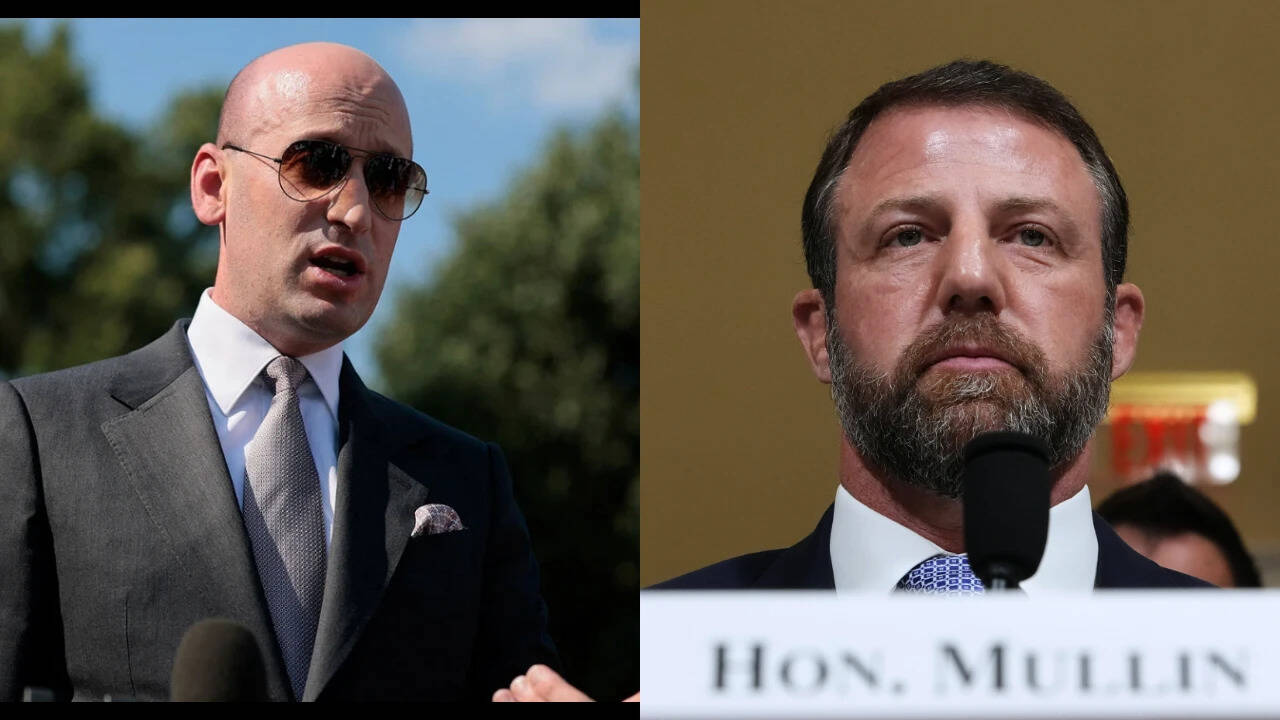
Centralized message discipline in executive branch governance operates as a strict principal-agent control system where unauthorized narrative deviation triggers immediate communication sanctions. When reports indicate that White House advisor Stephen Miller placed Department of Homeland Security (DHS) Secretary Markwayne Mullin in a "primetime timeout" following a Fox News appearance, the underlying dynamic is not personal friction—it is an institutional enforcement mechanism designed to eliminate principal-agent drift in high-stakes national messaging.
To analyze this dynamic accurately, one must separate reported claims from observable operational structures. Public reporting surrounding this episode centers on the allegation that a senior White House strategist restricted a cabinet official's tier-one television bookings after an interview generated internal administration dissatisfaction. Regardless of the granular internal deliberations—which remain opaque outside anonymous media attributions—the mechanism itself represents a classic case of executive communications governance.
The Principal-Agent Problem in Executive Communications
In political and organizational economics, the principal-agent problem occurs when an agent (a cabinet secretary or agency head) acts on behalf of a principal (the President and the central White House apparatus) while possessing distinct operational incentives, localized pressures, or divergent rhetorical instincts.
Cabinet secretaries occupy a structurally dual role:
- Operational Administrators: They manage massive federal bureaucracies, congressional oversight committees, and operational budgets.
- Media Surrogates: They serve as public-facing validators who project administration policy onto national broadcast networks.
The friction arises when the rhetorical requirements of operational management collide with the ideological or strategic priorities of the central communications office. In a media environment dominated by cable news ecosystems, a single unscripted phrase or poorly calibrated framing during a primetime broadcast alters the immediate news cycle. From the perspective of centralized White House strategists, an off-message cabinet interview imposes a direct reputational externality on the administration: the central staff must expend political capital and media cycles clarifying, walking back, or contextualizing the surrogate's remarks rather than advancing the primary legislative or executive agenda.
Anatomy of the "Primetime Timeout" Mechanism
Restricting a cabinet official from high-visibility television appearances—colloquially termed a "primetime timeout"—functions as a calibrated tier-one sanction within White House communications management. Rather than escalating immediately to formal personnel dismissal, which carries severe Senate confirmation costs and signals institutional instability, central strategists utilize media access throttling as an intermediate corrective tool.
This containment protocol operates through four sequential stages:
- Detection of Narrative Variance: Communications monitors evaluate surrogate appearances against pre-approved talking points and strategic framing objectives. Variance occurs when a surrogate introduces unauthorized policy speculation, adopts a defensive posture on a core administration priority, or inadvertently validates an opposing framing.
- Booking Freeze Implementation: The White House Office of Communications and senior strategic advisors exercise centralized clearance authority over cabinet-level national media bookings. Implementing a freeze involves revoking pre-clearance for tier-one outlets (such as primetime cable slots on Fox News, major network Sunday shows, or flagship broadcast interviews).
- Recalibration and Re-briefing: During the suspension window, the surrogate is restricted to non-broadcast duties, localized press, or internal operational briefings. Communications staff conduct messaging alignment sessions to re-establish strict boundaries on permissible talking points.
- Controlled Re-entry: Once strategic alignment is verified, the official is gradually reintroduced to lower-risk media environments—such as friendly regional radio or print backgrounders—before regaining access to live primetime television.
Why Primetime Cable Interviews Carry Asymmetric Risk
Not all media appearances carry equal strategic weight. A printed quote in a trade publication allows for editorial context and careful phrasing, whereas live primetime television introduces acute information asymmetry and real-time execution risk.
Live broadcast interviews compress decision-making into milliseconds. Under aggressive or unexpected questioning, a surrogate cannot consult legal counsel or policy advisors. Three structural vulnerabilities make primetime cable particularly hazardous for cabinet officials:
- The Soundbite Extraction Effect: Modern digital media ecosystems isolate ten-to-fifteen-second video clips from ten-minute interviews. Even if an official articulates an accurate policy position across nine minutes of discussion, a single imprecise sentence becomes the dominant artifact circulated across social platforms and competing networks.
- Audience Segmentation Mismatch: Primetime cable audiences—particularly on networks closely watched by the administration's core political base—evaluate surrogates on ideological precision and rhetorical conviction. A cabinet secretary accustomed to the bipartisan, procedural language of congressional hearings often struggles when transitioning to the high-contrast rhetoric expected in primetime commentary slots.
- Institutional Authority Amplification: When a DHS Secretary speaks on border security, immigration enforcement, or domestic threat posture, markets, foreign governments, and domestic constituencies treat those words as formal executive policy rather than personal commentary.
Centralized vs. Decentralized Communications Models
Administrations historically oscillate between two primary architectures for managing cabinet communications. Understanding these models clarifies why enforcement actions like booking freezes occur more frequently under tightly centralized regimes.
The Centralized Hub-and-Spoke Model
In this architecture, the White House senior staff—specifically top policy and communications advisors—acts as the sole clearinghouse for all major messaging. Cabinet agencies are treated as execution arms rather than autonomous political entities.
- Advantage: Produces unified, disciplined messaging across all federal departments, maximizing narrative impact during major policy pushes.
- Limitation: Creates severe bottlenecks. When every media booking and talking point requires central approval, agencies lose the agility to respond rapidly to breaking operational crises in their specific domains.
The Decentralized Federalist Model
In this model, cabinet secretaries maintain independent press operations and exercise broad discretion over their public appearances, coordinating with the White House primarily on major presidential initiatives.
- Advantage: Enables rapid, domain-specific communication during emergencies and allows secretaries to cultivate independent relationships with press corps and lawmakers.
- Limitation: Generates frequent internal contradictions, public turf battles, and conflicting policy signals that erode the administration's overall credibility.
When a senior strategist intervenes directly to bench a cabinet secretary from primetime television, it signals a decisive enforcement of the centralized hub-and-spoke model. The operational priority is clear: message uniformity supersedes individual cabinet autonomy.
Distinguishing Verified Facts from Analytical Inference
Rigorous analysis requires maintaining a strict boundary between documented reporting and structural deduction.
- What is established in public reporting: Media accounts attributed to anonymous sources inside the administration claim that Stephen Miller, operating as a central architect of the administration's policy and messaging strategy, reacted negatively to DHS Secretary Markwayne Mullin's performance during a Fox News interview and subsequently restricted his primetime television bookings.
- What remains unverified: Because White House internal communications directives are rarely documented in public records, the exact duration of any booking restriction, the specific internal exchanges between Miller and Mullin, and the precise threshold of dissatisfaction that triggered the decision remain reliant on unnamed press sources rather than primary-source documentation.
- What is structurally certain: Regardless of the private interpersonal dynamics, centralized booking clearance is a standard, verifiable instrument of modern White House communications operations. Senior advisors routinely gatekeep access to flagship broadcast platforms to enforce ideological and rhetorical conformity across the executive branch.
The Strategic Cost Function of Publicized Discipline
While internal media throttling is common across administrations, the public leaking of a "primetime timeout" introduces a distinct second-order dynamic. When internal disciplinary measures become public news stories, the administration absorbs a measurable strategic cost.
First, publicizing a surrogate's suspension shifts media coverage from substantive policy execution to internal palace intrigue. Instead of debating DHS operational metrics or legislative priorities, commentators focus on perceived friction between the West Wing and a major cabinet department.
Second, public rebukes weaken the external bargaining power of the cabinet secretary. Foreign counterparts, congressional committee chairs, and career civil servants within DHS closely monitor whether a secretary enjoys the full confidence of the White House inner circle. If an agency head is publicly perceived as sidelined by senior White House staff, institutional subordinates may slow-walk directives, anticipating potential leadership instability.
Third, excessive reliance on punitive booking freezes creates a chilling effect among other surrogates. Cabinet officials who fear public humiliation or sudden sidelining tend to adopt overly cautious, scripted delivery during live interviews. Overly defensive surrogates appear unconvincing on television, paradoxically degrading the exact persuasive impact the White House seeks to maximize.
Operational Limitations of Surrogate Containment
No communications control system eliminates risk entirely. Relying on media bans as a primary corrective tool carries inherent operational constraints:
- Loss of Domain Expertise on Air: Bench-warming a cabinet secretary removes the administration's highest-ranking subject-matter authority from public debate during critical news cycles, forcing lower-ranking spokespeople or generalist political surrogates to defend complex operational policies.
- Congressional Testimony Exposure: The White House can block a cabinet official from appearing on cable news, but it cannot prevent them from testifying under oath before House and Senate oversight committees. A surrogate who struggles with unscripted media questioning remains equally vulnerable during televised congressional hearings, where communications staff cannot intervene.
- Escalation Ceiling: A booking freeze works only as an intermediate warning. If an official repeatedly diverges from central messaging after returning to air, the White House faces a binary choice between tolerating the drift or executing a disruptive cabinet removal.
Strategic Protocol for Surrogate Alignment
To prevent principal-agent drift without incurring the reputational costs of public disciplinary leaks, executive communications operations must shift from reactive punishment to pre-broadcast structural alignment.
- Enforce Pre-Broadcast Red-Teaming: Replace passive talking-point memos with mandatory, adversarial simulation sessions prior to any tier-one live broadcast. Surrogates must be drilled specifically on the three most damaging counter-arguments circulating in opposing media ecosystems before stepping onto a set.
- Segment Surrogate Deployment by Medium: Match the official's rhetorical profile to the specific demands of the medium. Deploy policy-heavy cabinet secretaries to long-form, structured interviews or print briefings where technical precision is rewarded, while reserving high-velocity primetime cable slots for surrogates specifically trained in rapid soundbite defense.
- Contain Enforcement Internally: Maintain strict operational secrecy around booking adjustments. Adjust surrogate rotation schedules quietly through standard White House booking channels rather than allowing disciplinary framing to leak to political reporters, preserving the cabinet official's institutional authority while enforcing strict message discipline behind closed doors.