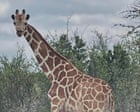
You can't hide a ten-foot-tall, 1,200-pound animal for two weeks. Except, apparently, you can.
When Gracie, a three-year-old reticulated giraffe, vanished into the Texas Hill Country, the internet did what it always does. It turned the situation into a circus. Rumors flew, fake news reports declared her found, and social media armchair detectives spent days spinning wild theories. Real County Sheriff Nathan Johnson didn't hold back, publicly blaming the chaos on internet trolls spreading misinformation from their basements. For a different perspective, consider: this related article.
The real story isn't about an animal escaping on a wild adventure. It's about how easily a massive creature can blend into the rugged Texas terrain, the surprisingly complex world of private exotic ranches, and what it actually takes to safely recover an animal that weighs more than a grand piano.
The Disappearance at Cedar Hollow Ranch
Gracie arrived at Cedar Hollow Ranch in Leakey, Texas, back in May. She was a newcomer to the property, which sits about 100 miles west of San Antonio. On June 12, she did something none of the ranch's other giraffes had ever done. She wandered up into a steep, rocky ledge to feed on the trees growing out of the stone. Similar reporting on this matter has been provided by NPR.
When she decided to head back down, she took a wrong turn. She came down on the wrong side of an open gate.
Ranch owner Vick Jones explained that the specific area lacked fencing. Building barriers in that part of the Texas Hill Country requires heavy machinery and jackhammering straight through solid rock. Because the other giraffes had always ignored the rocky ridge, the fence hadn't been built yet. Gracie kept walking in the wrong direction, and just like that, she was gone.
The search area spans thousands of acres of incredibly dense, heavily wooded, and remote land. It's a landscape packed with cedar trees, deep ravines, and rocky brush. To a human on the ground, a giraffe seems impossible to miss. But from the air or from a distance, the broken, spotted coat pattern of a reticulated giraffe acts as perfect camouflage against the scrubby Texas vegetation.
Jones initially launched helicopter searches covering 7,500 acres. For days, they found nothing. The search team was constantly playing catch-up, arriving at spots where sightings were reported days after Gracie had already moved on.
The Fake News and Pajama Trolls
By the second week of the search, the situation turned messy. A local television station published an online report claiming Gracie had been found safe. The news spread instantly across social media, bringing a collective sigh of relief from thousands of people following the story.
Except it wasn't true.
Sheriff Johnson had to scramble to correct the record, confirming that the giraffe was still very much at large. The station retracted the story, admitting they couldn't confirm the details. This prompted the sheriff's blunt comments about online misinformation.
The incident highlights a major issue with modern breaking news. In the rush to be first, verification gets pushed aside. People wanted a happy ending, so a rumor was packaged and sold as fact before anyone bothered to check with the ranch or local law enforcement.
Spotting a Needle in a Hill Country Haystack
The real breakthrough came on Friday morning, June 26. Vick Jones and pilot Jeff Hill of Concho Aviation took to the sky for another aerial sweep. Shortly before 10:00 AM, they spotted her.
Gracie was hanging out roughly four miles south of her enclosure on a remote piece of private property where nobody lives. She had set up camp near a pond and a creek, meaning she had easy access to fresh water. The area was packed with the exact kind of dense foliage she likes to eat.
According to the recovery team, Gracie didn't look stressed at all. Jones noted she was simply standing there, swishing her tail, and looking healthy. Sheriff Johnson joked that she had a "catch me if you can, suckers" attitude. She had spent a week living off the land, completely unbothered by the search party or the $5,000 reward hanging over her head.
The Logistics of Moving a 1,200-Pound Animal
Finding a giraffe is only half the battle. Getting her home is where the real work begins. You can't put a leash on a giraffe and walk it four miles through rugged, trackless brush.
The recovery process requires precision and expert veterinary care. The team can't just lasso her or spook her. If a giraffe panics and runs through rocky terrain, it can easily trip and break a leg, which is almost always fatal for an animal of that size.
Here is how the recovery team handles a situation like this:
- Sedation: A veterinarian must administer a precise dose of a sedative to calm the animal down without causing it to collapse completely in an unsafe area.
- Blinding: Workers place a specialized hood over the giraffe's eyes. Removing visual stimuli keeps the animal cooperative and prevents it from getting startled by the movement around it.
- Initial Transport: Because cars and standard trailers can't access the rugged terrain where Gracie was found, the team uses an open-pasture trailer to move her carefully out of the brush and onto a usable road.
- Final Transport: Once on solid ground, Gracie is transferred into a custom, extra-tall enclosed trailer designed specifically for transporting giraffes safely over long distances without risking injury to their necks or heads.
Exotic Animals on the Texas Range
While a giraffe wandering through Texas sounds bizarre to outsiders, locals are used to seeing strange wildlife. The Texas Hill Country has one of the highest concentrations of captive exotic animals in the United States.
Sheriff Johnson noted that over the years, his office has dealt with escaped wildebeests, water buffalo, monkeys, and zebras. Most of these escapes happen after major storms or floods destroy perimeter fencing. The climate and rugged environment of central Texas are surprisingly similar to the dry, semi-arid savannahs and grasslands of Africa, allowing these species to survive out on the range with relative ease.
Gracie's adventure is over, but it serves as a wake-up call for containment strategies on exotic ranches. Vick Jones confirmed that Gracie will remain in a secure, fully enclosed main pen for the immediate future. The ranch is bringing in equipment to begin the difficult process of jackhammering into the rocky ledge to install permanent fencing. If you manage exotic wildlife, you can't assume an animal won't explore a dangerous path just because previous animals ignored it. Security requires preparing for the unexpected before the animal exploits the gap.