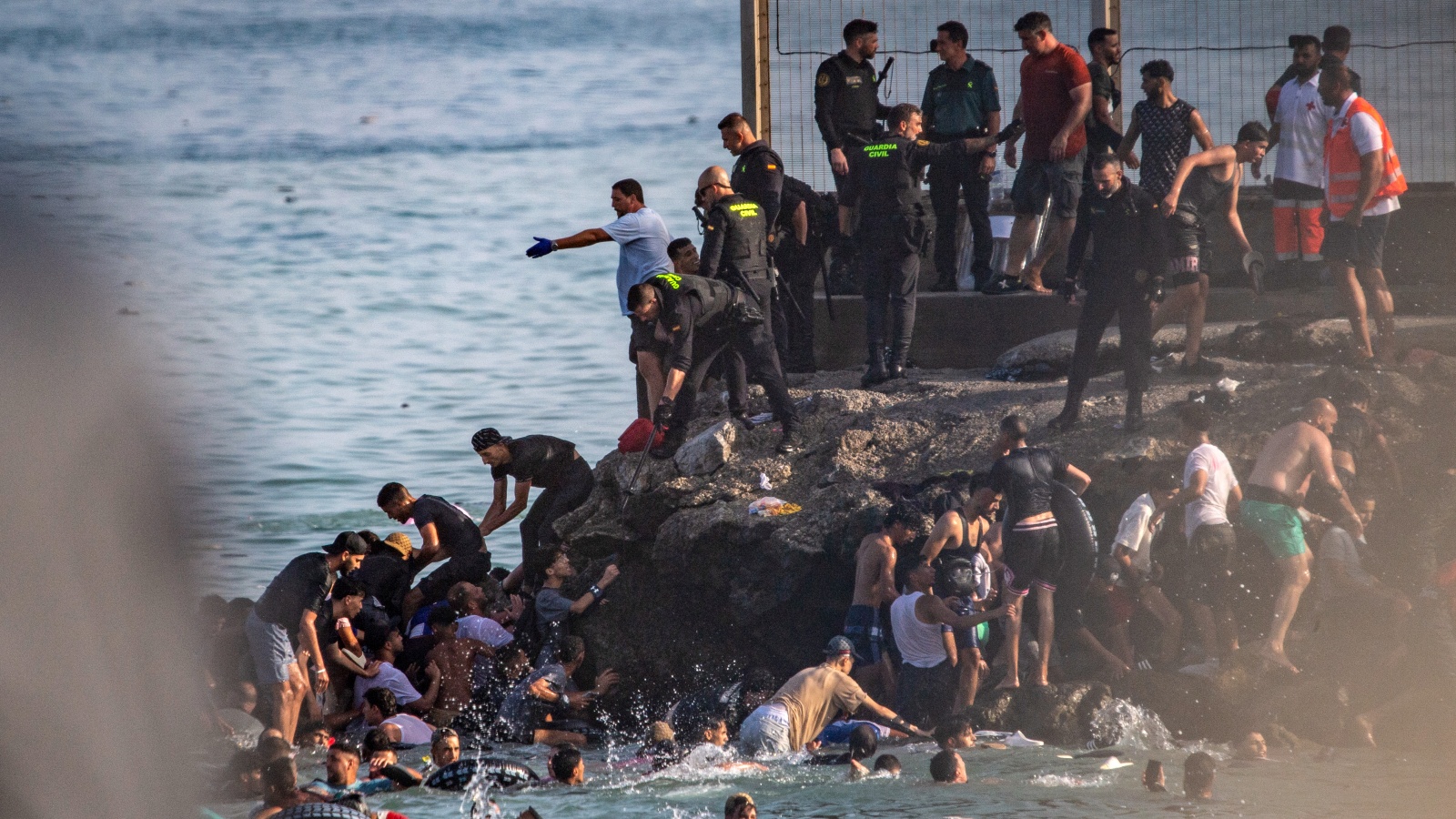
The standard media narrative surrounding the sudden mass border crossings into Spain’s Ceuta enclave reads like a predictable script written by algorithm. Thousands swim around breakwaters or scale double-fenced barriers, headlines scream about humanitarian crises, diplomats issue stern warnings, and pundits point fingers at bilateral diplomatic spats. Everyone treats the event as a spontaneous humanitarian eruption or a sudden failure of European perimeter defense.
They are wrong. They are asking the wrong questions, looking at the wrong metrics, and swallowing a sanitized version of geopolitical theater that completely ignores the structural mechanics of modern statecraft. If you found value in this piece, you should check out: this related article.
I have spent years watching policymakers panic over southern European borders while completely ignoring the actual incentive structures driving them. If you think Ceuta is merely a migration crisis, you are missing the entire chessboard. Ceuta is not a humanitarian accident. It is a pressure valve, a heavily instrumented bargaining chip, and a masterclass in transactional statecraft executed in plain sight.
The Lazy Consensus Must Die
Open any major newspaper covering a sudden surge of arrivals into Ceuta or Melilla, and you will find three default pillars of analysis: For another look on this development, refer to the recent coverage from NBC News.
- Economic desperation pushes desperate people past their breaking point.
- Sudden diplomatic friction between Spain and Morocco causes border authorities to momentarily look the other way.
- Europe needs more funding for border fences, patrol boats, and facial recognition tech to seal the gap.
This framing is intellectually lazy. It treats thousands of human beings as passive weather patterns rather than rational actors responding to precise incentives, and it treats sovereign governments as clumsy bureaucracies rather than cold-blooded negotiators.
Let us look at the actual physics of these events. Borders do not just fail because a fence is low or a beach is wide. Borders open when the cost of maintaining them temporarily exceeds the political value of keeping them closed for the gatekeeper. Morocco does not police its northern coastline out of altruism toward Madrid or Brussels. It does so because of a complex web of agricultural trade agreements, fishing quotas, counter-terrorism intelligence sharing, and financial aid packages dished out by the European Union.
When a sudden surge happens, it is rarely because border guards fell asleep. It is because a message was sent.
The Geopolitics of the Turnstile
To understand Ceuta, you have to stop looking at it as an immigration story and start looking at it as a leverage story.
Ceuta and Melilla are geographic anomalies. They are two Spanish autonomous cities located on the northern coast of Africa, sharing direct land borders with Morocco. They are the only European Union land borders on the African continent. This creates a permanent geopolitical friction point. For Morocco, these enclaves are a constant reminder of colonial history and a lingering nationalist sore spot. For Spain and the European Union, they are prized strategic footholds and symbolic testing grounds for the Schengen Area's external perimeter.
Because of this unique geography, Morocco holds an effective monopoly on the intake valve. When Rabat wants leverage in a bilateral dispute—whether over the legal status of Western Sahara, EU agricultural tariffs, or diplomatic snubs—it does not declare war. It simply lowers its guardrail.
During the massive surge of May 2021, when over 8,000 people crossed into Ceuta in a matter of hours, the immediate catalyst was Spain's decision to hospitalize Brahim Ghali, the leader of the Polisario Front fighting for Western Sahara's independence. Rabat was furious. Within days, Moroccan auxiliary forces simply stepped away from the beaches. The message was unmistakable: if you cross our diplomatic red lines, we stop holding the door shut.
To call this a border security failure is like saying a store owner failed to lock their door when they intentionally propped it open to make a point to a landlord. The security apparatus did not fail; it was weaponized through tactical passivity.
The Human Cost of Policy Theater
The tragedy here is not just that millions are misled by lazy journalism; it is that human lives are weaponized as diplomatic collateral.
Thousands of young men, and sometimes families, are fed rumors or direct signals on encrypted messaging apps about when and where a border will momentarily grow porous. They pay smugglers, risk their lives in freezing waters or scaling barbed wire, and endure horrific psychological trauma, all to serve as pawns in a high-stakes game between capitals that exchange handshakes behind closed doors a week later.
When journalists focus exclusively on the tear gas, the rubber bullets, and the sobbing arrivals on the beach, they play directly into the hands of the architects of this theater. They frame the issue as a humanitarian emergency requiring more cameras, more wire, and more surveillance hardware.
More hardware solves nothing when the gatekeeper holds the key and uses it as a bargaining chip. Building a higher fence against a state-managed pressure valve is like putting a stronger lock on your front door while the person who owns the house next door is holding the master key and turning it from the hallway.
Dismantling the Border Security Industrial Complex
The standard policy prescription for these enclaves is always the same: more money, more tech, more deterrence. Brussels sends millions of euros to Rabat for border management. Spain upgrades its perimeter security with thermal cameras, anti-climbing mesh, and biometric tracking.
It does not work. In fact, it often makes the situation worse by concentrating desperation into more dangerous routes or driving up the price and violence of smuggling networks.
Here is the uncomfortable truth that nobody in Brussels or Madrid wants to admit: security apparatuses cannot out-engineer geopolitical leverage. As long as a neighboring state can use migration as a political pressure valve, no amount of concrete or razor wire will secure the perimeter. The vulnerability is structural, not technical.
To fix the approach, policymakers need to stop treating migration management as a technical police problem and start treating it as a diplomatic reality. That means moving away from transactional, extortion-based border deals where Europe pays a third-party state to act as its jailer. When you outsource your border enforcement to an authoritarian regime, you hand them a loaded gun and point it directly at your own head. Every single time Rabat wants a concession on trade or territorial recognition, it knows it can pull the trigger by simply looking the other way at Bab Sebta.
The Unspoken Trade-off
My contrarian take comes with a heavy dose of realism, and I will be the first to admit its brutal downside. If Europe stops outsourcing its borders and refuses to be blackmailed by migration pressure, it must accept a different reality: transparency, accountability, and the painful process of genuine diplomatic normalization.
You cannot bully or bribe your way into a secure border. You either build a sustainable, rules-based economic partnership that makes stability more profitable than disruption for both sides, or you accept that you are living on a fault line where the earth can—and will—shake whenever a diplomat gets insulted.
Ceuta is not a warning about failing fences. It is a mirror reflecting the moral bankruptcy of outsourcing sovereignty to the highest bidder. Until we stop buying into the comforting lie of the spontaneous migration surge, we will keep pouring money into fences while the people holding the keys continue to laugh from the other side.
Stop asking how the migrants got over the wall. Start asking who told them they could climb it, and why we keep paying them to do it.