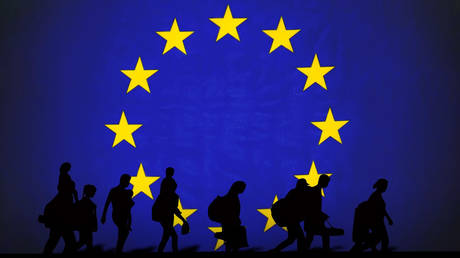
Walk into any Brussels think tank, open a broadsheet in Berlin, or listen to a nightly broadcast in Paris, and you will hear the exact same lazy panic. The narrative is frictionless, well-worn, and utterly bankrupt. We are told that Europe is witnessing an unprecedented demographic flood, an existential tidal wave of migration that threatens to drown the continent's cultural identity, bankrupt its welfare states, and tear down its borders.
It is a neat, terrifying story. It is also entirely wrong.
Europe’s primary crisis is not the arrival of human beings seeking work, safety, or a future. The continent’s fatal flaw is a paralyzing addiction to administrative inertia, a dysfunctional labor market model frozen in the amber of the 1970s, and a pathological refusal to treat human mobility as an economic asset rather than a permanent state of emergency.
Let us dispense with the fairy tales immediately. Europe does not have a migration crisis. It has an institutional competence crisis.
The Demographic Trap Nobody Wants to Name
Every mainstream debate on this topic begins with a fraudulent premise. Commentators point to arrival statistics at Lampedusa or the Evros river, gasp at the sheer volume, and treat these figures as an external shock hitting a pristine, self-sustaining ecosystem.
That ecosystem does not exist.
Look at the demographic ledger. The fertility rate across the European Union sits stubbornly around 1.5 births per woman, well below the 2.1 replacement threshold. Germany's workforce is aging off a cliff. Italy is losing towns to depopulation faster than a rust-belt American state. By 2050, the ratio of retirees to active workers in several Western European nations will approach parity.
When you point this out, the mainstream response is a shrug followed by a fantasy: automation, AI, and robotics will fill the gap.
I have spent the last decade auditing industrial supply chains and labor deployment strategies across the continent. Robots do not pay income tax. Industrial automation does not buy apartments in Lyon, fund municipal pension funds in Madrid, or staff night shifts in aging municipal hospitals. You cannot automate away the physical reality of a shrinking tax base supporting an exploding population of retirees.
The continent desperately needs working-age bodies. Yet, the entire political apparatus is constructed to repel, delay, and degrade the very people showing up at the door to do the work.
The Cost of Paperwork
Imagine a scenario where a multinational corporation decides to freeze its hiring pipeline for two years, forces every applicant to sleep on the pavement while filing three dozen forms in a language they do not speak, and then fines its own managers if they actually hire anyone. Wall Street would short the stock within the hour.
Yet this is the exact operational model of European asylum and migration management.
Brussels and national capitals spend billions of euros on border walls, offshore detention fantasies, and border-force contracts with authoritarian regimes. What do they get for this capital expenditure? A completely broken administrative pipeline. Asylum seekers sit in bureaucratic limbo for years, legally barred from taking formal employment, draining public resources while rotting in legal uncertainty.
This is not a border control failure. It is a self-inflicted wound.
When you trap hundreds of thousands of people in legal purgatory, you guarantee the very black-market outcomes you claim to fear. Unscrupulous employers exploit undocumented labor because the state has criminalized legal integration. Organized crime networks thrive precisely because legal pathways for seasonal and low-skilled labor have been choked off by politicians terrified of populist tabloids.
The economic cost of this inefficiency is staggering. A functioning migration system would fast-track work permits within thirty days, match arrivals directly to verified labor shortages in construction, agriculture, and elder care, and integrate newcomers into the tax base immediately. Instead, Europe chooses to spend a fortune manufacturing an illegal underclass, and then acts surprised when the underclass behaves like an underclass.
The Cultural Panic and Its Hypocrisy
The emotional core of the mainstream migration panic always drifts back to culture. We are told that European civilization is uniquely fragile, uniquely vulnerable to dilution by foreign values, languages, and religions.
This argument relies on a historical amnesia so profound it borders on clinical delusion.
European culture has never been a static museum piece preserved under glass. It is a violent, churning synthesis of trade, conquest, migration, and exchange that has been mutating for millennia. The modern European diet, language, architecture, and scientific foundation are products of continuous cross-border fertilization.
More to the point, look at the hypocrisy of the cultural protectionist argument. The same politicians who weep over the potential loss of European traditions are more than happy to staff their agricultural sectors, delivery networks, and gig-economy platforms with unregistered, unprotected migrants whom they can discard when economic conditions sour.
True cultural confidence does not cower behind barbed wire. It assimilates, adapts, and absorbs. When you treat newcomers as temporary intruders rather than permanent citizens-in-waiting, you create the very social ghettoes and parallel societies that nativists love to exploit for campaign ads. Integration is a two-way street, and Europe's municipal leaders have frequently abandoned their end of the bargain, ghettoizing migrant communities in suburban concrete blockades while denying them political representation and economic mobility.
What Real Reform Looks Like
If we are going to fix this, we have to stop talking about "stopping the boats" or "managing the flow" as if human beings were weather patterns.
First, scrap the Dublin Regulation entirely. It is a dead letter designed to punish frontline Mediterranean states like Italy, Greece, and Spain while allowing Northern European nations to posture about human rights from a safe distance. Replace it with a centralized, EU-wide processing agency that assesses claims in weeks, not years, and distributes arrivals equitably across all member states based on economic capacity and labor demand.
Second, decouple asylum processing from economic migration channels. Treat them as two entirely separate administrative vectors. If an economy needs plumbers, software engineers, and agricultural laborers, create direct, transparent talent pipelines from source countries. Make it easier to migrate legally than illegally, and the smuggling networks will collapse overnight.
Third, empower municipal governments over national bureaucracies. National capitals in Paris, Rome, and Berlin are paralyzed by culture-war posturing. Cities, however, know exactly how many workers they need to keep their transit systems running, their schools open, and their hospitals staffed. Let local authorities sponsor and integrate workers directly.
The Final Reckoning
Europe stands at a historic crossroads, to borrow a tired cliché that I despise. But the reality is stark.
The continent can continue down its current path: pumping billions into militarized borders, feeding a bloated human-smuggling industry, nursing an aging, uncompetitive demographic profile, and pretending that a fortress mentality will hold back global economic gravity.
Or it can grow up.
It can accept that the rest of the world is moving, that borders are porous by nature, and that human mobility is the defining engine of twenty-first-century economic survival.
The future does not belong to the gatekeepers. It belongs to those who know how to build. Stop treating migration as a crisis to be solved, and start treating it as the raw material of a continent refusing to die.


