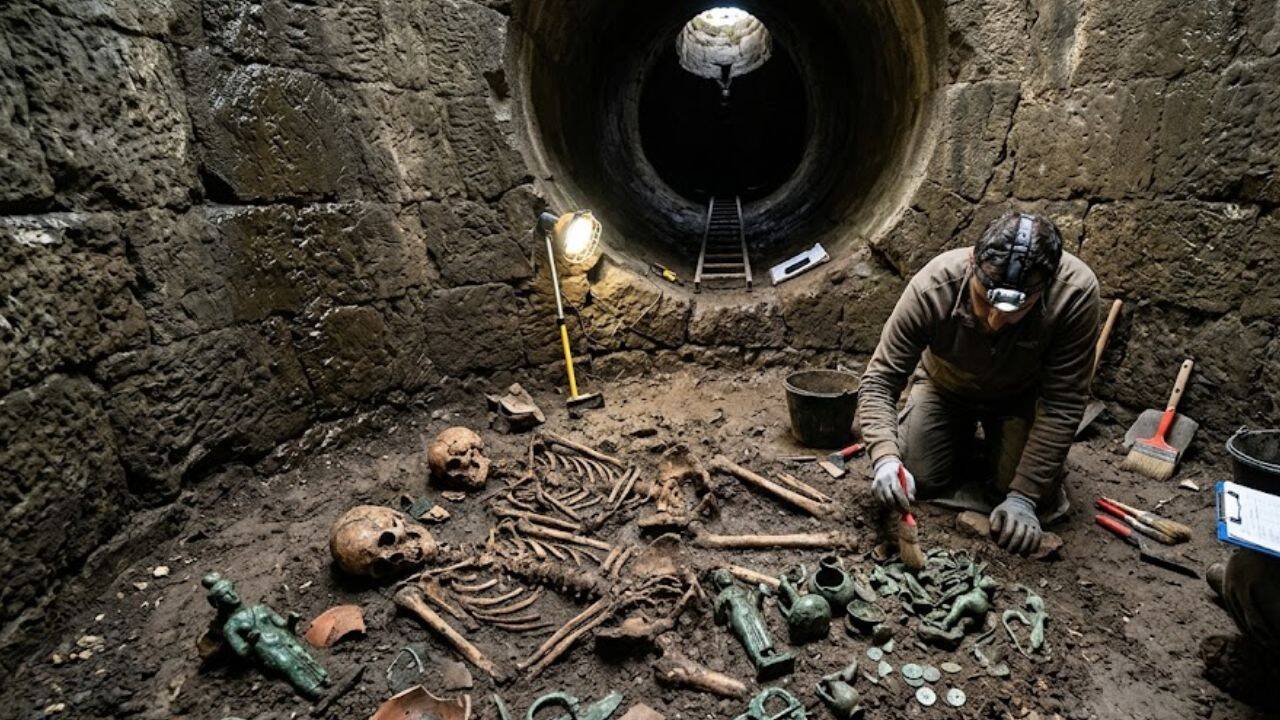
The recent discovery of a ritual well at the Etruscan site of Kainua, near modern-day Marzabotto, provides a quantifiable baseline for understanding the intersection of hydraulic infrastructure and sacred geography in the late 6th to early 5th centuries BCE. By identifying distinct depositional layers—specifically, the intentional placement of bronze votive offerings at the structure's inception and the subsequent inclusion of human remains at its closure—archaeologists have established a temporal bracket for a lifecycle ceremony. This is not merely an archaeological curiosity; it is evidence of a calculated urban planning strategy where utility and theology were synthesized to anchor a new settlement.
The Foundation Protocol
Urban centers in the ancient world required more than just geographical suitability; they required legitimacy. At Kainua, the placement of the well within a dedicated sacred precinct, adjacent to temples honoring the deities Tinia and Uni, suggests that the management of water was a primary instrument of civic authority. Expanding on this topic, you can also read: Operational Failure Analysis of Flight VN34 Runway Excursion.
The bronze statuettes and rare plate recovered from the well’s base serve as indicators of a deliberate foundation ritual. The deposition of high-value metalwork at the point of origin functions as a sunk-cost signal to the community. By embedding these bronze assets into the well’s architecture, the founders were not merely performing a religious act; they were establishing a permanent, non-recoverable link between the city’s water source and its spiritual infrastructure. This serves as a physical manifestation of a social contract: the city, through its gods, guarantees the viability of its water, provided the ritual lifecycle of that infrastructure is observed.
The Dual-Phase Chronology
The most critical analytical finding at the Kainua site is the evidence of two distinct temporal phases. The initial deposition of bronze artifacts correlates with the city’s establishment in the late 6th or early 5th century BCE. Conversely, the presence of two adult human skeletons represents a secondary, distinct event, associated with the decommissioning or closure of the structure. Experts at The Points Guy have also weighed in on this trend.
This bifurcation allows us to define the life-cycle of sacred infrastructure as a system with a clear start and end point:
- Inception Phase: Marked by high-value, durable votive deposits (bronze), emphasizing continuity, prosperity, and connection to the divine.
- Operational Phase: The period of practical utility where the structure served as a water source while retaining its sacred status, likely reinforced by recurring, lower-intensity rites or the memory of the foundation deposit.
- Decommissioning Phase: Marked by the terminal placement of human remains, signaling the intentional cessation of the structure’s sacred and functional utility.
The absence of evidence suggesting violent sacrifice at the moment of closure is significant. It directs the investigation toward a ceremonial burial—a ritualized conclusion that likely mirrored the solemnity of the foundation. The skeletons act as markers, essentially "locking" the well in a state of sacred closure, preventing its future repurposing by unauthorized entities.
Hydraulic Theology and City Planning
The spatial organization of Kainua confirms that the well was not a peripheral asset. Its location within the sacred area, in direct proximity to temples dedicated to the supreme deities Tinia and Uni, indicates that the water supply was a core pillar of the state-cult. In societies where the environment is unpredictable, the sanctification of a well functions as a risk-mitigation strategy. By assigning the water source to divine oversight, the governing elite managed social anxiety regarding resource stability.
The presence of the cult of Vei—linked to agricultural and human fertility—further contextualizes the well’s function. If the well was tied to Vei, the water served as a medium for both civic sustenance and biological reproduction. The foundational bronzes were therefore a proactive investment in the city’s future health, while the human remains at the closure point marked a final accounting, ensuring the protection of the space even after it ceased to provide water.
Operational Constraints and Future Analysis
The success of the Kainua excavation was enabled by a 14-day extension funded by the Italian Ministry of Culture. This illustrates the high sensitivity of archaeological data to operational duration. Had the excavation been terminated on its original schedule, the causal relationship between the well’s foundation, its operational life, and its final closure would have remained fragmented.
Strategic interpretation now rests on the upcoming laboratory analysis of the recovered bronzes and skeletal remains. To move beyond descriptive archaeology, researchers must prioritize:
- Isotopic and Paleopathological Profiling: Determine the provenance and metabolic history of the individuals found in the closure layer to identify their social status and potential roles in the city's hierarchy.
- Metallurgical Sourcing: Map the origin of the bronze components to trace the trade networks that supported Kainua’s early development.
- Spatial Correlation: Map the well’s exact distance from the primary temples to quantify the "sacred footprint" of the water cult in relation to the city’s broader civic grid.
The Kainua discovery reinforces that for the Etruscans, the development of urban space was an exercise in synchronized engineering and piety. Future excavations should treat infrastructure not as an ancillary feature of the city, but as the primary evidence for the political and religious frameworks that rendered ancient life viable. Focus must remain on the sequence of deposits, as the transition from metallic votives to human remains provides a definitive index for how these communities reconciled the necessity of natural resources with the requirements of the afterlife.