History prefers a clean narrative, especially in the hard sciences. We are taught to celebrate the lone genius who falsifies a theory in a flash of insight, or the charismatic physicist whose lectures fill halls. But the actual machinery of scientific progress is often built by outsiders who refuse to compromise on rigor, even when it alienates them from the establishment.
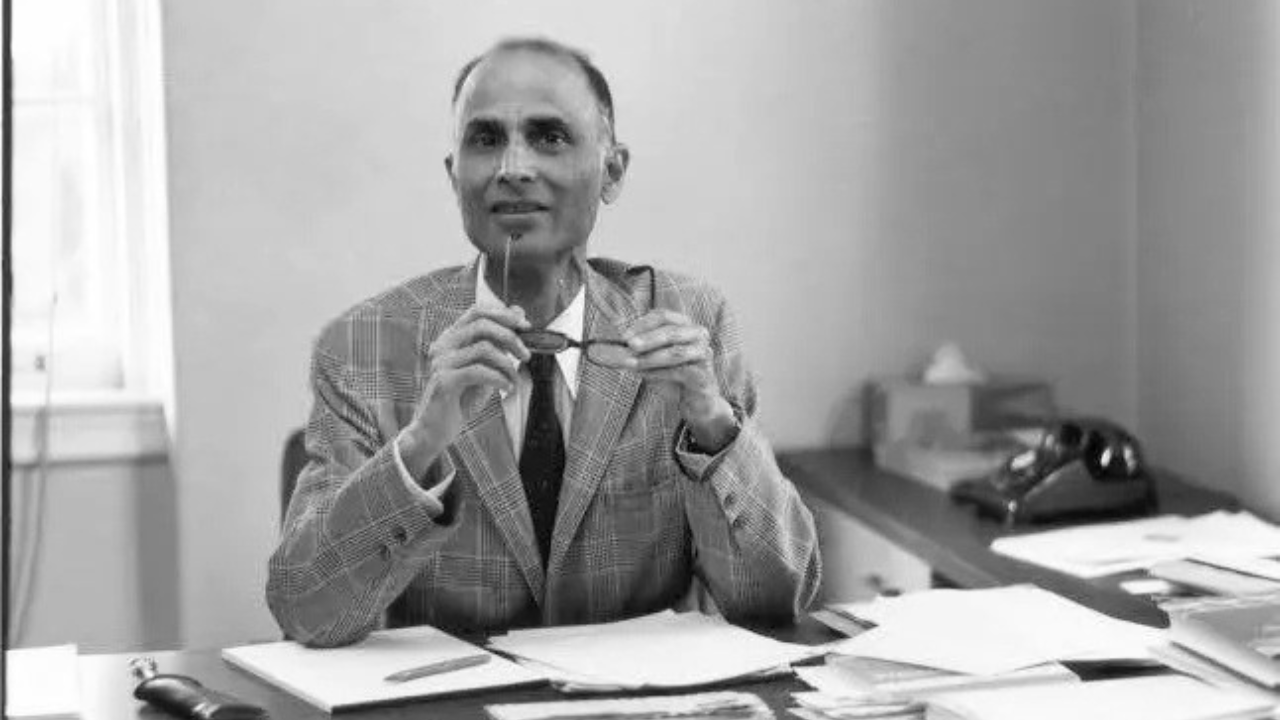
Harish-Chandra Chandrasekharan was one of those outsiders. While popular history frequently overlooks him, his mathematical framework solved a fundamental crisis in quantum mechanics, effectively correcting the trajectory of Nobel laureate Paul Dirac and providing the structural backbone for modern particle physics. If you liked this piece, you should look at: this related article.
The mathematical physicist did not just contribute to the field. He fundamentally rebuilt representation theory for semisimple Lie groups, creating a language that allowed physicists to map the chaotic, infinite-dimensional realities of subatomic particles onto structures that human mathematics could actually compute. Without his grueling, thousands-of-pages-long proofs, the standard model of physics would lack its rigorous mathematical justification. Yet, his name remains confined to advanced graduate textbooks, a casualty of an academic culture that often prioritizes immediate, flashy applications over foundational truth.
The Collision at Cambridge
The intersection of physics and mathematics is a volatile borderland. In the 1940s, Paul Dirac was the undisputed titan of this space. He had predicted the existence of antimatter using equations that matched the physical world beautifully, but he operated largely on intuition. Dirac was content to bypass mathematical subtleties if the equations yielded the correct physical answers. For another perspective on this development, check out the latest update from Gizmodo.
Enter Harish-Chandra. Arriving at the University of Cambridge from India in 1945, the young researcher was assigned to Dirac as a doctoral student. The relationship was not one of master and disciple, but rather a clash of fundamental philosophies.
Harish-Chandra quickly noticed that Dirac’s work relied on shaky mathematical foundations. Specifically, Dirac was working with infinite-dimensional representations, a territory where normal algebraic rules break down. When Harish-Chandra pointed out gaps in the logic, Dirac famously responded that he was not interested in proofs, only in nature.
This response triggered a profound shift in the young researcher. He realized that physics, when stripped of absolute mathematical rigor, was building castles on sand. He abandoned physics entirely to become a pure mathematician, adopting a standard of proof so exacting that it exhausted his contemporaries. His departure was not a retreat; it was a crusade to fix the tools that physicists were using blindly.
The Crisis of the Infinite
To understand why Harish-Chandra’s defection mattered, one must look at the problem of infinity in quantum mechanics. When physicists attempt to calculate what happens when two particles collide, the equations frequently spit out infinite values. In the mid-twentieth century, this was the great wall of physics.
Physicists developed a workaround called renormalization, a process of subtracting infinities to leave behind a finite, usable number. It worked in practice, but it was mathematically vulgar. Richard Feynman himself called it a "dippy process" and "hocus-pocus."
Harish-Chandra approached the problem from the opposite direction. Instead of fixing the equations after they broke, he sought to understand the underlying symmetries of space and time that governed these particles. This meant diving into the study of Lie groups, which are mathematical structures that describe continuous symmetries, like the rotation of a sphere or the transformation of space-time.
[Continuous Symmetries (Lie Groups)]
       │
       ▼
[Infinite-Dimensional Representations]
       │
       ▼
[Harish-Chandra's Plancherel Formula] ──► (Eliminates mathematical "hocus-pocus")
The challenge lay in infinite-dimensional representations of these groups. While a finite system, like a crystal lattice, has a limited number of ways it can be rotated or transformed, a quantum particle existing in a continuous field has infinite degrees of freedom. Mathematically representing this reality requires tracking an infinite number of variables simultaneously.
For decades, mathematicians believed that classifying these infinite-dimensional representations for complex, semisimple Lie groups was impossible. The calculations were too dense, the paths too fractured. Harish-Chandra spent nearly three decades in near-isolation at the Institute for Advanced Study in Princeton, working up to fourteen hours a day, to prove them wrong.
The Iron Will of a Mathematical Masterwork
The sheer volume of Harish-Chandra’s output is staggering. His collected papers span thousands of pages, characterized by a dense, relentless style that contains virtually no conversational prose. He treated the derivation of these formulas as a structural necessity, building a massive, interconnected architecture where every stone had to be perfectly square.
His crowning achievement was the determination of the Plancherel formula for semisimple Lie groups. In simple terms, the Plancherel formula allows mathematicians to break down complex, chaotic functions on a group into a combination of simpler, irreducible representations. It is the mathematical equivalent of taking a complex acoustic wave and separating it into its individual, pure musical notes.
       [Complex, Chaotic Function]
                   │
                   ▼ (Plancherel Formula)
  [Note A] + [Note B] + [Note C] ... (Irreducible Parts)
Before Harish-Chandra, this could only be done for simple, bounded systems. He figured out how to do it for systems that stretch to infinity, capturing the "discrete series" of representations that others had missed. This gave physicists a precise mathematical dictionary. When a physicist calculates the state of a quantum system under the influence of Lorentz transformations (the transformations of special relativity), they are using the exact pathways Harish-Chandra mapped out.
His peers were awed by his work ethic, which eventually took a severe toll on his health. He suffered his first heart attack in his late forties but refused to slow down, viewing his work not as a job, but as an obligation to the truth. He frequently noted that he felt he was discovering truths that already existed in the universe, rather than inventing them, and that any lack of clarity was a personal failure of vision.
Why the History Books Forgot Him
If Harish-Chandra’s work is so foundational, why is he not a household name alongside Feynman, Dirac, or his contemporary Harish-Chandra's friend, Freeman Dyson? The answer lies in the widening chasm between pure mathematics and applied physics, combined with the geopolitical biases of mid-century academia.
First, Harish-Chandra’s work was too difficult for the average physicist. He did not write practical guides or provide quick shortcuts for calculations. He wrote for eternity. Because he codified his work in the language of rigorous topology and algebra, physicists often preferred to use intuitive approximations rather than wading through his massive proofs. It took decades for the physics community to realize that the approximations they were using were actually just special cases of Harish-Chandra’s overarching theories.
Second, he lacked the desire for public acclaim. He did not write popular science books, he gave few interviews, and he avoided the political maneuvering that often secures major prizes. He was awarded the Cole Prize by the American Mathematical Society and was elected a Fellow of the Royal Society, but the ultimate recognition, the Fields Medal, eluded him due to a technicality regarding the age limit and the timing of his most massive breakthroughs.
Finally, there is the undeniable factor of his origin. Coming from India in the colonial era, Harish-Chandra had to establish his authority in Western institutions that were notoriously Eurocentric. While he spent most of his career at Princeton, he always remained somewhat apart from the academic social circles that manufactured scientific fame.
The Modern Revival
Today, the relevance of Harish-Chandra’s work is surging once again, driven by fields he could not have anticipated during his lifetime. The rise of string theory and quantum loop gravity has forced physicists to grapple even more deeply with infinite-dimensional spaces. As they try to construct a quantum theory of gravity, the smooth geometric structures of Einstein's relativity must be reconciled with the discrete, probabilistic nature of quantum mechanics.
This reconciliation requires the exact tools that Harish-Chandra forged. His work on Lie groups provides the mathematical language necessary to describe the symmetries of ten-dimensional space-time and the behavior of vibrating strings.
Furthermore, the Langlands Program, often described as the grand unified theory of mathematics, relies heavily on Harish-Chandra's work in representation theory. Mathematicians are currently using his formulas to find deep, hidden connections between number theory (the study of integers) and harmonic analysis (the study of waves).
The tragedy of modern scientific education is that it separates the architects from the bricklayers, teaching students how to use formulas without explaining the profound sacrifices required to prove they were true. Harish-Chandra did not just fix a mistake made by a Nobel laureate; he spent his life ensuring that the language we use to describe the universe is free from falsehood. He knew that if the mathematics is flawed, the physics will eventually crumble, no matter how elegant the theory appears on the surface.