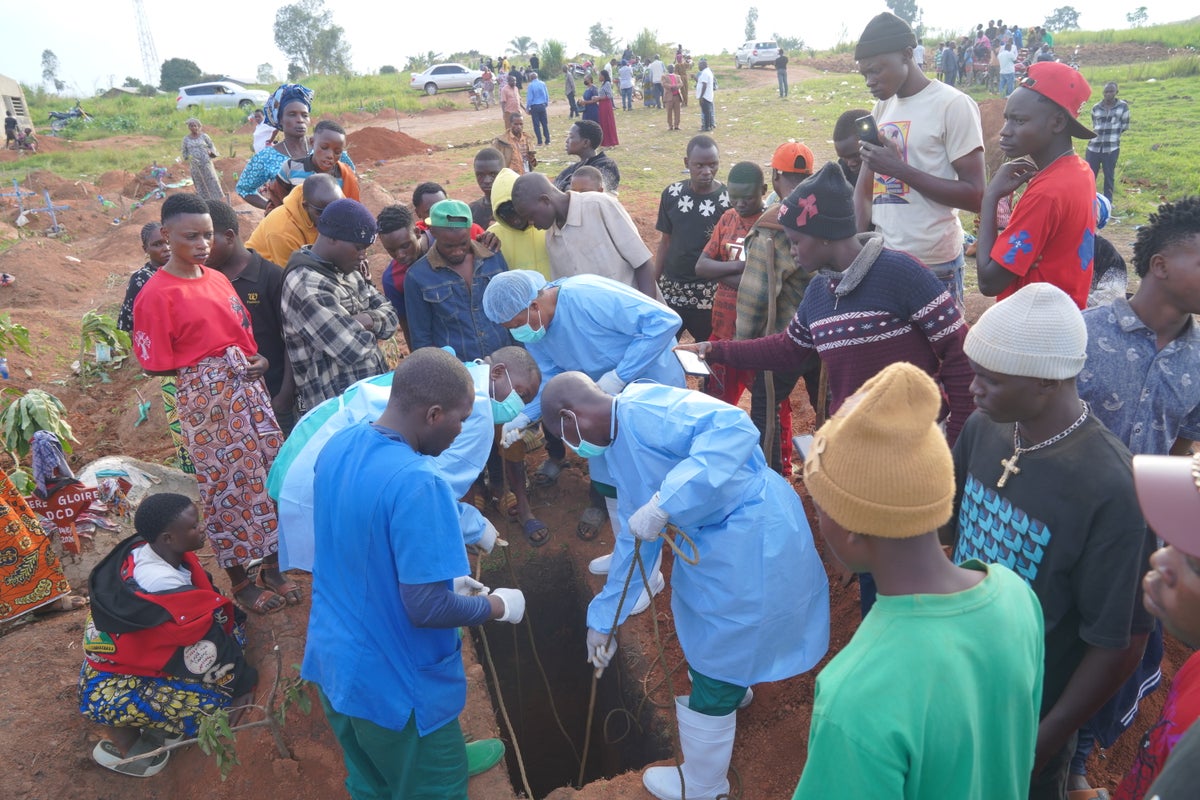
Epidemiological containment relies on a fundamental mathematical constant: the chain of transmission must be severed faster than the pathogen can multiply. When an outbreak breaches critical thresholds across conflict-affected zones, standard response mechanisms fail not because of medical ignorance, but because of operational paralysis. One hundred days into the current outbreak in the Democratic Republic of Congo, nearly 5,000 confirmed cases and over 2,500 deaths demonstrate a systemic inability to match the velocity of viral transmission. Analyzing this failure requires moving past reactive crisis narratives to examine the structural mechanics driving the epidemic forward.
The Transmission Velocity Deficit
The primary driver of the current crisis is a widening gap between infection rates and contact tracing capacity. Public health frameworks dictate that controlling a filovirus requires tracking roughly 95% of exposed contacts. In the eastern provinces of Ituri and North Kivu, current operational tracking sits at an estimated 10% to 12%.
This creates a catastrophic feedback loop:
- Unidentified contacts move freely within dense population sectors and displacement camps.
- Infections multiply silently outside monitored healthcare pipelines.
- More than 60% of fatalities occur directly within communities rather than inside treatment facilities.
- Families engage in traditional care and burial practices without personal protective equipment, seeding new transmission chains.
The math is unforgiving. With thousands of active cases and hundreds of individuals unaccounted for in treatment registries, the virus maintains a permanent head start over response teams.
The Operational Friction Matrix
Deploying medical assets into an active conflict zone introduces high friction coefficients that traditional humanitarian blueprints fail to address. The geographic footprint of the epidemic now spans an area larger than France, overlapping with regions fractured by armed militia activity, chronic food insecurity, and deep-seated institutional mistrust.
Frontline medical workers face acute physical threats. Over 160 healthcare providers have contracted the virus, resulting in dozens of fatalities, while ambulances and clinics face physical attacks from frustrated local populations. This security deficit breeds a severe operational paradox: external intervention teams arrive with heavy centralized protocols that alienate residents who have weathered decades of systemic neglect without state assistance.
When communities perceive top-down directives as foreign impositions, compliance drops to near zero. Patients present at treatment centers only in the terminal stages of the disease, transforming clinics into perceived terminals of no return rather than sites of healing.
Decentralizing the Intervention Architecture
Overcoming transmission momentum requires abandoning centralized treatment models in favor of localized, community-embedded detection units. The operational focus must shift from building high-capacity urban treatment centers to managing decentralized micro-interventions.
Successful containment models depend on three structural adjustments:
- Integrating surveillance into existing, trusted primary healthcare posts rather than isolated Ebola units.
- Engaging local leadership structures—such as those operating within high-density displacement camps—to lead early symptom identification and safe referral pathways.
- Deploying door-to-door diagnostic and triage teams accompanied by trusted community survivors who can dismantle local skepticism.
Funding structures must also transition from short-term emergency injections to flexible, long-horizon capital allocations. Humanitarian pipelines currently operate on multi-week funding horizons, leaving field teams vulnerable to sudden resource cliffs just as geographic spread accelerates.
Strategic Vector Allocation
To alter the trajectory of the outbreak, response coordinators must immediately reallocate capital away from facility-centric expansion and toward community-level human infrastructure. Funding must prioritize the mass training and hazard compensation of local health workers embedded directly within affected villages. Without shifting the operational center of gravity from institutional treatment wards to the front porch of the community, the transmission coefficient will continue to outpace containment efforts.


