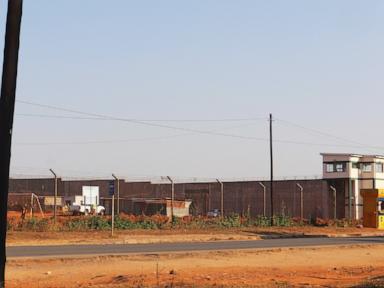
The door did not click shut. It groaned.
That is the first detail that stays with you when you spend four hundred days inside a concrete box that has no calendar on the wall. Doors in penal administrative limbo do not latch neatly. They require a heavy heave, a dull metallic thud of deadbolts sliding into grooves engineered to keep time suspended. When you wake up every morning in a foreign cell on a continent you never chose to map, time stops smelling like seasons. It smells like bleach, cold iron, and stale carpet.
Bounchanh Phommasone knew that sound intimately.
He knew it when the guards shifted at midnight. He knew it when the food tray scraped across the rubber threshold. He knew it during the long, suffocating afternoons when the heat of Eswatini pressed against the high, wired windows like a heavy hand held over a mouth.
More than a year. Three hundred and sixty-five days multiplied by an agonizing margin. For a man born in Laos, whose childhood memories smelled of Mekong dust and woodsmoke, finding himself dumped into a tiny African kingdom landlocked by South Africa was not merely an administrative relocation. It was a geographic abduction.
To understand how a human being becomes a parcel shipped across oceans to a destination with no personal history, you have to look past the cold vocabulary of immigration enforcement. Bureaucrats call it removal. Lawyers call it third-country deportation. The statistics call it a case resolution.
None of those words capture the reality of waking up in a place where your name is unpronounceable to the guards, where your language exists nowhere on any radio station, and where your freedom is contingent upon a piece of paper that took four hundred days to arrive.
Phommasone’s journey did not begin in Eswatini. It began decades prior, rooted in the chaotic diaspora that followed the Vietnam War and the restructuring of Southeast Asia. Like many refugees and immigrants of his generation, his life was shaped by displacement, survival, and the desperate hope for a permanent anchor. But anchors rust. Laws shift. A past mistake, paid for in the currency of criminal justice years earlier, can suddenly mutate into a retroactive death sentence of perpetual exile.
When the United States government decided to deport him, it faced a logistical wall. Laos, for many years, maintained strict limits on accepting repatriated citizens, particularly those with older criminal records. But immigration machinery, once engaged, rarely pauses for diplomatic nuances. If a home country is reluctant to take you back, the system invents a corridor.
Enter Eswatini. Formerly known as Swaziland, it is an absolute monarchy marked by stunning landscapes and profound economic struggles. It is also a nation that has occasionally found itself entangled in the opaque, heavy-handed agreements of global deportation logistics.
Imagine being handed a plane ticket to a nation you have never visited, whose culture you have never studied, and whose people have no connection to your heritage. Imagine stepping off the tarmac into an alien sun, only to be immediately transferred from the custody of one set of strangers to another.
That is what happened. And then, the silence settled in.
Prison walls are designed to keep the world out, but they also keep accountability in the dark. For over a year, Phommasone existed in administrative detention. He was not serving a criminal sentence under Eswatini law; he was being held because he had nowhere else to go. He was a human administrative error waiting for a filing cabinet to close.
Think about the psychological architecture of such confinement. If you commit a crime, your punishment has a terminal date. You count down the months, the weeks, the days. You know the price