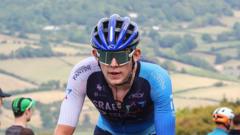
The morning air in Portugal usually smells of salt, baked earth, and the sharp, metallic tang of ambition.
Cyclists know that smell intimately. They live on the razor edge of exhaustion, chasing a dream measured in millimeters of tire clearance and heartbeats pushing past the red line. For Finlay Tarling, that road was supposed to be another chapter in a young life written in carbon fiber and sweat. He was a rider of immense promise, a young talent caught up in the beautiful, brutal machinery of competitive cycling.
Then, silence.
The news cut through the peloton like a crosswind off the Atlantic. Finlay Tarling was gone.
In the immediate aftermath, the world of professional sport does something strange. It hesitates. For a brief, suspended moment, the frantic calculation of watts, podiums, and UCI points grinds to a halt. The machinery stops.
Shortly after the tragedy shocked the sporting community, the decision came down from the hierarchy of his team. They were withdrawing from the Volta a Portugal. No hesitation. No corporate PR spin could soften the blow or pretend that the race mattered more than the empty chair in the team bus.
Kit bags packed away in lockers. Bikes wiped clean of road grime for the last time on this tour, then slid into their travel cases unridden. The psychological weight of a Grand Tour or a grueling national stage race is immense under normal circumstances. Add grief to the equation, and the asphalt turns to lead.
How do you pin a number to your back when your teammate is gone?
Every cyclist knows the quiet terror of the descent. You drop your shoulders, tuck your chin, and trust your tires to the physics of friction and gravity at seventy kilometers per hour. You trust the rider inches from your rear wheel. You trust the team car behind you. Cycling is often marketed as an individual gladiatorial contest, a lonely battle against the mountain.
It is a lie.
It is one of the most fiercely tribal team sports on Earth. You eat together. You suffer together in the crosswinds, taking turns shielding each other from the punishing drag of the air. You share bidons. When a crash ripples through the bunch like a falling domino tower, you feel the carbon splintering in your bones even if you stayed upright.
When a young rider dies, the invisible thread binding that peloton together snaps.
The Volta a Portugal is a punishing crucible. It is one of the oldest and most demanding races on the calendar, stretching across brutal climbs and searing Iberian heat. The roads do not care about your grief. The gradients of the Serra da Estrela do not soften because a nineteen-year-old heart stopped beating too soon. The race demands everything.
And sometimes, giving everything means walking away.
Think about what it takes to step off the bike mid-race. For an athlete, stopping is a failure of will. You are trained from childhood to push through the pain cave, to ignore the burning in your lungs, to race through injury, sickness, and exhaustion. Quitting is a dirty word in the locker room.
Yet, walking away from the Volta a Portugal was the only logical, human response left.
The team's withdrawal wasn't a sign of weakness. It was a loud, defiant declaration that human life outweighs the entertainment value of a sport. It forced the organizers, the fans, and the sponsors to look past the television screens and confront the fragile reality of the people wearing the jerseys.
We watch sports for the transcendence. We want to see mortals climb mountains and defy their own limits. We cheer for the breakaway, the sprint finish, the heroic comeback. We forget that behind the aerodynamic helmets and tinted Oakley sunglasses are kids far away from home, living out of suitcases, chasing a fleeting dream on dangerous roads.
The peloton rolled on without them. The stages continued. The commentators filled the airwaves with split-times and tactical analysis.
But down in the paddock, the absence spoke louder than any announcer's voice.
An empty bed in a hotel room in Portugal. A pair of cycling shoes left by the door, unpolished, gathering dust. A radio silent on channel two.
Finlay Tarling’s name remains etched into the start lists of races past, a sharp reminder of the cost of admission to elite sport. When the team packed their vans and left the race behind, they didn't just exit a competition. They drew a hard line between the relentless machinery of professional athletics and the fragile, irreplaceable value of a human life.
The road out of Portugal is long, steep, and winding.
And somewhere up ahead, through the mist rolling off the hills, the rest of the pack pedals onward into the silence.