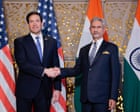
Diplomacy rarely announces its sharpest turns with a press release. Usually, the real story is told by an airplane’s flight path.
Consider a hypothetical scene at Indira Gandhi International Airport in New Delhi. Picture an Indian foreign ministry official—let us call him Vikram—standing near a tarmac that has been swept clean for a visiting American dignitary. Vikram has spent three weeks rehearsing talking points on semiconductor supply chains, maritime patrols in the Indian Ocean, and defense co-production. He checks his watch. He checks his briefing binder. Then his phone buzzes with an updated itinerary from Washington. The U.S. Secretary of State is in the region. He is flying over the subcontinent, or skirting its edges, stopping in capitals that feel urgent to the immediate news cycle, while New Delhi remains conspicuously absent from the manifest.
The tarmac stays empty.
That scenario is a dramatization, of course, but the diplomatic reality behind it is entirely concrete. When U.S. Secretary of State Marco Rubio bypassed New Delhi during his regional travel, political analysts in both Washington and India immediately began dissecting the omission. To the casual observer, a skipped stop on a busy cabinet official's calendar looks like a scheduling quirk. Jet lag is real. Time zones are brutal. In the high-stakes theater of international relations, however, calendars are ideological documents. Every city visited is a signal of priority; every capital skipped is a quiet recalculation of leverage.
To understand what Marco Rubio’s sidestepping of New Delhi actually reveals about the United States’ stance on India, you have to look past the polite handshakes of the past decade and examine the transactional coldness settling over modern American foreign policy.
The Illusion of the Inevitable Alliance
For the better part of twenty years, across both Democratic and Republican administrations, the U.S.-India relationship was treated in Washington like a favored heirloom. It was polished, admired, and talked about in sweeping, almost romantic terms. Presidents from George W. Bush to Joe Biden spoke of the "defining partnership of the twenty-first century." The logic seemed airtight. India was the world's largest democracy, a demographic titan with a booming economy, and the only Asian power with the sheer mass to counterbalance an increasingly assertive China.
I remember sitting in a cramped, over-air-conditioned conference room in Washington a few years ago, listening to policy wonks map out the future of the Indo-Pacific. On the whiteboard, arrows pointed cleanly from Silicon Valley to Bengaluru, from the Pentagon to New Delhi. The assumption in the room was almost religious in its certainty: India and the United States were destined to converge. Whenever friction arose—over Russian oil purchases, over tariff barriers, over democratic backsliding—Washington swallowed its frustration and kept smiling. The long game required patience.
That patience has thinned.
Marco Rubio, long before he stepped into the role of America's top diplomat, built his political brand as a hawkish realist who viewed the world through the lens of hard competition, particularly with Beijing. Yet realism cuts both ways. A realist looks at an alliance not for what it promises to be in twenty years, but for what it delivers on Tuesday afternoon. And when the current administration looks at New Delhi, it sees a partner that wants all the benefits of American technology, capital, and security guarantees without signing on to the obligations of an actual ally.
What Washington Actually Wants
To grasp the friction beneath the surface, imagine two neighbors who both dislike the aggressive homeowner down the street. Let us use this analogy to clarify the strategic impasse. One neighbor, the United States, wants to form a neighborhood watch with strict rules: everyone buys the same security cameras, shares footage immediately, and agrees to confront the troublemaker together. The other neighbor, India, agrees that the troublemaker is a menace, gladly accepts free security cameras from the first neighbor, but insists on keeping its own locks, refusing to share its camera feeds, and occasionally buying cheap firewood from the very troublemaker they are both worried about.
Eventually, the first neighbor stops knocking on the door.
India’s doctrine of "strategic autonomy"—its fierce refusal to enter formal alliances or take sides in great-power conflicts—has served New Delhi brilliantly for decades. It allows Indian diplomats to attend Quad security summits with the U.S., Japan, and Australia in the morning, and sit down with Russian and Chinese officials at BRICS meetings in the afternoon. During the war in Ukraine, India became one of the largest buyers of discounted Russian crude oil, refining it and selling products globally while refusing to condemn Moscow at the United Nations.
From New Delhi’s perspective, this is simple common sense. India is a developing nation with hundreds of millions of citizens still climbing out of poverty; cheap energy is a moral and political necessity, not an ideological statement. Furthermore, roughly sixty percent of India’s military hardware is still of Russian origin. Cutting ties with Moscow overnight would leave Indian borders defenseless in the Himalayas.
Washington understands these constraints intellectually. Emotionally and politically, however, the tolerance for India's hedging has hit a wall. Under a foreign policy doctrine driven by reciprocity and immediate national interest, strategic autonomy starts looking a lot like free-riding.
The Trade and Tariff Minefield
The diplomatic chill is not merely about geopolitics; it is deeply rooted in dollars, rupees, and factory jobs.
Before Rubio’s flight path raised eyebrows, trade tensions were already simmering beneath the diplomatic niceties. The United States remains India’s largest trading partner, with bilateral trade hovering around $190 billion. Yet the trade deficit—the gap between what the U.S. buys from India and what India buys from the U.S.—has widened to tens of billions of dollars in India's favor.
In Washington’s current political climate, trade deficits are treated less like macroeconomic statistics and more like personal insults. India maintains some of the highest import tariffs among major economies, protecting its domestic agricultural and manufacturing sectors from foreign competition. American companies trying to enter the Indian market frequently run into a labyrinth of regulatory hurdles, sudden rule changes, and data localization mandates that make doing business feel like running uphill in wet sand.
When a U.S. Secretary of State skips New Delhi, it sends an unmistakable message to South Block, the seat of India’s foreign ministry: the era of unilateral American concessions is over. Washington is no longer willing to overlook steep Indian tariffs on American motorcycles, agricultural goods, and medical devices simply because India shares a contested border with China.
The Human Cost of Diplomatic Drift
It is easy to treat these maneuvers like moves on a giant chessboard, detached from real life. They are not. When diplomatic momentum stalls at the highest levels, the tremors ripple straight down to ordinary people and mid-sized businesses.
Consider an engineer in Hyderabad working for an American tech firm's global capability center, or a family in New Jersey waiting years for green card backlogs to clear, or a small defense contractor in Ohio trying to finalize a joint-venture license with an Indian manufacturer. High-level visits by a Secretary of State are not just photo opportunities; they are the forcing mechanisms that clear bureaucratic logjams. When a cabinet official is scheduled to land in New Delhi, mid-level bureaucrats in both governments work through the night to get stalled agreements across the finish line so their bosses have something concrete to announce at the podium.
Without the visit, the urgency evaporates.
The visa processing bottlenecks remain untouched. The export control waivers sit in an inbox for another six months. The tech transfer agreements that were supposed to move supply chains out of southern China and into Tamil Nadu lose their political oxygen. Ambition slows to a crawl.
Why India Is Not Panicking
If Washington expected New Delhi to scramble in panic after being left off the itinerary, it misread the room. India today is not the hesitant, aid-dependent nation of the 1970s. It is the world’s fifth-largest economy, boasting a vibrant domestic market, a booming digital infrastructure, and a quiet confidence born of surviving decades of Western skepticism.
When the U.S. imposed crushing sanctions on India after its 1998 nuclear tests, New Delhi did not capitulate; it absorbed the blow, waited out the storm, and eventually watched Washington rewrite its own laws to accommodate a nuclear-armed India. Indian diplomats have long memories. They know that geography is permanent while administrations are temporary.
India’s Ministry of External Affairs knows a fundamental truth about the Indo-Pacific: you cannot contain China’s maritime expansion without India. Look at a map of the Indian Ocean. Every drop of oil flowing from the Persian Gulf to East Asia passes right past India’s southern tip and the Andaman and Nicobar Islands. The U.S. Navy, stretched thin across the Middle East, Europe, and the Western Pacific, simply does not have enough ships to police those waters alone. Washington needs India’s geography just as much as India needs Washington’s technology.
So New Delhi waits. It continues buying French fighter jets, negotiating trade deals with the European Union and the United Kingdom, and quietly managing its border standoff with Beijing on its own terms.
The End of Magical Thinking
What Marco Rubio’s sidestepping of New Delhi ultimately signals is not a rupture, nor is it an abandonment. The United States and India are still bound by shared anxieties about Beijing, deep diaspora ties, and massive commercial overlap. Rather, the skipped stop marks the death of magical thinking in Washington.
For years, American policymakers convinced themselves that if they just gave India enough warmth, enough summitry, and enough diplomatic deference, India would naturally evolve into a treaty-style ally that marched in lockstep with U.S. foreign policy. That was never going to happen. India is too big, too proud, and too scarred by its colonial past to ever become a junior partner to any foreign power.
By choosing not to land in New Delhi, Rubio stripped away the sentimental rhetoric and reset the relationship on colder, clearer ground. The message from Washington is blunt: we will work with you where our interests align, we will sell you weapons when it profits our defense industrial base, and we will share intelligence when China threatens us both. But we will no longer pretend we are building a brotherhood, and we will no longer spend precious political capital chasing a partner that refuses to commit.
It is a harsher, less inspiring vision of statecraft. There are no grand speeches about shared democratic destiny in this new playbook, no sweeping promises of a limitless horizon. Instead, there is a ledger. Every favor is recorded, every tariff is weighed, and every flight path is calculated down to the mile.
In New Delhi, the diplomatic corps understands the shift entirely. The red carpet is rolled up and stored away, ready to be brought out again the moment the ledger balances—and not a second before.


