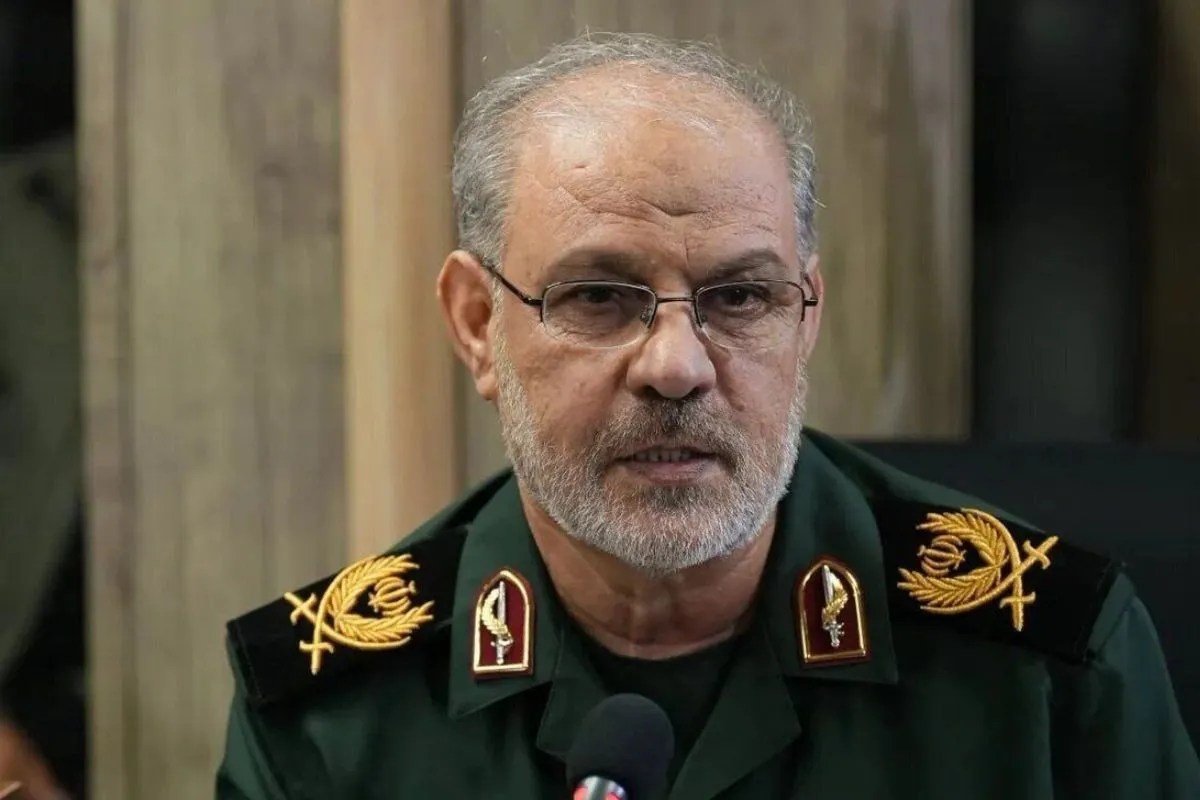
The microphone captures the exact moment a threat hardens into a doctrine. In a high-ceilinged hall in Tehran, an Iranian brigadier general steps up to the podium. His voice is measured, carrying the weight of decades of institutional defiance. The words he chooses are not diplomatic pleasantries. They are iron.
"America should leave the region," he declares, adding that Washington has no other path left to walk. Meanwhile, you can explore similar developments here: The Paper Walls Between Two Worlds.
To the casual observer half a world away, sitting in a quiet kitchen with a cup of coffee and a glowing smartphone screen, these declarations blend into the background noise of modern geopolitics. They sound like the standard soundtrack of a restless century. Saber-rattling. Posturing. Rhetoric designed for evening broadcasts and morning newspapers.
Yet, words spoken at this altitude do not vanish into thin air. They settle over the narrow shipping lanes of the Persian Gulf like a heavy, salt-laden fog. They dictate the posture of sailors standing watch on grey steel hulls under a merciless sun. They shape the calculations of strategists working late into the night in windowless rooms beneath the Pentagon. To explore the full picture, check out the detailed article by NBC News.
Consider what happens next in the quiet corridors where decisions are actually made.
An admiral looks at a logistics report. Fuel costs are rising. Maintenance cycles for carrier strike groups are stretched thin. The domestic appetite for endless commitments across distant oceans is fraying at the edges. Every deployment is a heavy logistical lift, measured in billions of dollars and millions of man-hours. The general in Tehran knows this math. When he looks across the geopolitical board, he does not see an invincible titan; he sees an exhausted giant balancing too many plates on too many sticks.
History is littered with the remnants of empires that believed their presence was permanent, right up until the morning they realized it was simply too expensive to maintain.
This is the hidden friction of modern power. It is rarely decided by a single apocalyptic clash. Instead, it erodes slowly, grain by grain, through fiscal strain, political fatigue, and the relentless, grinding pressure of local adversaries who have nowhere else to go. The home team is always home. The distant power is always a guest, and guests eventually outstay their welcome when the weather turns rough.
To understand the weight of the general's statement, one must look past the bluster and examine the geography of endurance.
Imagine standing on the shoreline of Bandar Abbas at dusk. The water is dark and oily. Tankers move silently through the Strait of Hormuz, their hulls low in the water, carrying the lifeblood of global industry. Every ship represents a calculated risk. The crews on board check their radar screens with a quiet vigilance that borders on exhaustion. They know that a single miscalculated maneuver, a single stray radio signal or misinterpreted command, could turn the commercial waterway into a theater of fire.
The Iranian military establishment has spent decades preparing for this exact war of attrition. They have built underground cities for missiles, mastered asymmetric naval swarming tactics, and woven a dense web of regional alliances that act as buffers against external pressure. When a senior commander stands up and tells the world's most powerful military to pack its bags, he is speaking from the comfort of a strategy designed to outlast, out-wait, and out-suffer an adversary whose attention span is dictated by four-year election cycles.
Democracy is a wonderful engine for domestic prosperity, but it is notoriously impatient with foreign entanglements that yield no clear, triumphant conclusion.
Washington finds itself caught in a structural trap of its own making. To withdraw entirely is to cede strategic dominance in one of the most vital resource hubs on the planet, inviting regional rivals to fill the vacuum. To stay is to bleed slowly, maintaining a permanent posture of high-alert defense against asymmetric threats that bite without warning. There is no clean exit strategy when the entire architecture of global security has been built around forward deployment.
The general's ultimatum exploits this precise vulnerability. It frames the choice not as a defeat in battle, but as an inevitable capitulation to reality.
Think about the psychological toll on the individuals caught in the crossfire of these grand strategies. Not just the generals and the presidents, but the ordinary families living in the borderlands, the merchants whose supply chains are disrupted by every spike in regional tension, and the young recruits stationed thousands of miles from home who wonder what exact purpose their vigil serves on any given Tuesday afternoon. For them, geopolitics is not an abstract chess match played on a polished mahogany table. It is the sound of a distant engine overhead, or the sudden spike in the price of bread at the local market.
When rhetoric reaches this pitch, it signals a shift in the weather. It means that the tolerance for ambiguity is shrinking. Both sides have mapped out their red lines so thoroughly that they now overlap.
The Iranian command structure is signaling that they believe time is on their side. They calculate that economic sanctions, internal pressures, and shifting global alliances with powers like Beijing and Moscow will eventually isolate Washington to the point of irrelevance in the region. They are betting that the cost of policing the Middle East will eventually outweigh any conceivable benefit the United States hopes to extract from it.
Whether that calculation is correct remains the central question of our era.
Power rarely surrenders its throne willingly. It clings to its outposts, justifies its budgets, and reinvents its justifications for staying long after the initial reasons have faded into history. Yet, the steady drumbeat of defiance from Tehran points to a deeper truth about the changing distribution of global leverage. The unipolar moment has cooled. Regional powers are no longer waiting for permission from Western capitals to chart their own course, and they are increasingly willing to test the limits of imperial patience.
The general's speech will soon be archived, replaced by the next headline, the next crisis, the next fiery quote broadcast across satellite networks. But the pressure beneath the surface will not dissipate. It will continue to build, quiet and relentless, shaping the decisions of commanders who know that empires do not fall all at once.
They simply run out of reasons to stay.


