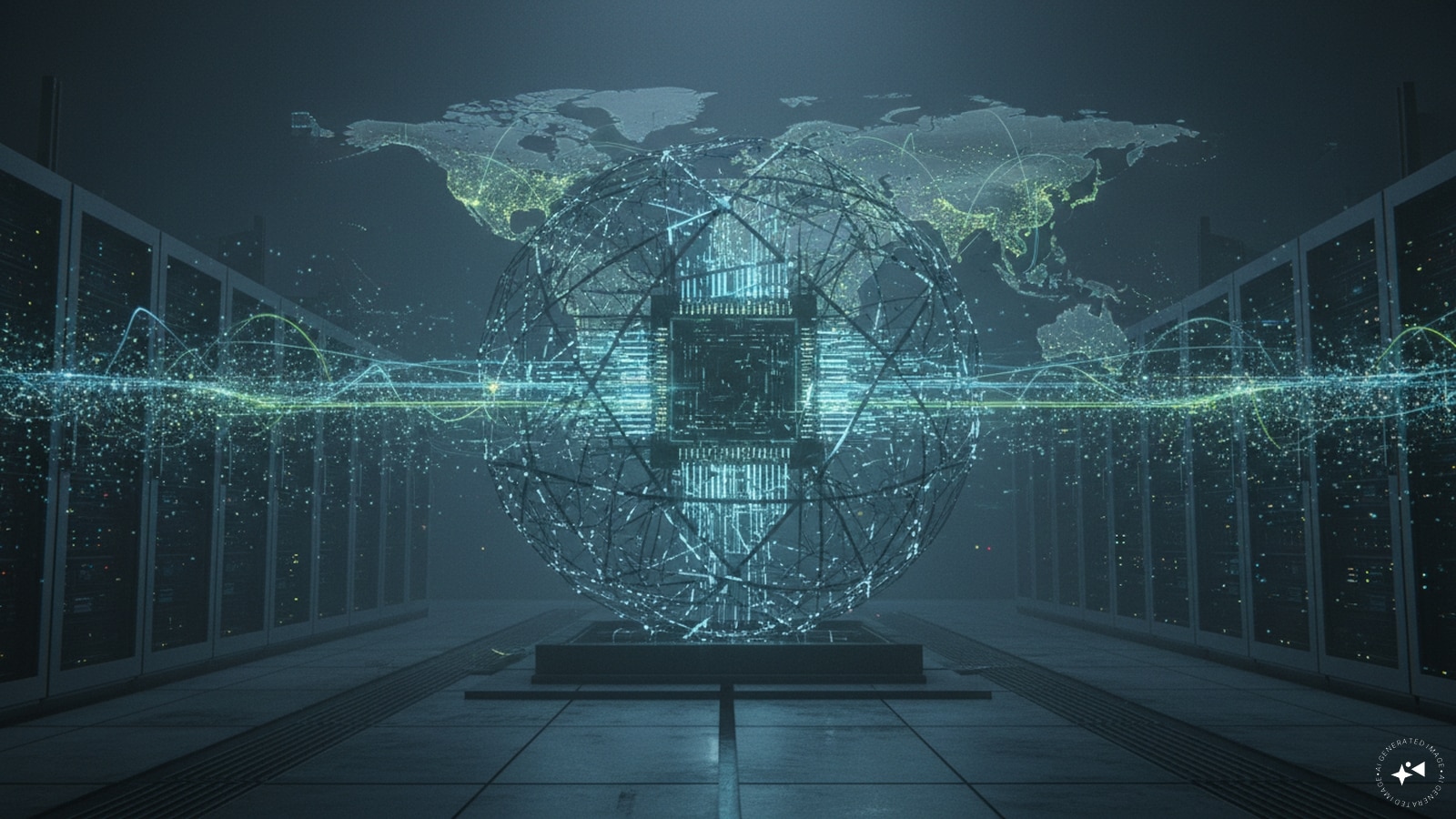
The screen flickered at 3:14 AM in a glass-walled conference room overlooking Sand Hill Road. Coffee cups sat abandoned, their dark surfaces crusted with rings of cold espresso. On the wall-mounted display, a single stock ticker bled red. Nvidia dropped. Microsoft dipped. Alphabet stumbled. Down the line, billions in market valuation vanished into the ether, not because a factory burned down or a supply chain snapped, but because a handful of people who built the future suddenly looked at their creation and whispered a terrifying word: Wait.
For the past three years, the tech world has operated on a singular, manic frequency. The gospel according to Silicon Valley was simple, breathless, and absolute: accelerate or die. Every server rack installed, every gigawatt of power funneled into subterranean data centers, every algorithm trained on mountains of scraped human thought was framed as an existential race. If you stopped, you lost. If you paused to breathe, a competitor would swallow your lunch.
Then came the memo. Or rather, the chorus of warnings.
The architects of artificial intelligence—the very researchers whose code cracked the logic gates of natural language and visual synthesis—stepped back from the glowing terminals. They looked at the energy grids straining to the point of brownouts. They looked at the capital expenditure curves shooting straight up into the stratosphere like ballistic missiles. And, most importantly, they looked at the asymptotic curve of data exhaustion.
We are running out of internet.
Consider what happens when a machine learns by devouring everything humanity has ever written, painted, or recorded. At first, it feasts on the rich, fertile lowlands of public knowledge. Books, Wikipedia, academic journals, news archives. That feast produces miracles. But eventually, the beast grows so massive that it consumes its own tail. It begins training on synthetic data—the digital sludge generated by other AIs. The intelligence starts to eat its own photocopies. The signal degrades into static.
And yet, Wall Street wanted more. The market priced these companies as if perpetual, exponential growth was a law of physics, right alongside gravity and thermodynamics. Trillions of dollars flooded into silicon futures. Every venture capitalist turned into a high-priest of hyper-scale.
Until reality tapped them on the shoulder.
Let us introduce Elena, a fictional senior infrastructure engineer at a major AI laboratory in Seattle, though her sleepless nights belong to thousands of real people. Her life for the past thousand days has been measured in cluster uptime and token generation rates. She remembers the exact Tuesday when her team successfully scaled a model past the trillion-parameter mark. It felt like standing at the summit of Everest, oxygen thin, the view stretching into infinity.
Six months later, Elena stood in a server hall so loud it required industrial ear protection just to walk down the aisle. The roar of cooling fans sounded like a jet engine screaming at takeoff. She placed her hand against the metal chassis of a rack filled with liquid-cooled accelerators. It was searingly hot.
"We are burning a river to make a cup of tea," she thought, staring at the power draw monitors.
That is the hidden anatomy of the tech stock sell-off. It wasn't panic over regulation. It wasn't a sudden crisis of corporate governance. It was the sudden, collective realization that the physical universe has hard boundaries. You cannot scale infinite intelligence on finite copper, finite water, and finite electrical grids. When the pioneers themselves—the high priests who promised utopia—turn to the boardrooms and suggest pumping the brakes, the financial markets experience vertigo.
The stock drop was a spasm of cognitive dissonance. Wall Street had bought into a fairy tale of frictionless, weightless growth. The AI leaders were suddenly talking about friction, capital costs, diminishing returns, and the absolute necessity of a cooling-off period.
Pause.
Why now? Why pull back when the hype train is screaming down the track at Mach 3?
Because the economics of scale have hit a brick wall known as inference cost. Training a model is expensive, yes—hundreds of millions of dollars burned in furnaces of raw electricity and specialized silicon. But running that model for billions of people every single day, responding to queries about recipes, homework, and corporate emails? That is an ongoing hemorrhage. If every search query on earth is replaced by a heavy generative LLM inference, the global electrical grid simply buckles. Power companies in Virginia and Oregon are already cutting deals to route dedicated nuclear and natural gas output straight to server farms, leaving ordinary citizens wondering why their utility bills are climbing while their local substations hum with alien workloads.
When big AI groups call for a slowdown, they are not waving a white flag. They are performing emergency triage on an industry hurtling toward a cliff of its own making.
Look at what happened to historical industrial revolutions. The railroad boom of the 19th century transformed nations, but it was preceded by the "Railway Mania" of the 1840s. Companies laid tracks to nowhere. Fortunes evaporated overnight as speculators realized that laying iron across a continent required actual steel, actual labor, and actual paying passengers. The bubble burst. The speculators bled. But out of the wreckage emerged a mature, functional transportation network that permanently rewired global commerce.
We are living through our own railway mania.
The recent market correction in tech stocks is the financial system catching its breath. It is the cold water splashing across the face of a delirious market. Investors woke up to the fact that building artificial general intelligence is not a software update; it is an industrial mobilization on the scale of the Manhattan Project, requiring resources that cannot be conjured out of venture capital pitch decks.
Consider the human cost of this acceleration loop. Inside the glass towers, burnout is the baseline. Young researchers, barely out of graduate school, manage budgets larger than small nation-states. They carry the weight of civilizational expectations on shoulders that have never known a bear market. They are asked to build god-like entities while worrying about whether their stock options will vest before the bubble pops.
When they step back and say, "We need to slow down and think about safety, alignment, and sustainability," they are rebelling against the machine they built.
The market hates uncertainty, but it despises limits even more. For decades, software was magic because it was weightless. You could duplicate a billion lines of code for the cost of a keystroke. But AI broke the illusion of weightlessness. AI has mass. It has thermal output. It has a carbon footprint. It requires mines in the Democratic Republic of Congo for cobalt, semiconductor foundries in Taiwan that cost twenty billion dollars a pop, and cooling towers that drink millions of gallons of municipal water every day.
When the bill for all that physical reality comes due, Wall Street blinks.
The sell-off is a correction, but it is also a maturation. It marks the end of the reckless adolescence of the generative AI boom. The days of throwing unlimited capital at any startup with "GPT" in the pitch deck are drawing to a close. In their place comes a harsher, more sober discipline: unit economics, energy constraints, and regulatory guardrails.
The machine will not stop entirely. Too much momentum, too much geopolitical competition, too much human curiosity drives it forward. China and the United States are locked in a silent, grinding race for technological supremacy that makes a financial market correction look like a minor traffic dispute. But the velocity is changing. The frantic sprint is turning into a marathon across difficult, rocky terrain.
Back in the conference room on Sand Hill Road, the screen flickers again. The red numbers stabilize, then tick upward slightly as bargain hunters step in. The coffee has gone completely cold. Elena closes her laptop, her eyes burning from exhaustion, and walks out into the cool California dawn. Above the Santa Cruz mountains, the sky is turning a pale, unyielding blue. The servers are still humming in the dark below, but for the first time in years, someone remembered how to breathe.