Eight.
Say the number out loud in a quiet room and let it sit there. Eight times, a woman puts on a gown tailored to the millimeter, steps out of a black sedan onto a red carpet lined with screaming strangers and blinding strobes, walks into the Dolby Theatre, takes her seat in the third or fourth row, and practices the face.
You know the face. Every actor who has ever lost on live television knows the anatomy of that expression by heart. The jaw softens. The corners of the mouth lift by three millimeters—enough to project warmth to a camera lens thirty feet away, not so much that it looks manic. The hands rise to chest level and clap with brisk, rhythmic precision while someone else walks past your knees toward the podium.
Glenn Close has performed that exact choreography eight times over four decades. And when the Academy of Motion Picture Arts and Sciences finally announced that it would hand her an honorary Oscar at the Governors Awards, her immediate public reaction wasn’t a triumphant fist-pump or a wry joke about overdue bills. She used a single, stripped-down word.
Overwhelmed.
To understand why that word carries so much weight, you have to look past the box-office tallies and the trophy cabinets. You have to look at what happens to a human nervous system when excellence is repeatedly acknowledged, publicly celebrated, and then—at the final threshold—consistently denied.
The Architecture of Almost
If you have ever watched a championship athlete lose in overtime, you recognize the specific kind of exhaustion that settles behind the eyes. Losing badly is actually easier on the soul; you go home, lick your wounds, and rebuild from the ground up. Losing by a hair—being told, decade after decade, that you are among the five finest practitioners of your craft on planet Earth, only to watch the gold statuette go to the seat next to yours—creates a strange, slow-burning psychological friction.
Consider a hypothetical scenario to strip away the Hollywood glamour. Imagine a master watchmaker in Geneva. Every five years, the guild inspects his work, gasps at the precision of the gears, places his timepiece on a velvet pedestal, and says, "This is a marvel of human ingenuity." Then, at the banquet, they hand the medal to a younger apprentice whose watch runs fast, simply because the apprentice’s story happens to be fashionable that season. Now imagine that happening to the watchmaker eight separate times across forty years.
At what point does the honor of the nomination begin to feel less like an embrace and more like an endurance test?
I have spent years watching award seasons unfold from press rooms and living room couches, and there is a distinct shift that happens around nomination number five. Early on, the narrative is electric. When Glenn Close earned her first nod for The World According to Garp in 1983, she was a theater prodigy stepping into cinema with startling authority. Then came The Big Chill the very next year. Then The Natural the year after that. Three nominations in three consecutive years. In Hollywood math, that trajectory practically guarantees a win before your fortieth birthday.
Except it didn't.
Instead, the industry built a pedestal for her and forgot to put a door in it. By the time Fatal Attraction arrived in 1987, Close wasn't just acting; she was altering cultural vocabulary. Alex Forrest became shorthand for obsession, a performance so ferocious and terrifyingly human that audiences still flinch at the sound of a boiling pot. Surely, that was the year. Cher won for Moonstruck.
One year later, Close transformed into the Marquise de Merteuil in Dangerous Liaisons, delivering a final close-up—silently wiping away theatrical makeup while her composure fractures in real time—that acting schools still dissect frame by frame. Jodie Foster won for The Accused.
What Happens When a Narrative Hardens
There is an unspoken trap in competitive art, and it is called the "legacy lock." Once an artist crosses six or seven losses without a win, voters stop evaluating the performance on the screen and start voting on the biography. The loss itself becomes the headline.
Think about the emotional cost of that shift. When you are twenty-five, you want to win because you are hungry. When you are seventy-eight, after spending years inhabiting characters like Albert Nobbs, Joan Castleman in The Wife, and Mamaw Vance in Hillbilly Elegy, you are no longer auditioning for validation. You already know what you can do. The real danger isn't losing the trophy; it is letting the scoreboard rewrite your memory of the work.
Take The Wife in 2018. Going into that ceremony, every mathematical model, every Vegas oddsmaker, and every veteran columnist had Close engraved on the plaque. She had swept the Golden Globes, the Screen Actors Guild Awards, and the Critics' Choice Awards. Her performance as a woman who spent forty years invisibly ghostwriting her husband's Nobel Prize-winning novels—swallowing her own genius to feed his ego—felt like an uncanny mirror of her own relationship with the Academy.
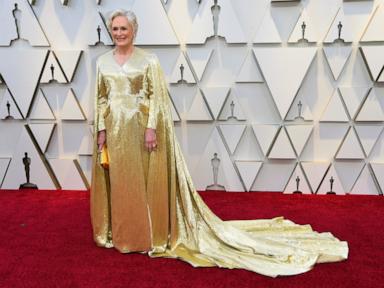
She arrived at the Dolby Theatre wearing a custom gold gown that weighed forty-two pounds, stitched with three million beads. She looked like the statuette itself. When Olivia Colman’s name was called for The Favourite, the collective gasp in the room was audible through television speakers thousands of miles away. Close stood up, beamed with genuine grace, and applauded.
Later, when people asked her how she survived that night without bitterness, she offered a perspective that cuts straight through Hollywood mythology. She pointed out that sitting in a room watching five wildly different performances—none of which can actually be measured against each other like runners crossing a finish line—makes the entire concept of a "winner" absurd. You cannot compare a sprint to a symphony.
Yet knowing a race is rigged by subjectivity does not stop your heart from pounding when the envelope opens.
The Difference Between a Consolation Prize and a Reckoning
Whenever the Academy announces an honorary Oscar for a living legend who never won in competition, a predictable murmur ripples through film circles. Skeptics call it a make-good. Cynics call it an apology wrapped in gold leaf.
That reading misses the point entirely.
To understand why Glenn Close described the news as overwhelming, you have to look at the sheer weight of the company she joins—Peter O’Toole, Deborah Kerr, Barbara Stanwyck, Richard Burton, Alfred Hitchcock. None of them won competitive Oscars. All of them defined the medium. An honorary statuette does not erase eight losses, nor does it pretend that 1988 or 2019 went differently. Instead, it steps outside the annual horse race altogether.
In a competitive year, an Oscar is an argument. It says, This performance beat those four performances between January and December. An honorary Oscar is an acknowledgment of permanence. It says, Without your body of work, the history of cinema would have a hole in it that nobody else could fill.
Let’s look at the evidence on the ledger. Few actors in American history have possessed Close’s range without ever relying on vanity or easy charm. She has never asked the camera to love her. Look at the physical transformation required to play Albert Nobbs, a nineteenth-century butler living as a man in Dublin simply to survive economic brutality. Close spent thirty years trying to get that film made, co-writing the script and producing it herself because studios couldn't fathom a commercial audience for quiet desperation. Look at Patty Hewes in Damages, a television role that earned her two Emmys and proved that ruthless corporate power looks far more chilling when delivered in a calm, maternal whisper.
Even when the movies around her stumbled, her commitment never flickered. In Hillbilly Elegy, buried under a frizzy wig, oversized glasses, and layers of worn-out fleece, she vanished so completely into the Appalachian grandmother that viewers spent the first twenty minutes waiting for Glenn Close to enter the frame before realizing she had been sitting on the porch the entire time. That performance tied her with Peter O’Toole for the most acting nominations without a win in Academy history—eight nods, zero victories.
Why We Care About Someone Else’s Trophy
You might reasonably ask why any of this matters outside Los Angeles. Why should a teacher in Ohio, a nurse in London, or a software engineer in Toronto feel a sudden surge of emotion when a millionaire actress finally gets a twelve-inch bronze statue plated in 24-karat gold?
Because almost every human being on earth knows what it feels like to do the work faithfully, year after year, while someone louder or flashier takes the credit.
We live in a culture obsessed with instant coronation. Overnight viral fame, sudden IPOs, twenty-two-year-old prodigies declared geniuses before they have weathered a single failure. Against that noise, a forty-four-year career built on showing up at five in the morning, memorizing dense pages of dialogue, and refusing to phone in a single close-up feels almost radical.
When Close admitted she was overwhelmed, she was reacting to the sudden drop of an armor she has worn since 1983. Think about the psychic energy required to show up to work for four decades knowing that every time you do something extraordinary, the public conversation immediately shifts to your losing streak. Every interview comes with the same subtext. Is this the one? How does it feel to be the bridesmaid again?
At some point, pride forces you to build a wall around your expectations so you don't get hurt in front of forty million viewers. You tell yourself the trophy doesn't matter. You convince yourself the work is enough—and truthfully, for an artist of her caliber, the work is enough.
Until the phone rings, and someone tells you that you don't have to brace for impact anymore. You don't have to practice the polite applause. You don't have to swallow the disappointment in a forty-two-pound gold dress while cameras zoom in on your pupils. You just get to walk up the stairs, hold the microphone, and speak without a stopwatch cutting you off after forty-five seconds.
The Weight of the Room
When Close steps onto the stage at the Governors Awards, the dynamic in that ballroom will be completely inverted from every other Oscar night she has ever attended. There will be no sealed envelopes. No drumrolls. No split-screen cameras measuring her grace under pressure against a younger rival.
Instead, a room full of directors, cinematographers, editors, and fellow actors—people who know firsthand how brutal it is to bare your soul in front of a lens and trust strangers to judge it—will stand up before she even reaches the podium.
The eight nominations won't disappear. In fact, they are the very reason the ovation will last as long as it does. Any actor can catch lightning in a bottle once, ride a wave of PR momentum for six months, and walk away with a statuette before fading into obscurity. Sustaining the level of craft required to be nominated eight separate times across five different decades requires a terrifying kind of stamina. It requires surviving changing tastes, ageism in an industry notorious for discarding women past forty, and the quiet humiliation of repeatedly coming in second.
A single win in 1988 would have made Glenn Close an Oscar winner. Eight losses followed by an honorary statuette makes her a monument to endurance.
Imagine her standing at that podium for a moment. The lights are hot. The statuette sits heavy in her palm—eight and a half pounds of solid metal, far heavier than people expect the first time they pick one up. For forty-three years, from the moment The World According to Garp put her name on the ballot, she has sat in the dark watching other people hold that weight. Now her fingers are wrapped around the base, the applause echoing off the walls, and for the first time in her life, she doesn't have to pretend she wasn't hoping for it.