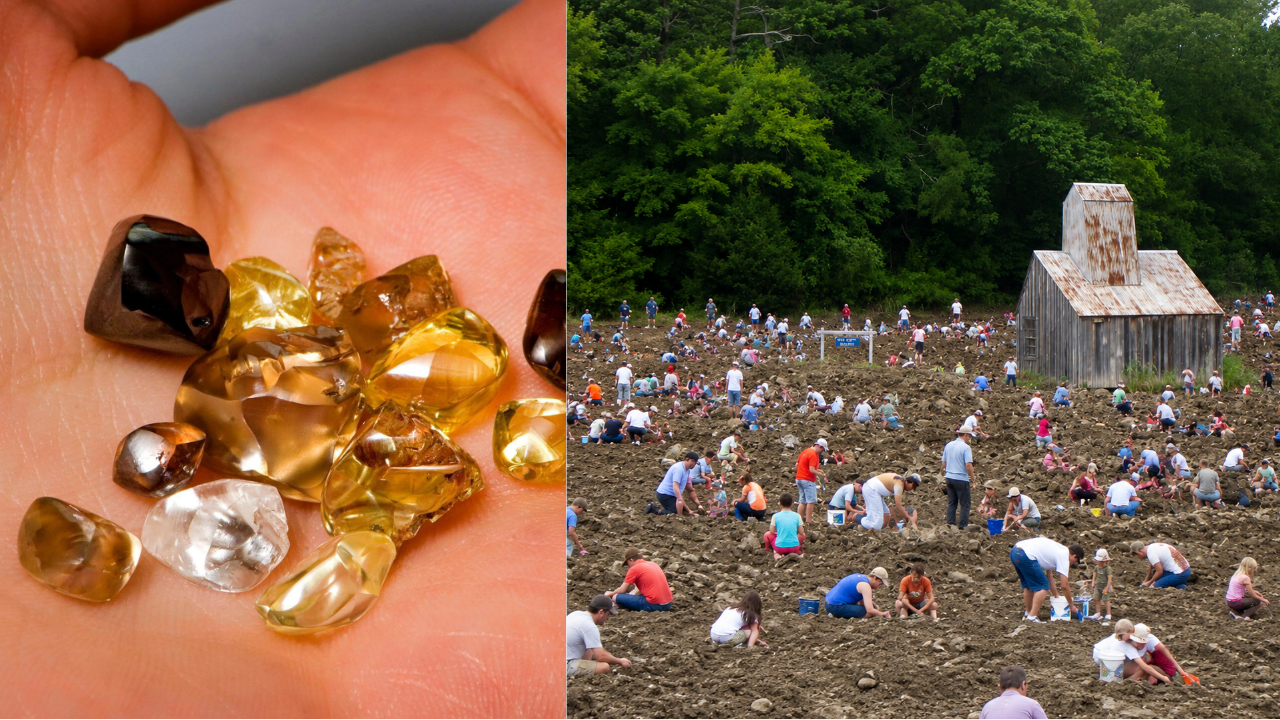
The concept of a public diamond reserve operating under an absolute "finders keepers" policy appears structurally counterintuitive to traditional extraction economics. At Crater of Diamonds State Park in Murfreesboro, Arkansas, visitors have registered more than 37,300 diamonds since the site transitioned to public management in 1972, with aggregate discoveries exceeding 75,000 gems since the initial 1906 surface discovery. While commercial mining entities abandoned the site due to capital inefficiencies and low ore grades, the state of Arkansas has sustained an economically viable tourism ecosystem. The viability of this public reserve relies on three interdependent mechanisms: specific geological volatility, an unconventional shift in extraction labor costs, and a highly optimized mineral sorting strategy.
The Geological Framework of the Prairie Creek Diatreme
The presence of elemental carbon crystals within a 37.5-acre search field is dictated by the Prairie Creek Diatreme, an 83-acre Early Cretaceous volcanic pipe. Understanding the extraction environment requires separating the age of the host rock from the age of the gems themselves.
MANTLE (Depth > 93 miles)          CRUST (Surface Eruption)
[3.2 Billion Years Ago] ---------> [106 Million Years Ago]
Diamond stabilization              Explosive lamproite conduit
- Genesis and Thermal Stability: The diamonds originated roughly 3.2 billion years ago within harzburgitic peridotite and eclogite host regions of the Earth's mantle. Formation required pressures near 5 GPa and temperatures stabilizing around 1,000°C.
- The Transport Mechanism: Approximately 106 million years ago, a deep-seated mantle melting event forced magmatic and pyroclastic lamproite upward through Cretaceous sedimentary strata. This explosive volcanic conduit acted as an elevator, carrying mantle xenoliths and xenocryst diamonds rapidly to the surface, bypassing the standard thermal degradation that converts carbon into graphite during slower ascents.
- The Weathering Advantage: Unlike classic South African kimberlite pipes, the primary diamond-bearing matrix here is a soft, phlogopite-rich pyroclastic lamproite. This material features high susceptibility to chemical and physical weathering. The state park capitalizes on this vulnerability by mechanically plowing the 37.5-acre open field on a regular cycle. This deliberate intervention accelerates the decomposition of the host matrix, exposing liberated gems without requiring energy-intensive industrial crushing.
The Labor Inversion: Turning Cost into Revenue
Commercial mining operations are bound by strict operating expense (OPEX) frameworks. The United States Bureau of Mines evaluated the site's industrial viability by excavating 435 tons of material down to a depth of 50 feet, yielding a sparse average of 0.25 carats per ton. In traditional corporate mining, the labor and heavy equipment costs required to process such low-yield ore generate a structural deficit.
Commercial Extraction Model:
Yield (0.25 carats/ton) < OPEX (Wages + Machinery + Processing) = Structural Deficit

Public Extraction Model:
Yield (Variable) + Ticket Sales + Tool Rentals - Zero Labor Overhead = Fiscal Surplus
The public park model completely flips this cost function. By shifting the labor requirement from paid employees to paying tourists, the state eliminates the primary financial bottleneck of low-grade ore extraction.
The economic model shifts from an asset-sale paradigm to an experiential service framework. Visitors pay an entry fee for the right to harvest resource wealth, transferring the financial risk of a zero-yield day entirely onto the laborer. The park further optimizes revenue through vertical integration, renting manual sorting kits, screens, shovels, and specialized sifting tools. The state generates guaranteed margins on the extraction process itself, irrespective of actual mineral yield.
Yield Dynamics and Sorting Typologies
Total registered finds average approximately two diamonds per calendar day, resulting in a annualized yield of roughly 600 to 700 diamonds. The distribution of these discoveries follows a stark power-law curve: the vast majority of finds consist of microscopic or low-carat industrial specimens, while highly publicized multi-carat gems occupy the extreme tail.
Diamonds recovered within the park populate three distinct color profiles: white (clear), brown (chocolate), and yellow (canary). The physical properties of these stones demand distinct searching methodologies, which visitors execute across three operational tiers.
Surface Hunting
This strategy relies purely on visual inspection after heavy rainfall events. Because diamonds possess a hydrophobic surface and a high refractive index, they do not retain dirt particles easily. When rainwater cleans the plowed field, liberated gems reflect sunlight efficiently against the dark, wet lamproite soil. This approach requires zero equipment but depends entirely on environmental cycles.
Dry Sifting
This technique targets the upper layer of dehydrated topsoil. Operators utilize a series of graduated wire mesh screens to isolate specific grain sizes. By shaking dry soil through coarse mesh, larger rocks are discarded, while a secondary fine mesh retains smaller heavy minerals. This method is effective for identifying small, surface-level crystals but is constrained by dust interference and human visual fatigue.
Wet Sifting (The Saruca Method)
The most rigorous and scientifically sound approach practiced at the reserve is wet sifting, utilizing a specialized circular screen known as a saruca. This process exploits the high specific gravity of diamonds ($3.52\text{ g/cm}^3$) relative to the surrounding lamproite matrix and common silicate minerals ($2.65\text{ g/cm}^3$).
- Submersion and Agitation: The operator places soil into a nested screen set and submerges it in a water trough, washing away light clays and silt.
- Gravitational Stratification: The operator applies a specific, rhythmic up-and-down jigging motion coupled with a circular twist. This movement creates a localized fluid bed within the screen.
- Centripetal Concentration: The heavier components—including diamonds, jasper, garnet, and iron-rich minerals—sink to the bottom and migrate toward the exact center of the screen due to centripetal forces.
- The Flip: The operator rapidly inverts the screen onto a flat inspection surface. If a diamond is present in the sample, it will sit directly on top, at the center of the concentrated mineral mound.
Systemic Risks and Operational Constraints
The primary vulnerability of this public extraction model lies in its dependence on non-renewable resource depletion. Volcanic pipes possess finite geometry; the diamond-bearing lamproite within the 37.5-acre search zone does not regenerate.
While seasonal plowing brings unworked material to the surface, the top layer of ore is continuously depleted by thousands of hours of manual sifting. Unlike commercial mines that can track a vertical ore body downwards through shaft sinking or open-pit scaling, a public state park cannot safely allow tourists to dig deep vertical shafts. The extraction zone is functionally restricted to near-surface regolith.
The second limitation involves the systemic information asymmetry regarding total yield. The park records rely entirely on voluntary self-reporting at the Diamond Discovery Center. While visitors have a strong social incentive to register large, high-value stones for validation and historical tracking—such as the flawless 3.09-carat Strawn-Wagner Diamond or the 40.23-carat Uncle Sam—there is no regulatory mechanism to prevent visitors from pocketing small or industrial-grade gems unregistered. Consequently, the actual historical yield of the Prairie Creek pipe under public management is likely higher than the 37,300 registered stones suggest, making precise statistical modeling of the remaining resource density impossible.
The optimal strategy for a prospective extractor requires balancing labor velocity against processing volume. Because the distribution of diamond mass is heavily skewed toward small stones, maximizing total volume processed via wet sifting yields the highest probability of a successful find. However, the highest financial return per hour of labor remains tethered to the low-probability, high-impact event of a major surface find immediately following a convective thunderstorm. High-efficiency hunters should monitor local meteorological data to deploy capital and labor when natural erosion maximizes surface visibility, rather than relying on continuous, random excavation.