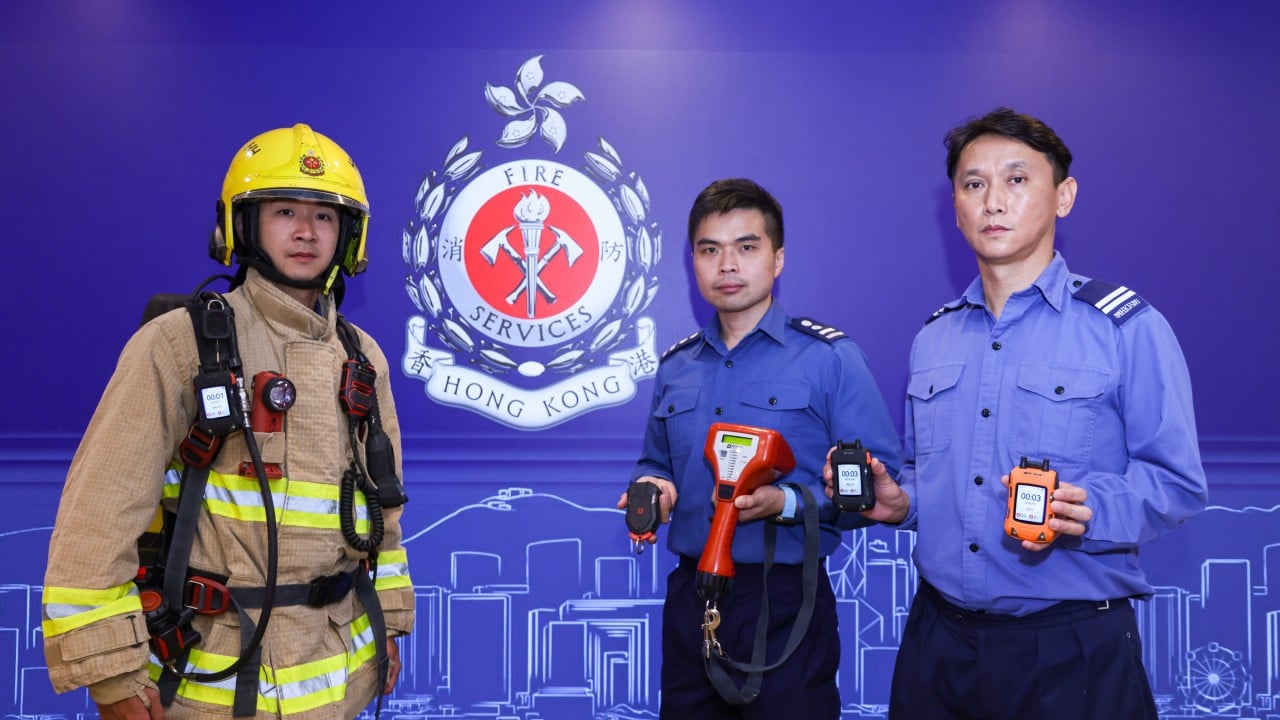
Allocating HK$8.4 million to deploy indoor positioning systems for Hong Kong firefighters is not a routine equipment purchase; it is an attempt to solve one of the hardest localization problems in applied physics while correcting a fatal command-and-control vulnerability exposed during the Tai Po fire. Standard emergency response relies on external perimeter accountability—marking entry times on physical boards and maintaining intermittent voice contact over ultra-high frequency (UHF) radio. When structural integrity degrades, visibility drops to zero, and radio channels saturate, those manual protocols fail instantly. The HK$8.4 million capital allocation represents a structural shift from reactive voice-based tracking to continuous, automated telemetry, though the operational return on this investment depends entirely on which underlying sensor architecture the Fire Services Department deploys and how well that architecture survives extreme thermal and structural interference.
The Accountability Deficit in High-Density Urban Fires
To understand the necessity of this expenditure, one must map the failure modes of legacy firefighter accountability systems. In high-rise and compartmentalized industrial fires—the exact profile of modern Hong Kong urban architecture—incident commanders manage personnel across three spatial dimensions without direct line of sight. For a different perspective, check out: this related article.
Legacy accountability operates on three fragile mechanisms:
- Entry Control Boards (ECBs): Breathing apparatus (BA) control officers manually record the time a team enters a hazard zone, their cylinder pressure, and their assigned sector. This provides a static snapshot of intent, not a dynamic record of location. Once a crew breaches a smoke-logged floor, their actual coordinates diverge rapidly from their assigned sector as they navigate around collapsed debris or search for fire seats.
- Voice Telemetry via UHF/VHF Radio: Commanders rely on periodic verbal sitreps. Under high cognitive and physiological load, firefighters experience auditory exclusion and tunnel vision. Transmitting accurate spatial coordinates while dragging charged hoselines through zero-visibility environments degrades search speed and increases air consumption. Furthermore, concrete-and-rebar construction attenuates radio frequencies, creating dead zones precisely where crews face the highest risk of entrapment.
- Personal Alert Safety Systems (PASS): Traditional PASS devices are acoustic motion sensors worn on the harness. If a firefighter remains motionless for roughly 20 to 30 seconds, the unit emits a high-decibel alarm to guide nearby rescuers. The fatal flaw of an acoustic PASS is localized range; thick concrete walls, roaring fire, and positive-pressure ventilation fans easily mask an 95-decibel alarm from a Rapid Intervention Team (RIT) operating just one floor away.
The Tai Po incident demonstrated that when these three mechanisms fail simultaneously, rescue operations revert to blind grid searches. Searching a multi-story structure without telemetry turns a targeted extraction into a statistical probability problem, burning through the air supply of rescue teams while the trapped firefighter's survivability window closes. Further reporting on this matter has been shared by The Verge.
The Physics of Indoor Localization Under Extreme Conditions
Deploying an indoor tracking system in a burning building is fundamentally different from asset tracking in a warehouse or hospital. Consumer and commercial indoor positioning relies on existing infrastructure—Wi-Fi access points, Bluetooth Low Energy (BLE) beacons, or Global Navigation Satellite Systems (GNSS). In a structure fire, GNSS signals cannot penetrate reinforced concrete, and municipal power is routinely cut by fire crews to prevent electrocution, rendering building-installed Wi-Fi and BLE infrastructure dead on arrival.
Any viable system funded by the HK$8.4 million allocation must operate independently of host-building infrastructure while maintaining sub-meter accuracy across three axes (X, Y, and Z). Three primary technological architectures address this constraint, each carrying distinct physical trade-offs.
Inertial Navigation Systems (INS) and Zero-Velocity Updates
Boot-mounted or waist-mounted Inertial Measurement Units (IMUs) use micro-electromechanical systems (MEMS)—specifically tri-axial accelerometers and gyroscopes—to calculate displacement from a known starting point outside the structure via dead reckoning.
The primary mathematical vulnerability of dead reckoning is double-integration drift. Accelerometer noise integrated once yields velocity error; integrated twice, it yields position error that grows exponentially over time. Within five minutes of dynamic movement, an uncompensated MEMS IMU can drift by tens of meters, placing a firefighter in the wrong room or outside the building footprint entirely.
Engineers mitigate this drift using Zero-Velocity Update (ZUPT) algorithms. By mounting the sensor on the boot, the algorithm detects the brief stance phase of every footstep when the foot's true velocity is zero, resetting the accumulated velocity error. However, ZUPT fails when firefighters abandon normal walking gaits. Crawling beneath a thermal layer, sliding down stairs, or being dragged by a teammate eliminates the distinct stance phase, causing positional error to spike rapidly during the exact moments a firefighter is most likely to be incapacitated.
Ultra-Wideband (UWB) Mesh Topologies
Ultra-Wideband transceivers transmit nanosecond-scale pulses across a wide frequency spectrum (typically 3.1 to 10.6 GHz). By measuring the Time of Flight (ToF) or Time Difference of Arrival (TDoA) of these pulses between nodes, UWB systems achieve spatial accuracy within 10 to 30 centimeters—far superior to received signal strength indicator (RSSI) methods used in standard radio.
Because the target building lacks pre-installed anchors, firefighters must establish an ad-hoc UWB mesh network dynamically. Firefighters drop battery-powered UWB "breadcrumb" nodes at entry points, stairwells, and corridor intersections as they advance. Each firefighter wears a transceiver tag that communicates with the dropped nodes and adjacent crew members.
The operational friction of UWB lies in hardware logistics and signal attenuation:
- Deployment Overhead: Carrying and manually deploying bread-crumb nodes adds weight and cognitive tasks to crews already burdened with 25 to 30 kilograms of personal protective equipment, SCBA cylinders, and forcible entry tools.
- Non-Line-of-Sight (NLOS) Bias: While UWB penetrates drywall and light partitions effectively, dense reinforced concrete, water curtains from firefighting hoses, and heavy steel fire doors delay or scatter the radio pulses, introducing positive bias into Time-of-Flight calculations that skews altitude (Z-axis) readings.
Barometric Altimetry for Z-Axis Resolution
In multi-story environments, knowing a firefighter's X-Y coordinates is useless without knowing which floor they occupy. Mistaking the 4th floor for the 5th floor costs a Rapid Intervention Team three to five minutes of breach-and-search time.
Modern firefighter tracking suites pair horizontal localization (INS/UWB) with high-precision barometric pressure sensors to resolve the Z-axis. Because atmospheric pressure drops predictably with altitude (roughly 12 Pascals per meter near sea level), a differential barometer comparing the firefighter's unit against a reference base station outside the building can determine floor elevation within half a meter.
Yet fire dynamics actively corrupt barometric data. Rapid thermal expansion of gases in an enclosed compartment increases localized atmospheric pressure, making the barometer read as though the firefighter has descended several floors. Conversely, mechanical positive-pressure ventilation (PPV) fans deployed at building entrances artificially pressurize stairwells, distorting the pressure differential between the interior and the exterior base station.
Capital Allocation Anatomy of HK$8.4 Million
In public safety procurement, headline figures like HK$8.4 million (approximately US$1.08 million) are frequently misread as hardware-only budgets. When analyzed through the lens of enterprise defense and emergency-services procurement, capital deployment for specialized tactical telemetry breaks down into four distinct cost buckets.
Hardware Acquisition and Intrinsic Safety Certification
Tactical wearables cannot use commercial off-the-shelf enclosures. Every transmitter, battery pack, and sensor housing entering an explosive or high-heat atmosphere must meet strict thermal resistance and Intrinsic Safety (IS) standards (such as ATEX or IECEx). Intrinsic safety ensures that the device cannot generate a spark or thermal effect capable of igniting flammable gases—a critical requirement in industrial zones like Tai Po where chemical storage or gas leaks frequently accompany structural fires.
Certifying electronics to survive flashover-adjacent temperatures (up to 260 degrees Celsius for short durations) without thermal runaway in lithium-ion batteries multiplies unit hardware costs by a factor of three to five compared to industrial equivalents. Assuming a per-unit kit cost (wearable transceiver, inertial module, and shared mesh nodes) between HK$15,000 and HK$25,000, an HK$8.4 million budget equips roughly 300 to 400 active personnel—enough to outfit specialized rescue units, breathing apparatus teams, and select high-risk divisions rather than the entire multi-thousand-person force.
Command-and-Control Software and Visualization Engines
Raw coordinate streams are useless to an incident commander standing in a noisy, rain-soaked street. The software layer must ingest multi-sensor telemetry and render it onto a three-dimensional wireframe or floor plan in real time.
This requires developing or licensing a tactical visualization engine capable of operating on ruggedized tablets at the incident command post. The software must fuse telemetry with physiological or equipment data—such as remaining SCBA air pressure and automated distress triggers—while filtering out sensor noise so icons do not erraticly jump across walls on the commander's screen.
Infrastructure Integration and Maintenance Reserve
Public sector budgets must account for multi-year lifecycle costs rather than single-year capital expenditure. This includes:
- Data Backhaul: Establishing reliable cellular or dedicated microwave links between the on-scene incident command post and central headquarters so senior command can monitor major incidents remotely.
- Calibration and Battery Replacement: Barometric and inertial sensors require periodic firmware updates and recalibration, while high-discharge batteries degrade rapidly under repeated thermal cycling.
- Training Overhead: Technology introduced without muscle-memory integration becomes a liability during emergencies. Budget allocation must fund simulation drills where BA control officers practice managing digital tracking interfaces alongside physical entry boards.
Operational Integration and Human Factors
The primary failure point of advanced firefighting technology is rarely the silicon; it is the human-machine interface under acute physiological stress. Introducing digital tracking changes the workflow of both the interior crew and the exterior command team, creating specific operational bottlenecks that must be managed through strict standard operating procedures.
Information Overload at the Command Post
An incident commander at a multi-alarm fire processes dozens of competing data streams: water supply pressures, structural collapse indicators, civilian evacuation statuses, and sector progress reports. Adding real-time 3D tracking icons for 20 to 40 interior firefighters introduces the risk of cognitive saturation.
If the interface requires the commander to manually pan, zoom, and toggle between floors to track individual movements, the system will be abandoned during peak incident escalation. Effective integration requires automated exception-based alerting. The software must remain visually quiet during normal operations and generate high-contrast visual and auditory alerts only when specific thresholds are breached: a sudden vertical drop indicating floor collapse, a stationary timer exceeding 20 seconds, or an icon crossing into a designated structural exclusion zone.
The Latency-Reliability Trade-Off in Mesh Networks
Wireless telemetry inside steel-and-concrete structures operates on a narrow bandwidth budget. Lower radio frequencies (sub-1 GHz) penetrate concrete walls effectively but offer low data rates, restricting transmissions to basic coordinates and status flags every few seconds. Higher frequencies (2.4 GHz or UWB) provide high bandwidth and precise ranging but suffer severe attenuation through wet concrete and dense smoke particulates.
Consequently, the system cannot guarantee continuous, zero-latency streaming from deep underground basements or reinforced cold-storage facilities—structures common in industrial districts. Commanders must treat the tracking display as a probabilistic aid rather than an absolute truth. Relying exclusively on a digital screen to confirm a firefighter's safety creates automation bias; if a transceiver battery fails or a signal drops in a dead zone, a commander conditioned to trust the screen may delay initiating physical voice checks or deploying a Rapid Intervention Team.
Strategic Imperatives for Deployment
To maximize the life-safety return on the HK$8.4 million investment and prevent the system from becoming shelfware after initial rollout, the Fire Services Department must execute three operational controls:
- Prioritize Hybrid Sensor Fusion Over Single-Modality Tracking: Procurement specifications must mandate a multi-sensor fusion engine combining boot-mounted IMUs, differential barometers, and ad-hoc UWB/sub-GHz mesh transceivers. Relying on inertial dead reckoning alone guarantees unacceptable drift during crawling operations, while relying on radio ranging alone fails in reinforced concrete basements.
- Enforce Dual-Redundancy Accountability Protocols: Digital tracking must augment, not replace, physical Entry Control Boards and mandatory radio sitreps for at least the first 24 months of deployment. Standard operating procedures should treat a loss of telemetry signal in an active hazard zone with the same urgency as a missed radio check-in, triggering immediate RIT staging.
- Concentrate Allocation on High-Risk Structural Profiles: Rather than diluting the HK$8.4 million across low-risk residential stations, hardware deployment should be concentrated in specialized rescue squads and divisions covering high-density industrial estates, subterranean transit hubs, and aging composite buildings where complex floor layouts and hazardous materials create the highest probability of firefighter disorientation.