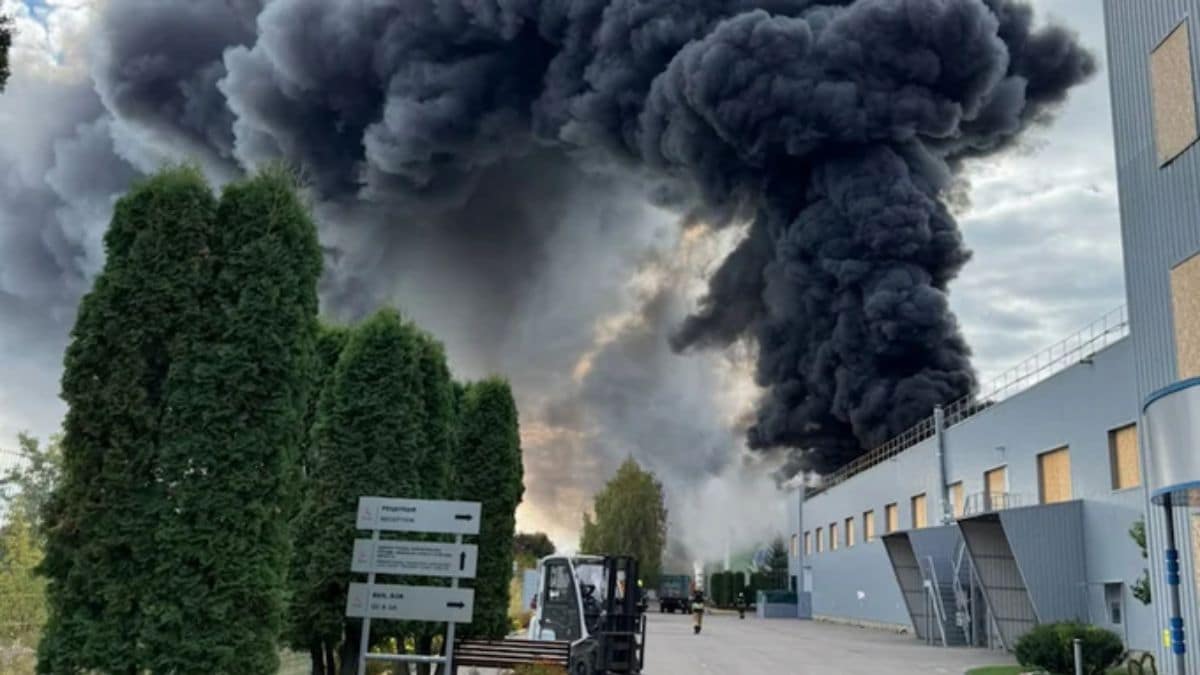
The destruction of the Kusum Group pharmaceutical facility in Sumy, Ukraine, by Russian drone strikes marks a critical intersection of geopolitical conflict, supply chain fragility, and cross-border corporate exposure. Valued at upwards of 400 crore rupees ($50 million) in total projected damages, the event transcends a simple localized casualty report. It exposes the structural hazards of maintaining fixed physical assets within active conflict zones and highlights the compounding friction of international operational risk management.
The Cost Function of Cross-Border Operations
When an enterprise chooses to sustain manufacturing operations inside a theater of war, it engages in a high-stakes calculus involving capital preservation versus market retention. The Kusum Group, an enterprise with Indian roots founded in 1994 as a distributor and expanded into local manufacturing in Sumy by 2009, operated its facility through years of active hostilities.
The decision matrix for maintaining active production under such conditions relies on three primary variables:
- Replacement Cost vs. Sunk Capital: Fixed assets, cleanrooms, specialized synthesis machinery, and cold-chain storage infrastructure cannot be evacuated or easily replicated.
- Market Share Persistence: Abandoning a regional distribution network often results in permanent displacement by domestic or alternative foreign competitors.
- Insurance and Risk Premiums: Commercial underwriting for war-risk zones typically excludes direct kinetic damage, transferring the entire tail risk directly to the corporate balance sheet.
When six drones converged on the facility, targeting its engineering infrastructure and resulting in one fatality alongside multiple injuries, the financial equation inverted instantly. Management estimates indicate that reconstruction and operational recovery will require a timeline of one to two years, effectively neutralizing the plant's economic utility in the medium term.
The Mechanics of Kinetic Targeting in Civil Infrastructure
The operational profile of the attack reveals critical shifts in tactical employment by Russian forces. The utilization of massed drone saturation—including jet-powered variants alongside standard loitering munitions—overwhelms localized point-defense networks.
For industrial facilities, vulnerability is a function of three physical properties:
- Geometric Signature: Large square-footage footprints dedicated to warehousing and generic drug synthesis make visual and electronic concealment virtually impossible.
- Dual-Use Ambiguity: Pharmaceutical manufacturing plants house chemical inputs, power generation backups, and logistics hubs. In total war economies, these characteristics frequently complicate the operational distinctions between civilian industrial assets and military logistics nodes.
- Proximity to Contested Borders: Sumy’s geographic placement near the northeastern frontier places it within rapid-response range of short-range tactical drones and artillery, drastically compressing early-warning intervals.
The strike on the engineering department, which resulted in the loss of critical technical personnel, underscores a secondary vulnerability: human capital concentration. Specialized pharmaceutical engineers cannot be easily replaced in a wartime labor market marked by mass migration and active mobilization.
Supply Chain Contagion and Regional Pharmacoeconomics
The disruption of the Sumy plant ripples outward through regional pharmaceutical markets. Kusum produces over fifty generic formulations distributed across Ukraine, Uzbekistan, Kazakhstan, and other emerging markets.
The systemic effects manifest across specific economic vectors:
- Inventory Depletion: Existing buffer stocks located in unaffected warehouses mitigate immediate shortages, but inventory run-out rates accelerate linearly with prolonged reconstruction timelines.
- Substitution Friction: Transitioning generic drug procurement to alternative manufacturing hubs in India or Western Europe introduces regulatory certification delays, higher freight costs, and currency conversion exposure.
- Price Elasticity: As local supply contracts, public health procurement costs rise, placing additional fiscal pressure on regional health ministries already burdened by wartime expenditures.
Strategic Forecast and Asset Allocation Dynamics
The destruction of cross-border industrial assets like the Sumy plant forces a fundamental reassessment of foreign direct investment (FDI) resilience in sovereign conflict zones.
Multinational enterprises operating in high-risk jurisdictions must transition from reactive crisis management to formal asset-hardening strategies. This involves three mandatory operational adjustments:
- Asset Decentralization: Disaggregating monolithic manufacturing plants into modular, smaller-scale production units reduces the single-point-of-failure concentration risk.
- Inventory Buffering: Maintaining multi-month offshore reserve stocks outside the operational theater to decouple current sales from localized physical destruction.
- Dynamic Exit Thresholds: Establishing pre-computed financial triggers that mandate plant mothballing and personnel extraction before localized conflict intensity crosses critical kinetic thresholds.
The Kusum Group incident confirms that fixed industrial capital within an active war zone operates on borrowed time. Future corporate strategy must price kinetic destruction not as an anomalous tail risk, but as a deterministic certainty when operating under saturated drone warfare conditions.

