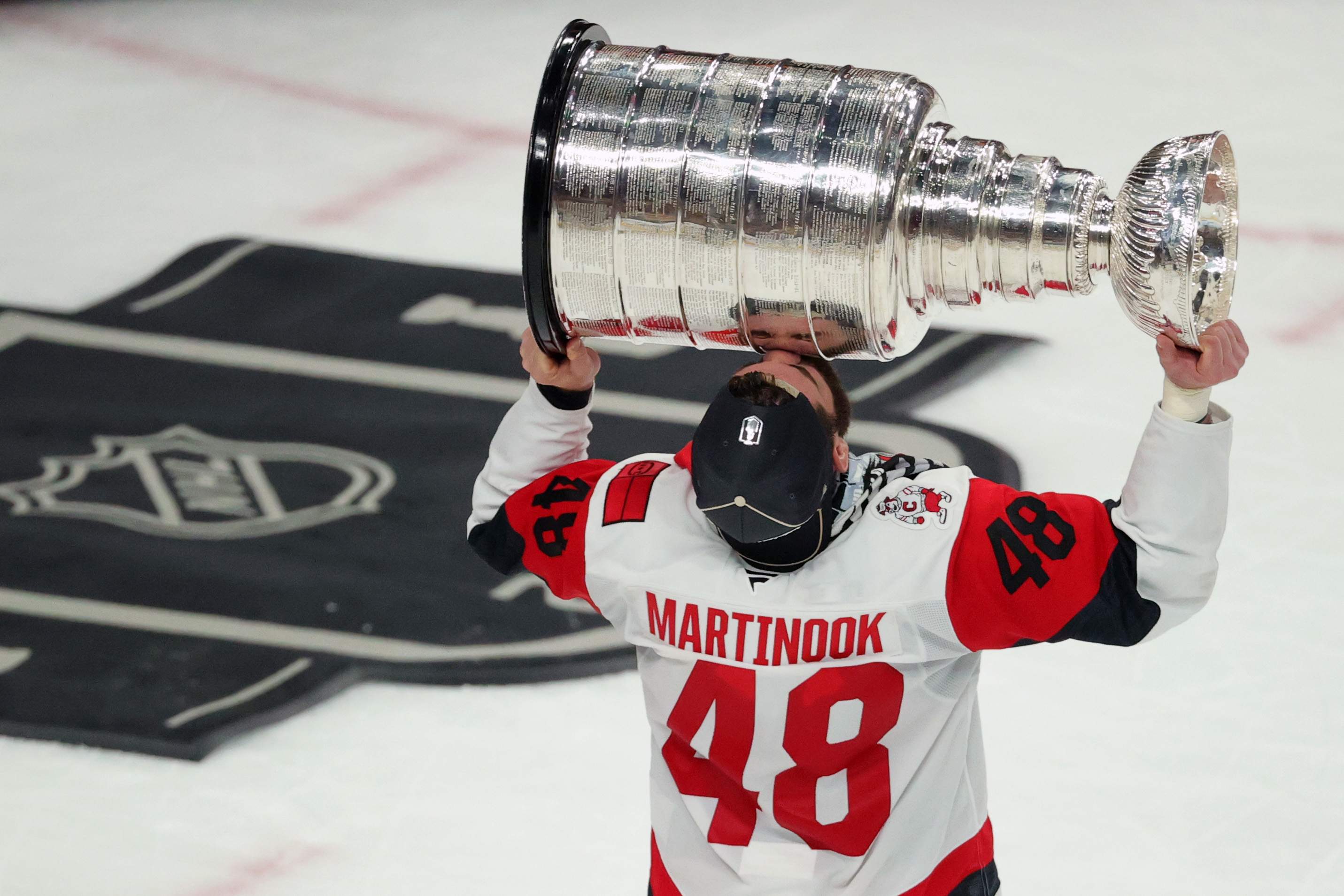
The modern professional sports ecosystem operates on a dual engine of hyper-centralized media distribution and localized emotional retention. When an elite asset like the Stanley Cup is transported from a major league market to a secondary or tertiary municipality such as Leduc, Alberta, the transaction is often framed purely through the lens of romanticism. This perspective misses the underlying structural mechanics. The return of a championship trophy to a player's foundational community represents a concentrated injection of social capital, a localized public relations multiplier, and an operational stress test for municipal logistics.
Deconstructing Jordan Martinook bringing the Stanley Cup to Leduc requires evaluating the anatomy of sports migration, the mechanics of community-level economic signaling, and the depreciation curve of professional athletic output. By stripping away the celebratory rhetoric, the event reveals a predictable sequence of institutional engagement, brand equity transfer, and civic identity reinforcement.
The Tripartite Framework of Trophy Localization
When a professional athlete secures a major championship, the distribution of access rights follows a strict contractual protocol dictated by league authorities. The player receives a finite window—typically one day—to allocate the trophy's physical presence. This allocation strategy exposes a calculated framework of priorities that can be categorized into three distinct operational pillars: foundational acknowledgment, peer validation, and public asset distribution.
The first pillar centers on the foundational geography. For Martinook, a journeyman forward known for high defensive utilization and cultural leadership within an NHL locker room, Leduc serves as the origin point of his developmental pipeline. Returning the trophy here is not merely sentimental; it is an efficient allocation of scarce relational capital. In economic terms, the marginal utility of displaying the Stanley Cup in a major metropolitan center where championships are common approaches zero. Conversely, the marginal utility of deployment in a community of roughly thirty-three thousand residents creates an asymmetric return on community goodwill.
The second pillar involves peer and institutional validation. The logistics mandate physical movement through minor hockey infrastructure, local municipal facilities, and private gatherings with early-stage coaches, billet families, and amateur organizations. This mechanism reinforces the local sports ecosystem by creating a direct causal link between localized minor hockey participation and ultimate professional achievement. It provides empirical proof of attainability for a demographic that statistically faces prohibitive barriers to entry in major professional leagues.
The public asset distribution forms the final pillar. Unlike a private trophy or an individual award, the Stanley Cup carries institutional heritage that supersedes any single player. Transporting the object into a public square or community arena requires crowd control dynamics, security protocols, and municipal coordination that mirrors small-scale event management. The municipality absorbs temporary congestion costs in exchange for permanent narrative reinforcement, cementing the city's status as a producer of elite athletic talent rather than a mere consumer of televised sports entertainment.
The Labor Economics of the Supporting Forward
To understand the cultural resonance of Martinook's victory, one must analyze the economic profile of the player archetype he represents. In modern hockey analytics, star players command the vast majority of salary cap allocation and media focus. However, roster construction theory dictates that championship sustainability relies entirely on the surplus value generated by bottom-six forwards—players whose contract cost-to-production ratio heavily favors the franchise.
Martinook operates within the category of the high-tempo checking winger. These assets are defined by metrics that traditional box scores routinely undervalue: zone-entry denial, shot-suppression rates, penalty-kill efficiency, and locker room cohesion indices. The physical and psychological toll required to maintain this style of play over an eighty-two-game regular season followed by a four-round playoff gauntlet is immense.
When a player without elite offensive point production captures a championship, the community narrative shifts. It validates an operational model based on resilience, role clarity, and incremental optimization rather than raw genetic lottery outcomes. In corporate strategy terms, this mirrors the recognition of operational excellence over executive-level vision alone. The celebration in Leduc functions as an organizational case study in organizational psychology: it proves that systemic utility and physical sacrifice yield the highest possible organizational reward.
Municipal Logistics and Capital Allocation
Executing a public Stanley Cup visitation event in a municipality the size of Leduc requires navigating a complex set of operational constraints. Unlike major urban centers with dedicated event-management divisions, secondary cities must absorb these transient spikes in demand using existing municipal overhead.
The security apparatus alone demands coordination between local detachment services, municipal bylaws enforcement, and private logistics teams contracted by the league. Crowd density management around open-air viewing areas introduces liabilities that must be mitigated through strict perimeter control and regulated queuing systems. The opportunity cost for local governance involves the temporary reallocation of public servants from standard municipal duties to event containment.
Yet, the return on this public expenditure is realized through intangible economic velocity. Local businesses—ranging from hospitality providers to minor hockey retail outlets—experience localized revenue spikes during the visitation window. More importantly, the event functions as a decentralized marketing campaign for the municipality itself. Media syndication of a player celebrating a world-class championship in a specific regional context provides brand exposure that municipal economic development boards could not replicate through traditional advertising channels.
The Lifecycle of Regional Sports Heroism
The trajectory of a professional athlete from a local minor hockey association to hoisting the Stanley Cup follows a strict lifecycle model that dictates how communities consume sports narratives. This lifecycle is governed by three distinct phases: extraction, transition, and repatriation.
During the extraction phase, young athletes leave their home municipalities to enter higher-tier developmental leagues, junior systems, and ultimately the major junior or collegiate pipelines. This phase represents a net export of local talent. The community invests time, volunteer hours, and facility usage into the athlete with zero direct financial return.
The transition phase occurs when the athlete enters the professional tier. Here, the local community shifts from an active developer to a passive consumer, following the athlete's career via broadcast media and remote tracking. The geographic distance between the municipality and the professional franchise creates a disconnect in direct stakeholder value.
The repatriation phase—exemplified by the Stanley Cup tour—closes the loop. By bringing the physical artifact of the championship back to the geographic origin, the athlete executes a retroactive distribution of dividends. The community’s early-stage investment is symbolically validated, completing an economic and social cycle that transforms abstract athletic success into tangible local pride.
Strategic Operational Recommendations for Regional Sports Governance
For secondary municipalities and regional minor sports associations seeking to maximize the long-term value of hosting a professional champion, passive celebration is an insufficient strategy. Leadership must treat the event as an organizational inflection point.
Minor hockey associations must leverage the narrative momentum to restructure grassroots recruitment models. The presence of the Stanley Cup should coincide with targeted enrollment campaigns, equipment subsidy announcements, and coaching development seminars. Capitalizing on the psychological peak of community engagement ensures that short-term enthusiasm converts into long-term systemic participation.
Municipal economic development offices must formalize the logistics playbook developed during the visit. Documenting crowd management protocols, security resource allocation, and vendor coordination creates a reusable operational framework for future high-visibility civic events. Treating a championship homecoming not as an ad-hoc celebration, but as a structured municipal project, ensures that the city maximizes return on invested public resources while minimizing operational friction.
The true utility of the Stanley Cup's arrival in Leduc lies not in the momentary display of silver, but in the structural alignment of community identity, operational resilience, and youth development pathways. By dissecting the mechanics behind the celebration, stakeholders can replicate the underlying principles of success long after the trophy has departed for its next destination.