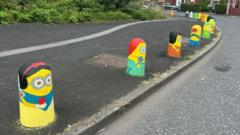
Graffiti abatement operates on a strict economic margin where municipal budgets collide with private property rights and the psychological thresholds of urban decay. When an individual intervenes in this cycle without state sanction—such as the independent actor colloquially termed the Minion Man covering obscene graffiti on an estate—they disrupt a predictable administrative pipeline. Standard journalistic coverage of such incidents relies on human-interest framing, reducing a structural breakdown in public maintenance to a quirky local anecdote. That framing misses the underlying mechanics. Property degradation follows a predictable downward trajectory known in urban planning as the broken windows dynamic, and unauthorized physical interventions reveal distinct systemic failures in asset protection, resource allocation, and liability management.
The Cost Function of Urban Defacement
Property defacement imposes an immediate economic penalty on asset holders through three distinct mechanisms: direct restoration expenditure, accelerated depreciation of real estate value, and the cognitive overhead of distress induced in neighborhood occupants. When a municipal entity or private estate manager calculates the cost of graffiti, the equation accounts for labor hours, chemical solvents, equipment mobilization, and frequency of recurrence.
$$\text{Total Cost} = \text{Labor} + \text{Materials} + (\text{Frequency} \times \text{Depreciation Rate})$$
Standard municipal response times are dictated by bureaucratic triage. High-traffic commercial zones and priority administrative districts receive rapid remediation, whereas peripheral residential estates, public housing corridors, and semi-abandoned private properties languish on low-priority waitlists. This creates a temporal gap between the act of defacement and its correction.
During this latency period, secondary economic damages compound. Unaddressed vandalism signals a lack of passive surveillance, inviting further transgressive acts including trespassing, property damage, and localized criminality. The unauthorized actor short-circuits this feedback loop by absorbing the labor and material costs independently. However, bypassing institutional channels introduces friction regarding material compatibility, aesthetic continuity, and surface preservation. Industrial masonry and heritage stonework demand specific chemical formulations to prevent permanent substrate erosion; amateur repainting using generic exterior latex often seals moisture into porous brickwork, accelerating structural degradation while solving the immediate visual offense.
The Regulatory Vacuum and Liability Exposure
Private intervention in public or semi-private space exposes a complex web of legal liabilities that standard narratives overlook. Property law distinguishes clearly between maintenance performed by a legal titleholder, an authorized contractor, and an officious intermeddler. When a citizen paints over graffiti on an estate boundary without explicit authorization, they operate in a legal grey zone defined by potential charges of criminal mischief, property alteration, or trespassing, regardless of their benevolent intent.
Asset managers face an operational dilemma when confronted with unauthorized remediation. Accepting the free labor reduces immediate operating expenditures, but it compromises quality control and creates a dangerous legal precedent. If a well-intentioned volunteer applies incorrect coatings to a protected surface, the property owner incurs a higher long-term restoration bill to reverse improper mitigation. Furthermore, if the actor sustains an injury while performing unauthorized labor on private premises, the property owner or municipal body may face severe liability claims under premises liability statutes.
The phenomenon highlights a broader institutional vulnerability: the inability of formal systems to police every linear foot of urban infrastructure consistently. Municipalities rely on citizen reporting mechanisms, such as 311 hotlines or dedicated mobile applications, to crowd-source asset monitoring. Unauthorized physical intervention represents a mutation of this crowd-sourcing model, shifting from passive observation to active, non-sanctioned physical execution.
Psychological Thresholds and Vigilante Maintenance
The urge to remediate disorder without institutional backing stems from a distinct psychological reaction to visual pollution. Environmental psychologists have long established that immediate surroundings dictate human behavioral expectations. A defaced perimeter wall acts as a visual anchor for social friction, lowering the perceived barrier to subsequent rule-breaking behaviors.
Independent actors who take asset preservation into their own hands are motivated by a desire to reset the local equilibrium. By masking obscene imagery or hostile markings, they alter the signaling environment, reassuring residents and deterring repeat offenders who rely on the canvas remaining visible to achieve their psychological objectives.
However, this form of informal maintenance borders on vigilantism when it intersects with public space governance. Communities cannot sustainably outsource infrastructure maintenance to itinerant volunteers or costume-wearing hobbyists. Relying on ad-hoc interventions exposes a structural vulnerability in civic upkeep: when municipal agencies fail to maintain baseline aesthetic standards, private citizens step into the administrative vacuum. This substitution effect indicates that public service delivery is lagging behind community expectations, forcing a privatization of municipal upkeep through informal, uncompensated labor pools.
To eliminate the systemic conditions that invite unauthorized intervention, asset managers and local governments must restructure their operational response models. Establishing rapid-deployment abatement teams dedicated exclusively to offensive or obscene imagery can shrink the latency period between defacement and removal, rendering independent intervention obsolete and preserving the integrity of both municipal infrastructure and private property rights.



/getty-brown-bear-56afcf215f9b58b7d01d5195.jpg)