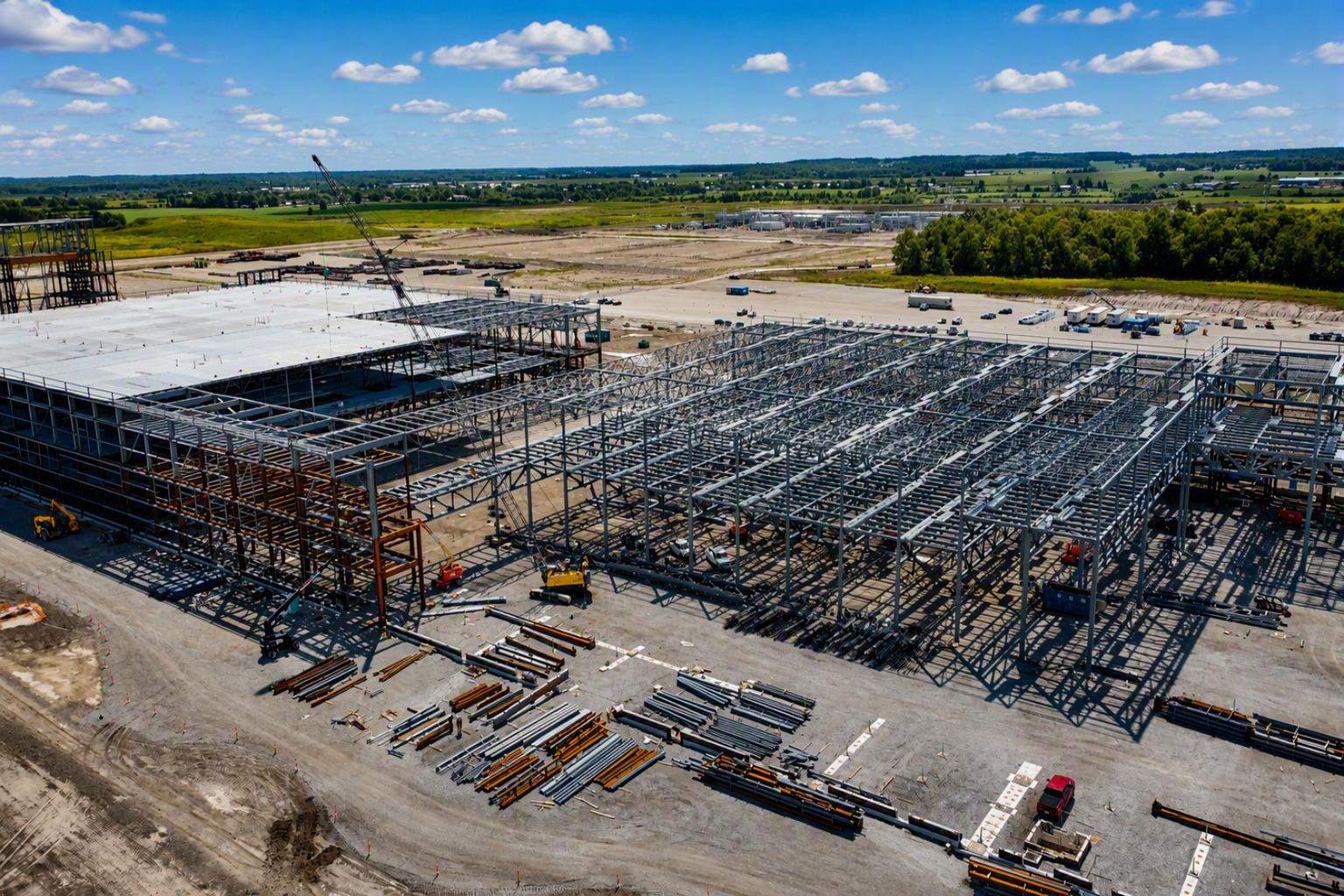
Capital expenditure discipline in the automotive sector requires matching asset creation velocity with adoption curve realities. When PowerCo, the battery subsidiary of Volkswagen Group, announced a two-year postponement of its St. Thomas, Ontario facility to 2029, it exposed the structural friction between macro-level industrial policy subsidies and micro-level capacity utilization math. This analysis deconstructs the underlying drivers of the schedule revision, the cost function of delayed capital deployment, and the regional supply chain adjustments triggered by the recalibration.
The Cost Function of Retarded Capacity
Megaprojects of this magnitude operate under strict Net Present Value constraints. The original timeline targeted commercial output by 2027, backed by a combined federal and provincial capital commitment totaling $1.2 billion in upfront subsidies ($700 million federal and $500 million provincial), alongside production-linked tax credits that scale with output. Also making headlines recently: The Soybean Blind Spot Behind Beijing Tariff Cuts.
When a facility launch is deferred by 24 months, the economic equation alters across three distinct vectors:
- Carrying Costs on Fixed Capital: Upfront public and private capital deployed into civil engineering, site grading, and foundational infrastructure sits dormant for an extended period, degrading return on invested capital.
- Inflationary Pressure on Balance Phases: Transitioning from foundational work to core electrical, mechanical, and structural phases under general contractor EllisDon exposes the remaining capital expenditure to input cost inflation.
- Subsidy Velocity Disconnect: Production-linked incentives are designed to disburse funds as cells roll off the assembly line. Deferring manufacturing output delays the realization of these operational offsets, shifting cash-flow realization deep into the decade.
The decision to delay is not merely an operational setback; it is a mathematical reaction to lagging volume absorption in Western electric vehicle markets, where consumer adoption velocity has failed to clear internal breakeven hurdles for high-cost platform rollouts. Additional information regarding the matter are explored by Investopedia.
Supply Chain Propagation Effects
A gigafactory does not operate in a vacuum. It functions as the central gravitational node for an entire regional manufacturing ecosystem. The Yarmouth Yards Industrial Park and surrounding southwestern Ontario industrial corridors were mapped on the assumption of a 2027 demand shock for raw materials, chemical precursors, and localized logistics.
The shift to 2029 creates a cascading adjustment period for tier-one and tier-two suppliers:
- Working Capital Stagnation: Component suppliers who synchronized their own capital expenditure pipelines to co-locate or secure regional warehouses now face extended carrying costs without corresponding revenue generation.
- Labor Force Bifurcation: Construction trades experience a temporal stretching rather than a compression. While peak trades employment remains intact, the density of specialized engineering and operational hiring events is redistributed across a wider window.
- Technology Risk Hedging: By explicitly citing technological advancements as a variable in the delay, PowerCo signals that cell chemistry standards are shifting faster than factory re-tooling cycles can comfortably absorb. Committing to 2027 infrastructure would have locked the plant into legacy prismatic or pouch cell formats, whereas a 2029 window allows integration of next-generation solid-state or high-density chemistries currently moving out of pilot labs.
Strategic Realignment for Regional Competitiveness
The structural reality of modern industrial subsidies dictates that public capital is leveraged to anchor manufacturing footprints before global competitors capture them. However, public balance sheets cannot insulate private enterprises from miscalculated market penetration rates.
To mitigate systemic risk during this extended timeline, industrial planners and regional stakeholders must shift from calendar-date dependency to milestone-based verification. Public accountability mechanisms must focus on ensuring that civil construction milestones continue uninterrupted while the technological architecture inside the shell is upgraded. The strategic imperative for regional operators is to treat the interim period as an optimization phase, locking in process efficiencies and supply chain resilience before the plant transitions from a construction site into an active production engine.