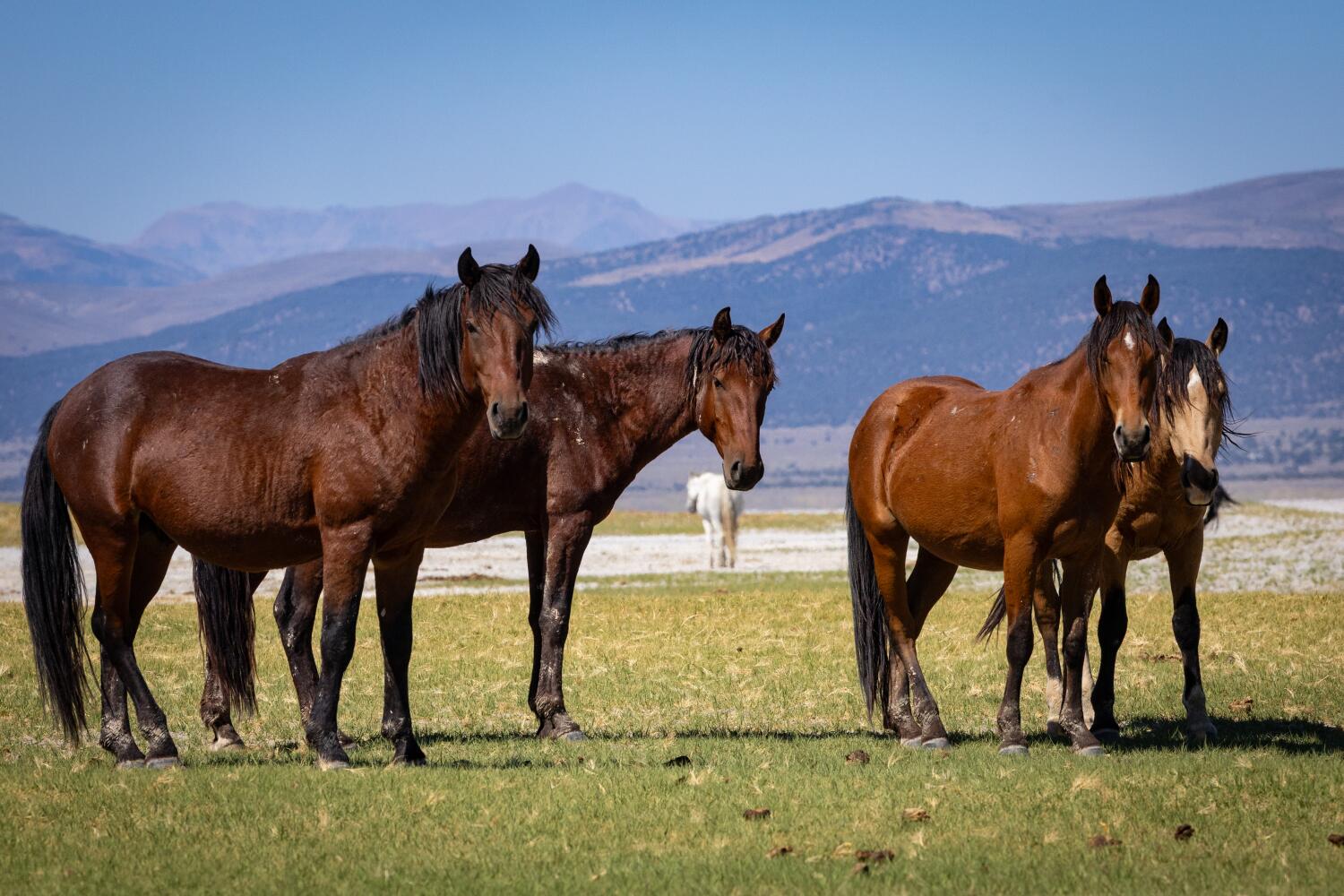
The federal directive to execute a gathering and removal operation of approximately 450 wild horses along the California-Nevada border within the Inyo National Forest exposes a structural breakdown in public land resource management. While superficial analysis frames the issue as a localized clash between federal authorities and animal welfare advocates, the underlying mechanism is driven by a zero-sum resource constraint. Public land allocation operates under a strict carrying capacity model, where ecological equilibrium requires balancing competing demands: native wildlife preservation, fragile riparian ecosystem integrity, and public grazing permits.
When a biological population exceeds its geographical boundaries, it signals an acute failure of localized containment systems. By analyzing the Eastern Sierra roundup through the lens of population dynamics, carrying capacity frameworks, and fiscal long-term costs, the operational realities of public land governance become clear.
The Carrying Capacity Disconnect
The core driver of the federal intervention is the concept of Appropriate Management Level (AML). This metric defines the maximum number of wild horses an ecosystem can sustain without causing long-term degradation to vegetation, water sources, and native wildlife habitats. In the Montgomery Pass Wild Horse Territory and surrounding Eastern Sierra sectors, population growth has scaled non-linearly. Without natural apex predators to regulate numbers, equine herds exhibit annual growth rates between 15% and 20%.
This exponential growth creates a compounding resource deficit:
- Riparian Degradation: The arid High Sierra ecosystem relies heavily on localized water systems like the Mono Lake basin. High-density herd concentrations compress soil strata, accelerating erosion and destroying fragile wetland vegetation.
- Forage Depletion: Heavy grazing alters the composition of native plant communities, favoring invasive weeds over native bunchgrasses. This shifts the ecological balance away from native species like mule deer, pronghorn antelope, and the bi-state greater sage-grouse.
- Spatial Overflow: As herd sizes cross the ecological threshold, the animals migrate past their designated boundaries in search of water and forage. This expansion forces horses across major transportation corridors like U.S. Route 6, turning an ecological management issue into a public safety liability.
+------------------------+      +--------------------------+      +---------------------------+
| 15-20% Annual Population| ---> | Local Resource Depletion  | ---> | Spatial Dispersion Across |
| Growth (Zero Predators) |      | (Riparian/Forage Damage) |      | Boundaries & Highways     |
+------------------------+      +--------------------------+      +---------------------------+
The Cost Function of Population Containment
Federal containment operations rely primarily on helicopter-assisted gathering methods, which maximize capture yield per operational hour but carry significant structural variables. The financial architecture of the Wild Horse and Burro Program reveals a systemic bottleneck: the long-term cost of holding facilities outpaces active rangeland management spending.
When animals are removed from public lands, they enter a multi-tiered pipeline. Captured horses are processed through temporary holding corrals, evaluated for adoption programs, and, if unadopted, transferred to long-term off-range pastures. The economic trade-off is clear: while a helicopter gathering requires an immediate capital outlay, the lifetime care of an unadopted animal creates a fixed, multi-decade liability for taxpayers.
The economic model contains three primary financial variables:
- Direct Capture Expenses: Helicopter contracts, veterinary triage, and short-term transport logistics require substantial upfront funding.
- Adoption Market Absorption Limits: The domestic demand for unhandled wild horses is highly inelastic. Annual adoption rates consistently fall below total removal volumes, leaving a structural surplus of captured animals.
- Long-Term Holding Costs: Maintaining thousands of animals in off-range facilities consumes over 60% of the Bureau of Land Management’s annual wild horse program budget, diverting resources away from on-range fertility control programs.
Strategic Alternatives and Limitations
Proponents of non-lethal population management advocate for immunocontraceptive vaccines (such as Porcine Zona Pellucida, or PZP) to stabilize herd growth on the range. While biologically viable, this strategy faces severe operational constraints in rugged, vast geographies like the Eastern Sierra.
Administering dart-delivered fertility vaccines requires close, consistent access to individual mares. In dense mountain terrain, the labor costs and tracking requirements needed to achieve a statistically significant inoculation rate (typically greater than 80% of fertile mares) make it unfeasible as a standalone solution for a rapidly expanding herd. Consequently, fertility control works best as a maintenance tool rather than an emergency intervention for a herd that has already tripled its target population.
The Path Forward for Resource Optimization
To resolve the structural imbalance in public land management, federal agencies must shift from reactive gathering cycles to an integrated resource model. Stabilizing the High Sierra ecosystem requires a multi-phase framework:
- Execute the targeted removal of overflow populations to immediately relieve pressure on the Mono Lake watershed and reduce public safety risks on regional highways.
- Establish a legally binding Herd Management Area Plan (HMAP) for the Montgomery Pass territory to formalize water access rights and install strategic exclusion fencing.
- Deploy targeted, helicopter-assisted capture-and-release programs strictly to administer multi-year fertility vaccines to mares before returning them to the range, shifting the population trajectory from exponential growth to a manageable baseline.
https://www.youtube.com/watch?v=6Rr_l56d6S0
This brief overview outlines the scope of federal plans to manage expanding wild horse numbers across the Western states, providing valuable national context for the specific regional pressures impacting the Eastern Sierra.