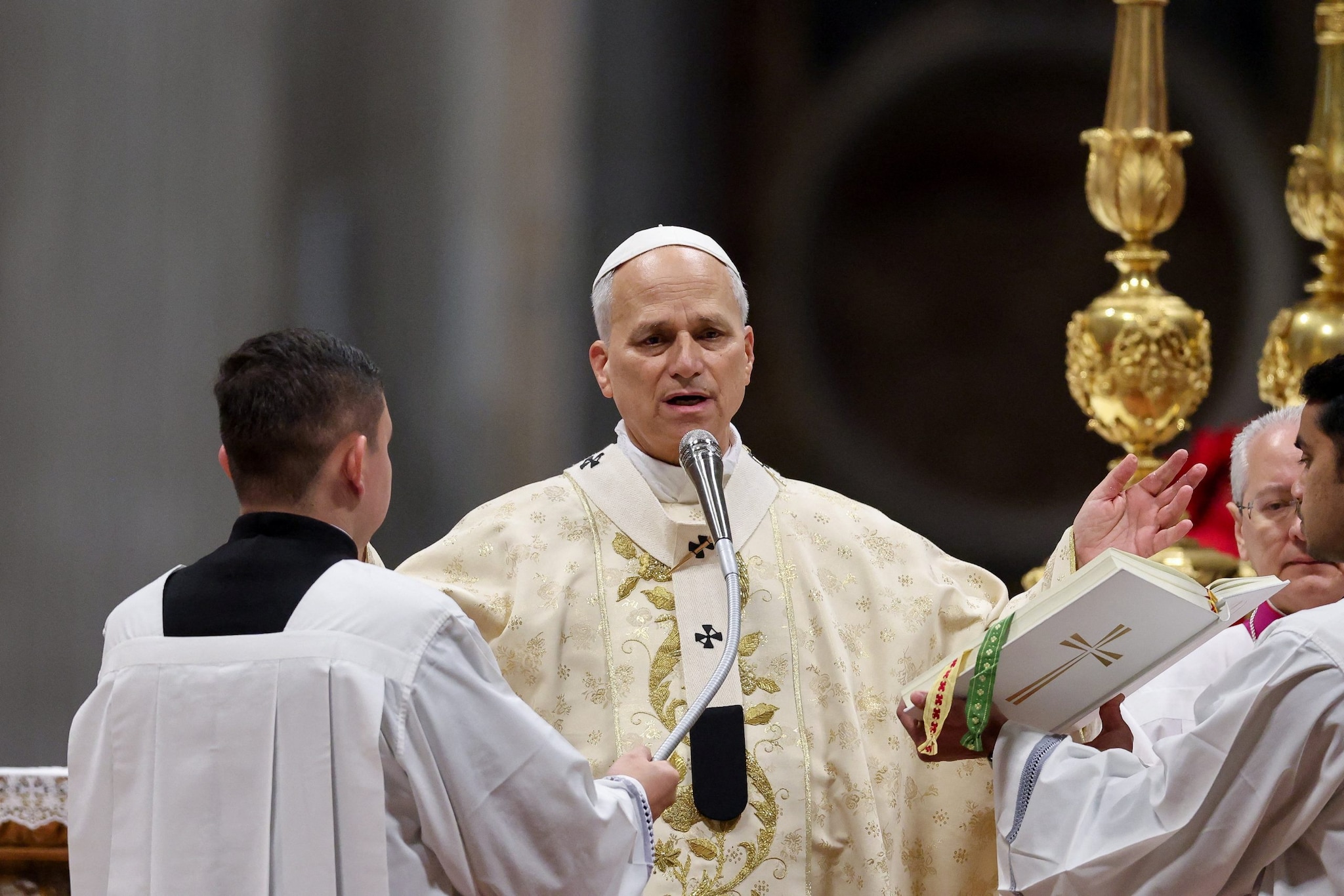
The intersection of the Roman Catholic Church’s global moral mandate and the populist nationalist movements of the West creates a friction point that alters the risk profile of international diplomacy. When Pope Francis addresses the "rich and powerful" as threats to peace during a visit to Cameroon, he is not merely delivering a sermon; he is executing a strategic maneuver within a complex geopolitical framework. This maneuver addresses three specific systemic pressures: the internal stability of the Lake Chad Basin, the erosion of multilateralism by Western populist rhetoric—specifically from figures like Donald Trump—and the competition for influence between traditional religious authority and secular political movements.
The Tripartite Conflict Framework
The current tension is best understood through three distinct pillars of influence that dictate how papal rhetoric interacts with global political instability.
1. The Rhetorical Feedback Loop
The ongoing verbal conflict between Donald Trump and Pope Francis functions as a closed-loop system where each actor uses the other to solidify their domestic base. For Trump, the Pope represents a "globalist" institution that threatens national sovereignty and border integrity. For the Pope, Trump represents a "nativist" surge that undermines the Church’s core mission of universalism and migrant advocacy.
This feedback loop has measurable consequences on diplomatic efficacy. When the Pope speaks in Cameroon, his words are filtered through this Western lens, often stripping the local context of its nuance. The "rich and powerful" label serves a dual purpose: it identifies local African kleptocracies and simultaneously signals a critique of Northern Hemisphere economic dominance.
2. The African Security Nexus
Cameroon sits at the center of a security crisis involving the Boko Haram insurgency in the north and the "Anglophone Crisis" in the northwest and southwest regions. The Pope's visit is a high-stakes intervention in a state where the Catholic Church often provides the only functioning social safety net.
- Institutional Presence: In regions where the Cameroonian state has retreated due to conflict, the Church maintains hospitals, schools, and distribution networks.
- Mediatory Authority: Because the Church transcends ethnic and linguistic lines, it holds the unique position of a neutral arbiter, a role that is compromised if the Papacy is seen as too closely aligned with specific Western political factions.
3. The Economic Disparity Function
The Pope’s critique of the "rich and powerful" is rooted in the Catholic Social Teaching principle of the "preferential option for the poor." In the context of Cameroon, this is a direct challenge to the extractive economic models that define the region's relationship with global markets. The cost of peace in Central Africa is inversely proportional to the concentration of wealth within the ruling elite and foreign corporate entities.
Quantifying the Geopolitical Friction
To understand the weight of these statements, one must analyze the mechanisms of power projection used by the Holy See. Unlike a nation-state, the Vatican’s power is purely soft, relying on moral suasion and a network of 1.3 billion adherents.
Structural Vulnerability of Multilateralism
The "rich and powerful" are not a monolith, but in the Pope’s logic, they represent a shift toward bilateralism and isolationism. This shift creates a bottleneck in international aid and conflict resolution. When the United States—the primary funder of UN peacekeeping and global health initiatives—pivots toward "America First" policies, the structural support for fragile states like Cameroon weakens. This withdrawal leaves a vacuum that is often filled by more transactional actors, such as private military companies or non-democratic foreign powers seeking resource concessions.
The Migration Vector
The Pope’s focus on peace is inextricably linked to his stance on migration. Trump’s attacks on the Pope typically center on the Vatican’s advocacy for open borders and refugee rights. In the African context, the "rich and powerful" are blamed for creating the conditions—war, climate instability, and economic despair—that drive migration. By addressing these issues at the source in Yaoundé, the Pope is attempting to solve a problem that the West attempts to manage at its borders.
Mechanisms of Local Destabilization
The Pope’s visit occurs against a backdrop of internal Cameroonian friction that most Western analysts overlook. The "Anglophone Crisis" is not merely a linguistic dispute; it is a battle over the distribution of resources and political representation.
The Centralization Bottleneck
The Cameroonian government, led by Paul Biya for over four decades, represents the "powerful" elite the Pope referenced. The centralization of power in Yaoundé has led to:
- Economic Marginalization: The English-speaking regions feel stripped of their oil and agricultural wealth.
- Judicial Conflict: The imposition of the French civil law system over the English common law tradition in Anglophone regions.
- Military Escalation: A cycle of rebel insurgency and state crackdown that has displaced hundreds of thousands.
The Pope’s presence forces a temporary pause in hostilities but also raises the stakes for the Biya administration. If the government ignores the Papal call for peace, it risks alienating a massive, organized segment of its population. If it concedes, it risks appearing weak to the secessionist movements.
Strategic Divergence: Universalism vs. Nationalism
The conflict between the Pope and Trump is a clash of two diametrically opposed organizational theories.
The Universalist Model (The Vatican)
The Church operates on a long-term temporal horizon—decades and centuries rather than election cycles. Its objective is the maintenance of a global moral order that facilitates the survival of the faith. This requires a stable, interconnected world where borders are permeable for ideas and people.
The Nationalist Model (The Trump Doctrine)
This model operates on a short-term, zero-sum logic. Power is defined by the ability to extract favorable terms for the nation-state, often at the expense of global institutions. The Pope’s critique of the "powerful" is viewed by this camp as a direct interference in the right of a sovereign nation to prioritize its own citizens.
The Role of Information Warfare in Religious Diplomacy
The "attack" by Trump on the Pope is often delivered via social media and mass rallies, leveraging a high-velocity information environment. In contrast, the Pope’s communications are deliberative, delivered in formal encyclicals or structured speeches during apostolic journeys.
This creates an asymmetrical conflict. Trump can shift the narrative in minutes, while the Vatican’s response takes days to permeate through its hierarchy. However, the Vatican’s message has higher "stickiness" among local populations in the Global South, where the Church is a physical presence rather than a digital one.
Economic Implications of the "Rich and Powerful" Critique
When the Pope speaks of peace being threatened by wealth concentration, he is referencing the "resource curse" or Dutch Disease. In Cameroon, the presence of significant oil, gas, and timber reserves has not translated into broad-based prosperity. Instead, it has funded the security apparatus required to keep the "powerful" in place.
- Variable A: Foreign Direct Investment (FDI) often flows into extractive sectors with high capital intensity but low employment generation.
- Variable B: The resulting wealth gap fuels resentment, which insurgent groups like Boko Haram exploit for recruitment.
- Result: The "peace" the Pope seeks is impossible without a structural shift in how African resources are valued and managed by the global North.
The Geopolitical Strategic Play
The Holy See is currently positioning itself as the primary advocate for the Global South in a world where the United States and Europe are increasingly inward-looking. This is not just a moral stance; it is a survival strategy for an institution that is seeing its influence wane in the West while exploding in Africa and Asia.
The strategic play for international observers is to recognize that the Pope’s statements in Cameroon are a signal to the upcoming G7 and G20 summits. He is framing the security of the "periphery" (Africa) as a direct consequence of the policy decisions made at the "center" (The West).
The specific recommendation for policy analysts is to monitor the Vatican’s diplomatic appointments in the coming months. If the Holy See increases its diplomatic presence in non-aligned nations while maintaining its rhetorical pressure on Western populist leaders, we are witnessing the formation of a "Moral Third Block." This block would seek to mediate between the US-China rivalry by using humanitarian and ethical frameworks to influence international law.
To mitigate the risk of total regional collapse in Central Africa, Western powers must decouple their security assistance from transactional politics. The Vatican has signaled that it will use its ground-level infrastructure to resist extractive models that don't provide local stability. For corporate and state actors, the "cost of doing business" in the region is now tied to a moral audit that the Church is increasingly willing to lead. Failure to integrate these social and ethical variables into regional strategy will result in a continued erosion of Western influence as local populations pivot toward the Church’s universalist, albeit critical, framework for development.