The dust gets in your teeth first. It is fine, chalky, and tastes faintly of ancient volcanic ash. Then comes the sound. It begins as a low, physical vibration in the soles of your boots, a rhythmic shuddering of the Anatolian earth that climbs up your spine before you even see the source.
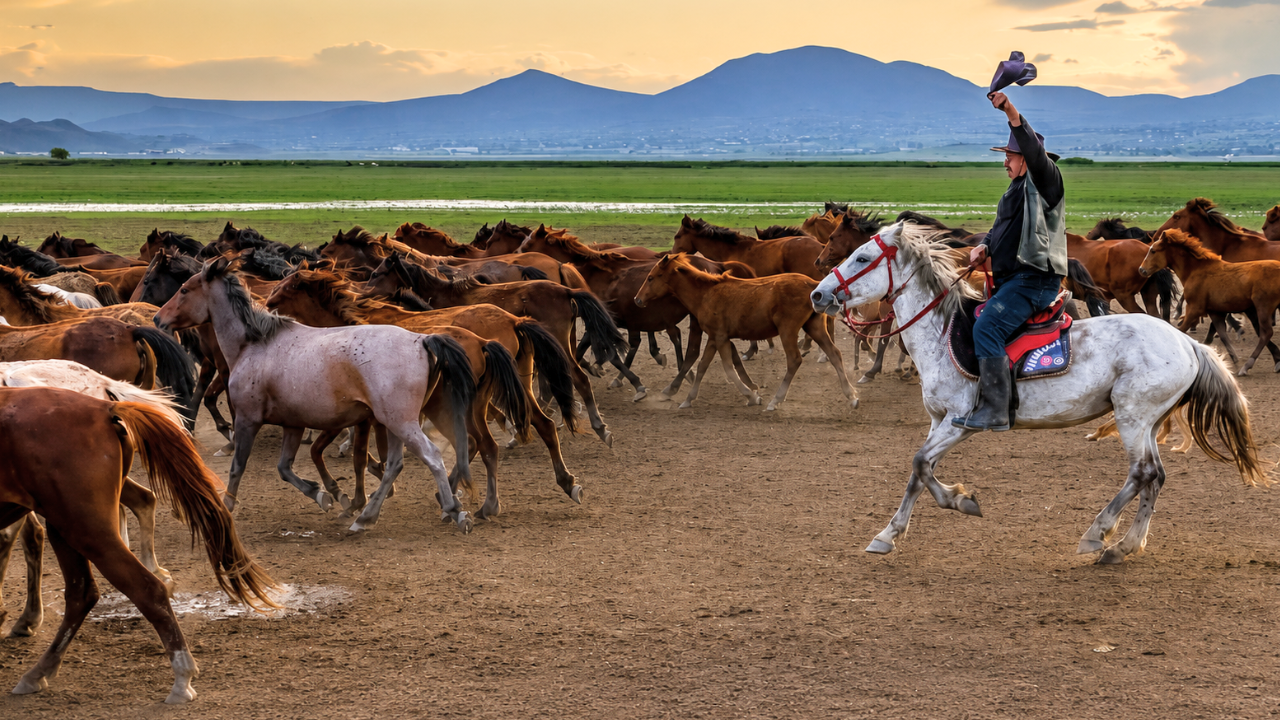
Out of the amber haze of the Turkish highlands, they materialize. Fifty, maybe a hundred, then suddenly hundreds of horses running shoulder-to-shoulder. Their manes are tangled with burrs, their coats caked in the dry soil of Cappadocia. They move not with the manicured grace of show breeds, but with the raw, heavy momentum of animals that answer only to the wind.
Behind them, barely visible through the billowing golden cloud, rides a single man on a dark bay stallion. He does not yell. He whips a lasso through the air, his silhouette cutting sharp against the sinking sun. He is a modern Anatolian cowboy. With a sharp whistle and a shift of his weight, he guides this thundering mass of muscle and history through the valley, holding them in a perfect, sweeping arc just long enough for the shutter clicks of thirty cameras to slice through the roar of hooves.
This is the theater of the Yılkı—the abandoned horses of the Turkish steppe. It is a spectacle born of necessity, where survival and tourism have struck an unlikely, beautiful bargain.
The Ghost Herds of Anatolia
To understand why these horses run wild, you have to understand the quiet tragedy of the tractor.
For generations, these animals were the muscle of Central Anatolia. They plowed the stubborn volcanic soil, hauled the harvest through the brutal summers, and pulled the sledges through winters so cold the air feels like broken glass. They were family. But when diesel engines and mechanization swept through the villages in the mid-twentieth century, the horses became an expensive luxury. Farmers simply could not afford to feed animals that no longer worked.
The traditional solution was bittersweet. At the end of every autumn, farmers would turn their horses loose into the wild plateaus around Mount Erciyes. The animals were expected to fend for themselves, to dig through the snow with their hooves for frozen grass, and to survive the wolves. Some died. Many survived, banding together into fierce, highly structured herds. In the spring, a farmer might recapture his horse for the planting season, but eventually, as the old ways faded completely, the horses were left to the wild permanently. They became the Yılkı—literally, "horses left to nature."
For decades, they were ghosts. They roamed the marshes and the dry valleys, unseen by the millions of tourists who flocked to Cappadocia to sleep in cave hotels and drift over fairy chimneys in hot air balloons. They were beautiful, but they were also a problem. Without management, they faced starvation during extreme winters, conflicts with expanding farms, and the quiet threat of being rounded up for slaughter.
Then came the cowboys.
The Men Who Chase the Wind
Consider the life of a young man in rural Turkey today. The pull of Istanbul or Ankara is almost magnetic. The ancient villages are emptying out as the younger generation trades the hard, dusty life of the farm for the neon glow and steady pay of the metropolis.
But a few stayed. Men like Ekram, who lives in a cave ranch carved directly into the soft volcanic tuff of the valleys, saw something different in the dirt. They saw a heritage slipping away.
The idea was simple, almost desperate at first. If the tourists wanted to see the "Land of Beautiful Horses"—which is what the old Persian name for Cappadocia, Katpatuka, allegedly translates to—why not show them the real thing? Not the docile trail ponies tethered outside souvenir shops, but the roaring, untamed spirit of the steppe.
The cowboys began tracking the wild herds. It was not about taming them; it was about understanding them. Horses are creatures of habit and hierarchy. By identifying the lead stallions, the cowboys learned how to move the herds without breaking their wild spirit. They began organizing afternoon runs, guiding the horses through the wide, dusty flats of Hürmetçi Village just as the sun dips below the horizon.
It is a carefully choreographed dance. The cowboys ride out, gather the free-roaming herds, and drive them across the plains. The dust kicks up. The low sun illuminates the cloud, turning the entire valley into a cathedral of gold light. Photographers from Tokyo, New York, and Paris stand at the edge of the dust, capturing images that look like they were painted in the nineteenth century.
Once the shoot is over, the cowboys turn their mounts back, and the Yılkı disappear back into the hills. They are not locked in stables. They are not saddled. They remain wild, but now, their wildness has a budget.
The Price of Freedom
It is easy to romanticize this. To write about "free spirits" running under the Anatolian sky makes for a lovely postcard. But the truth is always heavier.
The winters here are brutal. When the temperature drops to minus twenty, a wild horse cannot eat romance. The success of these photography tours has changed the equation of survival. The money generated by the visitors doesn't just buy fancy gear for the cowboys; it buys tonnes of hay and feed that are distributed into the valleys during the worst winter freezes.
It is an imperfect, fragile ecosystem. The horses are semi-wild now, dependent on the very humans who once abandoned them, yet still fiercely independent. It is a compromise that purists might scoff at, but without the tourism revenue, the herds would likely have been thinned by starvation or culled to make way for development.
Instead, the Yılkı have become the living, breathing pulse of the region. They are protected because they are valued.
As the last light of the evening fades, the dust begins to settle, coating the camera lenses and the faces of the silent onlookers in a fine, gray shroud. The cowboys dismount, their faces weathered and creased from years of wind and sun, sharing a thermos of hot, bitter black tea.
A mile away, the herd is already gone, swallowed by the purple shadows of the volcanic valleys. You can no longer see them, but if you hold your breath and listen closely, you can still hear the faint, distant thud of their hooves against the stone, keeping time with the ancient heart of the earth.