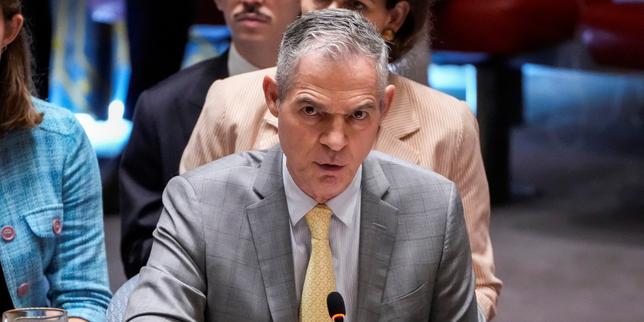
The heavy oak doors of the United Nations Security Council chamber rarely swing open in sudden protest. When the American delegation physically packed their notes, stood up from their leather chairs, and marched out during a sharp rebuke by French diplomats, the optics reverberated far beyond the glass building on the East River. This was not a routine diplomatic disagreement over administrative wording or minor budgetary amendments. It exposed a fracture in Western coordination that has been widening for months beneath a polite veneer of multilateral unity.
For anyone tracking international relations, the incident at the UN Security Council serves as a masterclass in how institutional friction turns into public spectacle. The core dispute centered on divergent strategies regarding an ongoing international crisis where Paris and Washington find themselves pulling in opposite directions. France demanded immediate, unvarnished accountability for civilian protection failures, while the United States sought to shield its broader geopolitical maneuvering room behind closed-door calibrations. When the French representative refused to soften the critique, the American response was swift and physical.
The Anatomy of a Walkout
Diplomatic walkouts are heavy instruments. They are rarely impulsive. They are calculated signals designed to register maximum displeasure without entirely severing communications channels. When a superpower abandons its seat, the message to the international community is stark: the conversation has crossed an invisible line from disagreement to disrespect.
For decades, the transatlantic alliance has relied on a shared vocabulary of crisis management. Washington sets the security umbrella, and European capitals provide regional context, humanitarian aid, and occasional sharp critiques to keep policy grounded. Yet that division of labor is fraying. European nations, particularly France under its current foreign policy trajectory, increasingly view unconditional alignment with American crisis management as a strategic liability.
Paris wants a more autonomous European voice on the global stage. That ambition means European diplomats are far less willing to swallow procedural delays or strategic omissions pushed by Washington in the Security Council. When French representatives leveled their critique during the closed-or-open session—depending on the exact procedural phase—they were speaking to a domestic and continental audience that demands proof of European independence.
Beneath the Procedural Surface
To understand why a few pointed words from a French delegate could prompt an American exodus, we have to look past the immediate diplomatic theatre and examine the underlying structural pressures. The United Nations Security Council is paralyzed by design. Its permanent members hold veto power, transforming every major crisis into a zero-sum game of blocking maneuvers and symbolic resolutions.
When Washington and Paris clash within this machinery, the stakes are magnified. The United States views its UN strategy through the lens of global superpower competition, where every local conflict is weighed against broader confrontations with rival powers like China and Russia. Every vote, every statement, and every drafted resolution is scrutinized for how it might be weaponized by adversaries elsewhere.
France, conversely, operates with a different set of priorities. As a permanent member with distinct historical ties to various global friction points, Paris often positions itself as the guardian of international humanitarian law and institutional integrity. When American vetoes or diplomatic foot-dragging obstructs resolutions perceived as vital by European capitals, frustration boils over.
The walkout was the physical manifestation of this strategic dissonance. It showed that the traditional assumption of Western consensus at the UN is increasingly conditional.
The Cost of Multilateral Fragmentation
When key allies publicly fracture in front of the world, adversaries take notes. Moscow and Beijing watch these diplomatic tantrums with quiet satisfaction, recognizing that every public display of transatlantic discord weakens the normative power of Western institutions.
For the UN itself, such incidents degrade an already fragile authority. The Security Council is supposed to be the premier forum for resolving international peace and security challenges. When delegations treat the chamber like a stage for theatrical walkouts, they accelerate the irrelevance of an institution already struggling to manage twenty-first-century conflicts.
The immediate fallout will not likely cause a permanent rupture in bilateral relations between Washington and Paris. Intelligence sharing continues, military cooperation remains deep, and economic ties are too vast to be derailed by a single afternoon of high-stakes theatre. However, the diplomatic capital burned during that walkout cannot be easily recovered.
Washington has signaled that it will not sit quietly while European allies use multilateral forums to score points at America's expense. Paris has signaled that it will not temper its diplomatic rhetoric simply to maintain a facade of unbroken Western harmony. As these two positions harden, the real danger is not a single dramatic exit from a council meeting, but the slow, quiet erosion of trust that makes future international cooperation infinitely more difficult.