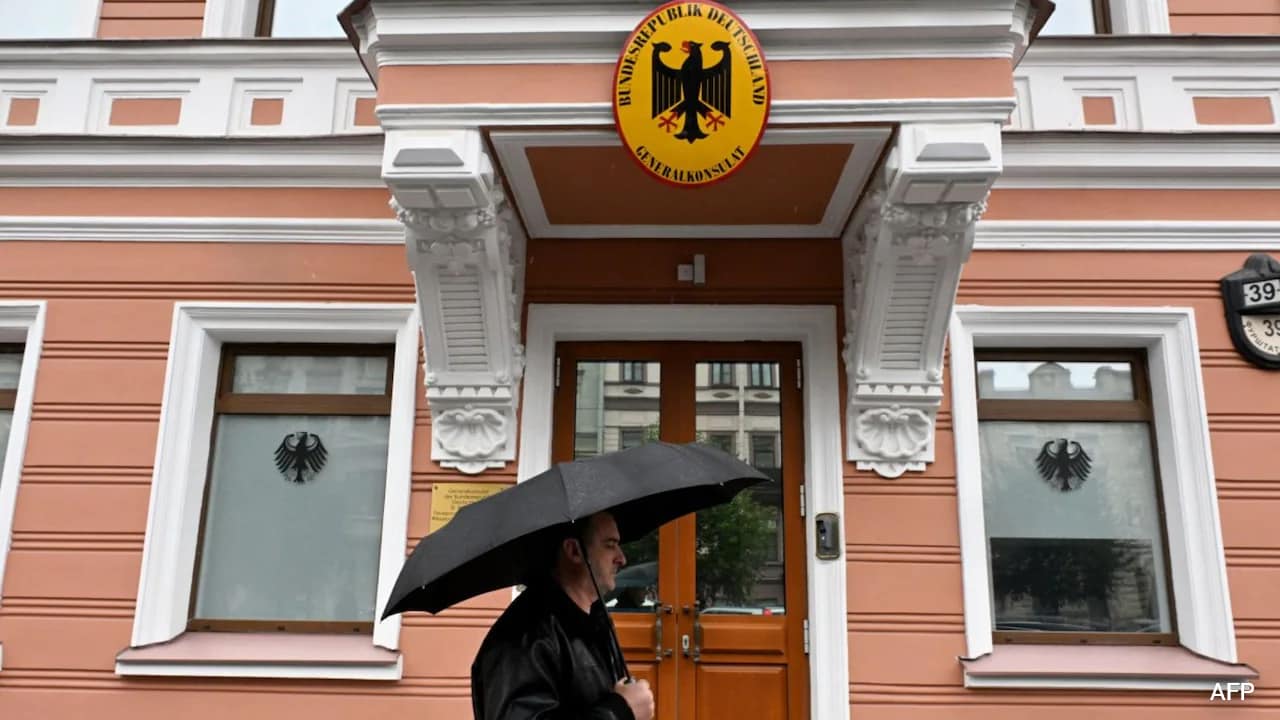
The reciprocal shutdown of diplomatic outposts between Berlin and Moscow marks a structural contraction in bilateral state-to-state channels. When Russia ordered the closure of the German Consulate-General in St. Petersburg alongside the remaining Goethe-Institut branches, it mirrored Germany's prior removal of the Russian consulate in Bonn and the Russian House in Berlin. This sequence is not merely a superficial exchange of diplomatic grievances. It represents a compounding loop of institutional decoupling driven by unverified security accusations, asymmetric intelligence claims, and a total breakdown of mutual deterrence.
The Tripartite Escalation Architecture
The operational breakdown follows a precise escalation ladder built upon three distinct variables: physical infrastructure, intelligence warfare, and public signaling.
- Infrastructure Reduction: Diplomatic consulates function as localized intelligence-gathering hubs, visa-processing vectors, and direct communication channels during crises. Shuttering the St. Petersburg consulate and the Bonn office removes the physical machinery required for lower-tier diplomatic friction management.
- Hybrid Warfare Attribution: The trigger for this cycle—an alleged explosives-laden drone incident targeting a Ukrainian transport plane at Leipzig/Halle Airport on August 4—highlights the operational reality of gray-zone conflicts. Germany attributed the sabotage attempt to Russian actors, while Moscow categorized the event as a staged provocation and an absurd fabrication. Without transparent forensic verification accessible to both parties, the accusation functions as a political weapon rather than a judicial finding.
- Cultural Asset Weaponization: The inclusion of the Goethe-Institut network alongside official state consulates signals an expansion of statecraft parameters. Cultural diplomacy tools are systematically reclassified by Moscow as vectors of ideological influence, leading to immediate expulsion timelines—such as forcing Goethe-Institut staff to evacuate Russian territory by September 13.
The Cost Function of Diplomatic Isolation
Severing consular ties carries immediate economic and administrative friction costs for both nation-states, while producing asymmetric long-term strategic outcomes.
[Accusation: Leipzig Drone Incident]
       │
       ▼
[Asymmetric Attribution & Retaliation]
       │
       ├──► Germany Shuts Bonn Consulate & Berlin Cultural Center
       │
       └──► Russia Shuts St. Petersburg Consulate & Goethe-Institut
       │
       ▼
[Systemic Result: Complete Elimination of Low-Level Diplomatic Backchannels]
When consular networks dissolve, citizen services, commercial advocacy, and localized consular protection vanish. For German nationals in northwestern Russia and Russian nationals in western Germany, routine legal, financial, and travel contingencies must now be routed through heavily overburdened embassy capitals in Moscow and Berlin.
More critically, the removal of mid-level diplomatic outposts eliminates the institutional shock-absorbers that typically prevent localized tactical disputes from escalating into systemic strategic confrontations. When foreign ministers openly frame standard diplomatic expulsions in existential terms—such as Russian Foreign Minister Sergey Lavrov characterizing Berlin's posture as a move toward a direct state of war—the threshold for miscalculation drops near zero.
Strategic Trajectory and Institutional Outcomes
The mechanism governing this ongoing contraction relies on a tit-for-tat equilibrium. Each government responds to institutional losses by inflicting symmetrical damage on the other's remaining footprint. Because neither side possesses an incentive to de-escalate without conceding narrative control over the underlying security breaches, the system continues toward complete diplomatic minimalism.
The strategic outcome is a permanent freeze in bilateral bureaucratic communication, shifting all European-Russian friction exclusively to multilateral military signaling and border fortification measures—exemplified by concurrent infrastructure projects like Finland's border fencing to manage hybrid migration pressures. The diplomatic channel is no longer utilized for negotiation; it is actively being dismantled.