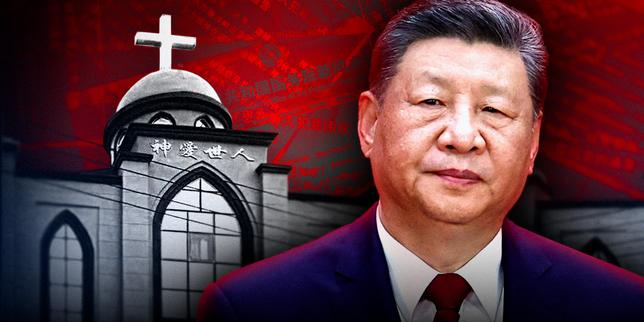
The physical demolition of crosses and the forced closure of underground sanctuaries across China are no longer the primary methods of religious control. Instead, the state has pivoted toward a sophisticated, data-driven strangulation of faith that operates through smartphones, facial recognition, and financial surveillance. This shift from blunt force to surgical, digital repression is designed to make religious practice invisible and, eventually, impossible for anyone outside the state-sanctioned Patriotic Associations.
Under the leadership of the Communist Party, "Sinicization" has evolved from a vague ideological goal into a precise bureaucratic weapon. The state isn’t just asking Christians to be loyal to the country; it is demanding that the theology itself be rewritten to mirror Party doctrine. This is being achieved through the most comprehensive surveillance apparatus ever constructed, turning every church service into a data point and every believer into a tracked subject.
The Architecture of Total Visibility
In provinces like Zhejiang and Henan, the "Sharp Eyes" program has moved from the streets into the pews. It is common to find high-definition cameras installed directly next to the pulpit, wired into local Public Security Bureau hubs. These are not simple security measures. They are equipped with facial recognition software that logs attendance in real-time, cross-referencing worshippers against databases of civil servants, students, and medical professionals—groups strictly forbidden from practicing religion.
The pressure is psychological as much as physical. When a teacher or a local official is spotted entering an unregistered "house church," the repercussions are often swift and administrative rather than criminal. A phone call from a superior or a sudden freeze on a promotion acts as a powerful deterrent. The state has realized that it does not need to fill jails when it can simply make the cost of faith too high for the middle class to bear.
The Algorithm of Social Credit
China’s social credit system is frequently discussed as a tool for managing debt or traffic violations, but its application in religious circles is far more insidious. Participation in "illegal" religious gatherings is increasingly linked to these personal scores. A lowered score can mean being barred from high-speed trains, being denied loans, or seeing your children blocked from top-tier schools.
This creates a self-policing environment. Families often pressure their own members to cease attending unregistered churches to protect the collective future of the household. It is a brilliant, albeit chilling, use of traditional Chinese family structures against the individual’s conscience.
Rewriting the Text from Within
The most ambitious part of this campaign is the literal revision of the Bible. In 2019, state-run news outlets confirmed that a new translation of the scriptures was underway to "reflect the values of Socialism." This is not a subtle academic exercise. In some leaked textbook samples used in vocational schools, biblical narratives have been altered to emphasize blind obedience to the law over divine mercy.
In one specific instance, a textbook recounted the story of Jesus and the woman caught in adultery. Instead of the traditional ending where he tells her to "go and sin no more," the revised text has Jesus stoning the woman himself, stating that he too must respect the law of the state. While these texts are currently limited to specific educational settings, they signal a long-term strategy to decouple faith from any moral authority that exists outside the Party.
The Financial Noose
Cash was once the lifeblood of the house church movement. Small, anonymous donations allowed congregations to rent secret spaces and support their pastors. However, China is now a nearly cashless society. Every transaction on WeChat Pay or Alipay is tracked, categorized, and searchable by the state.
When a congregation tries to pay rent for a secret meeting room, the digital paper trail is immediate. Landlords are threatened with the loss of their own business licenses if they accept money from "unauthorized organizations." By controlling the flow of money, the government has managed to evict hundreds of churches without ever needing to break down a door. The churches aren't being banned; they are being bankrupt.
Rural Pressure and the Poverty Alleviation Trap
In rural areas, where Christianity has historically seen rapid growth, the government uses economic incentives as a cudgel. Poverty alleviation programs are often contingent on the removal of religious imagery from the home. Families are told to replace posters of the cross or the Virgin Mary with portraits of President Xi Jinping.
The logic presented to these villagers is simple: the Party provided your new roof and your clean water, not God. Therefore, your gratitude and your visual devotion belong to the Party. For many living on the edge of subsistence, this is a choice they cannot afford to get wrong.
The Youth Ban
The most significant long-term threat to the church is the absolute prohibition of religious education for minors. It is illegal for anyone under eighteen to enter a church or attend a Sunday school. In the past, this was often overlooked in more lenient provinces. That era of "benign neglect" is over.
Security guards at the entrance of state-sanctioned churches are now required to check IDs. This creates a generational vacuum. If the faith cannot be passed down to the next generation through formal teaching, the state calculates that the church will eventually age out of existence.
The Limits of State Control
Despite this multi-layered assault, the underground church has not disappeared. It has fragmented. Instead of large gatherings of hundreds, believers are meeting in groups of three or four in public parks, coffee shops, or while walking. They are utilizing encrypted messaging apps, though even these are a cat-and-mouse game with state censors.
There is a historical irony at work. The very pressure intended to crush the movement is stripping it of its institutional bloat, returning it to a lean, decentralized structure that is significantly harder to track than a traditional church.
A Global Laboratory for Repression
What is happening in China is a blueprint. Other authoritarian regimes are watching closely to see how effectively high-tech surveillance can neutralize a large, organized group of people with a competing worldview. The "China Model" of religious management proves that you don't need a cultural revolution-style purge to win. You just need enough cameras, enough data, and the patience to wait for the older generation to pass away.
The international community often focuses on the "Big Three" issues: trade, Taiwan, and the South China Sea. Religious freedom is frequently relegated to the footnotes of diplomatic summits. This silence is interpreted by Beijing as a green light to continue.
The strategy is no longer about total eradication through blood and fire. It is about a quiet, digital evaporation of the soul. Those who believe that the church in China will simply "wait out" this period of repression are ignoring the permanence of the digital record. The data does not forget, and the algorithm does not tire.
The struggle for the future of faith in the East will be won or lost in the servers of the Ministry of Public Security.


:max_bytes(150000):strip_icc():focal(819x186:821x188)/Murdaugh-Family-e90854a716884d608fb6fd925e18d840.jpg)
