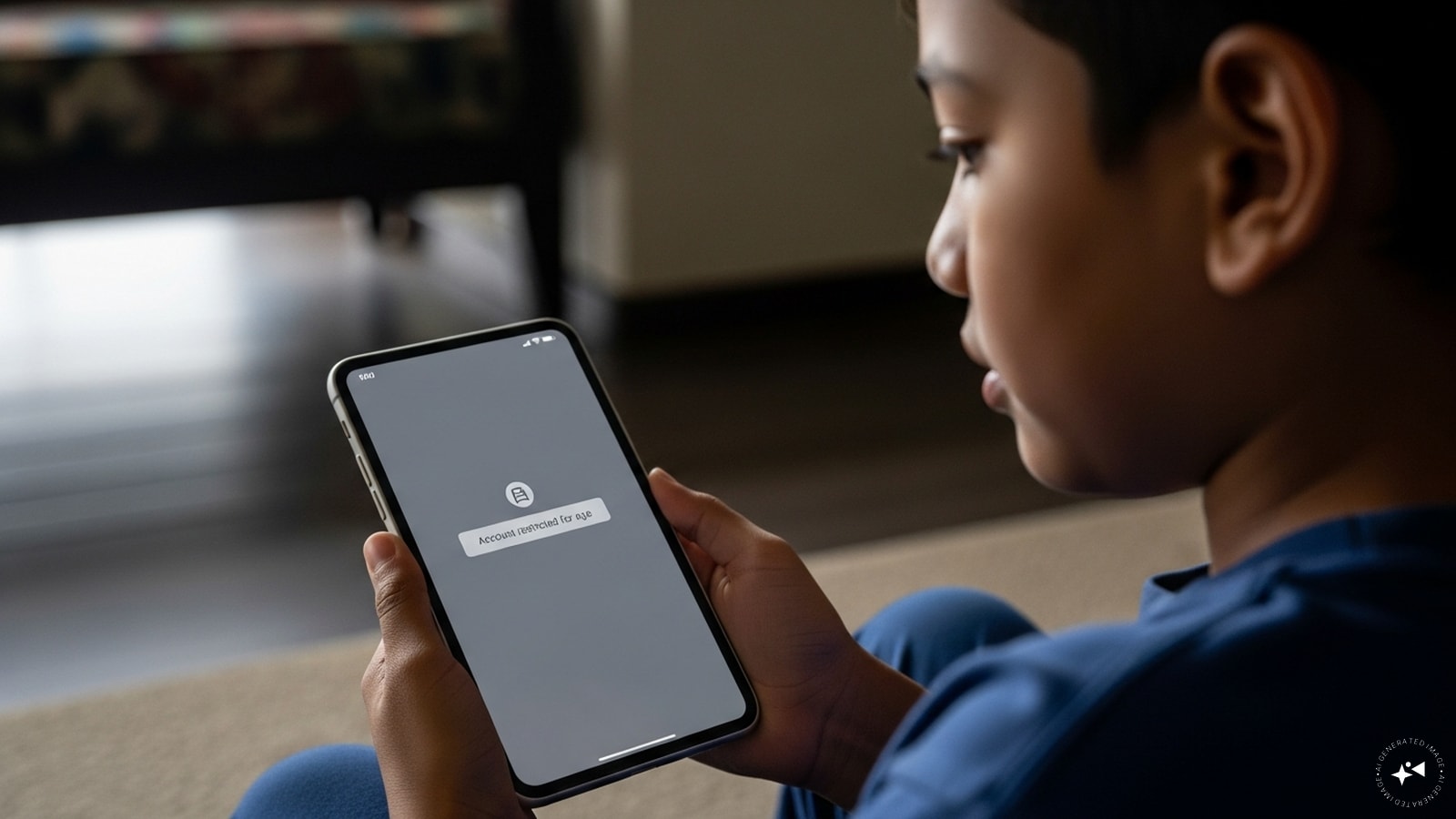
The blue light hits a child’s face exactly the same way in Kuala Lumpur as it does in New York, London, or Sydney. It is a cold, flickering glow that drains the color from the room and pools in wide, unblinking eyes.
For years, parents across Malaysia watched that glow with a mixture of gratitude and growing dread. Gratitude, because a smartphone keeps a teenager quiet during a long commute down the Federal Highway or throughout a rainy afternoon in a high-rise apartment. Dread, because of the phantom shape the silence takes. You do not know who is whispering back through the glass.
Now, the government has stepped into the bedroom.
Malaysia has enacted a sweeping, uncompromising ban on social media accounts for children under the age of 16. It is a legislative line in the sand, a hard stop in a digital ecosystem that has spent two decades resisting boundaries. The policy does not merely suggest moderation; it criminalizes non-compliance for platforms, shifting the burden of digital gatekeeping from overwhelmed parents to tech conglomerates.
To understand why a nation of over 34 million people took this drastic step, you have to look past the legal text and look at the dinner tables.
The Ghost in the Living Room
Consider a hypothetical family living in the suburbs of Petaling Jaya. Let us call the daughter Maya. She is 14. She is not a statistic; she is a bright, fiercely observant teenager who happens to navigate her entire social life through a five-inch screen.
Before the ban, Maya’s day did not end when she closed her bedroom door. That was when the second shift began. The algorithms of TikTok, Instagram, and WhatsApp do not recognize school nights. They recognize engagement. Every scroll, every paused video, every frantic refresh at 2:00 AM feeds a machine designed by the world’s most brilliant minds to do one specific thing: keep Maya looking.
Her mother, sitting in the next room, felt the invisible pull of that machine. She noticed the sudden bursts of irritability, the declining grades at the local secondary school, the withdrawal from family meals. It felt like competing against a ghost for her daughter’s attention. A ghost armed with trillions of data points and a psychological roadmap of the adolescent brain.
This is the human reality that fueled Malaysia’s legislative fire. The policy was born out of a collective realization that individual families were losing an asymmetric war. A single parent cannot out-negotiate a multi-billion-dollar algorithm engineered to exploit human vulnerability.
The government’s response was an abrupt decoupling. By rendering it illegal for platforms to host underage users, the state effectively became the vanguard.
The Anatomy of the Iron Curtain
The mechanics of the ban are aggressive. This is not the standard "click here to confirm you are 13" checkbox that has served as a global joke for a generation. The Malaysian regulatory framework demands strict age verification protocols. Tech companies must deploy biometric scanning, government database cross-referencing, or third-party verification systems to ensure that a 15-year-old cannot simply type in a false birth year.
Failure to comply results in astronomical fines for the platforms. In severe cases, it means a total loss of their operational licenses within the country.
Predictably, the pushback from Silicon Valley was swift. Critics argue that the technology required for foolproof age verification creates massive privacy risks. To prove a user is over 16, platforms must collect highly sensitive personal data—national identity numbers, facial scans, or digital footprints. The irony is thick. To protect children from psychological harm, the state requires them, or their parents, to surrender more intimacy to the machine.
There is also the question of the digital black market. Teenagers are inherently resourceful. The moment a digital wall goes up, virtual private networks (VPNs) look less like technical tools and more like standard teenage rebellion. A 14-year-old with a basic understanding of internet protocols can spoof an IP address to appear as though they are browsing from a café in Tokyo or a library in Berlin, bypassing the Malaysian firewall entirely.
Yet, the enforcement strategy focuses less on chasing individual teenagers through the digital undergrowth and more on strangling the platforms' monetization of youth. If a tech company cannot legally target advertisements to a domestic demographic under 16, the financial incentive to look the other way disappears.
The Architecture of Attention
We have spent twenty years treating social media as a public utility, like water or electricity. We forgot that it is an extractive industry.
When a child logs onto a platform, they are not the customer. They are the product. The raw material being mined is their attention span, their emotional stability, and their developing sense of self. For a brain that will not fully develop its prefrontal cortex—the area responsible for impulse control and risk assessment—until the mid-twenties, this environment is toxic.
Imagine introducing a child to a casino at age twelve. We would find the concept abhorrent. We understand that the flashing lights, the intermittent rewards, and the engineered highs are too potent for a young mind to regulate. Yet, we have allowed an identical psychological architecture to sit on the nightstands of our children, disguised as a tool for connection.
The numbers coming out of public health sectors validate the Malaysian intervention. Cyberbullying incidents, body dysmorphia tied to algorithmic beauty filters, and severe sleep deprivation have spiked dramatically across Southeast Asia over the last decade. The data points all converge on a singular, uncomfortable truth: the current iteration of the internet is incompatible with childhood.
But laws are blunt instruments. They cannot heal the loneliness that drove teenagers to the screen in the first place.
The Quiet Aftermath
Walk through a neighborhood in Kuala Lumpur a few weeks after the implementation of the ban, and you can feel a subtle shift in the air. It is not a dramatic transformation. The skyscrapers still gleam against the humid sky, and the traffic still hums along the highways.
But in certain households, there is a strange, jarring quiet.
For Maya, the first few days without her accounts felt like an amputation. The phantom itch to check her notifications returned every few minutes. She experienced a profound sense of isolation, convinced that the world was moving on without her, that jokes were being shared and memories made in digital spaces she could no longer access.
Then, something else happened.
The time expanded. Fourteen hours a week that had vanished into the algorithmic void suddenly materialized as empty space. She read a book. She sat on the balcony and watched the monsoon rain hit the street below. She talked to her mother, not in short, distracted bursts, but in actual sentences that meandered and settled into comfortable silence.
The Malaysian experiment is a high-stakes gamble. It challenges the fundamental narrative of the twenty-first century: that technological progress is inevitable and irreversible. It dares to suggest that a society can look at an innovation and say, no, this costs too much.
Whether the ban holds or crumbles under the weight of technological workarounds and corporate lobbying is almost secondary to the statement it makes. The illusion of the frictionless digital world has been shattered. A nation has decided that the protection of its children's minds is worth the disruption of its digital economy.
The blue light is turning off. In the darkness that follows, a generation is being forced to look at each other again, face to face, without the comfort of a filter. It is terrifying. It is beautiful. It is entirely necessary.