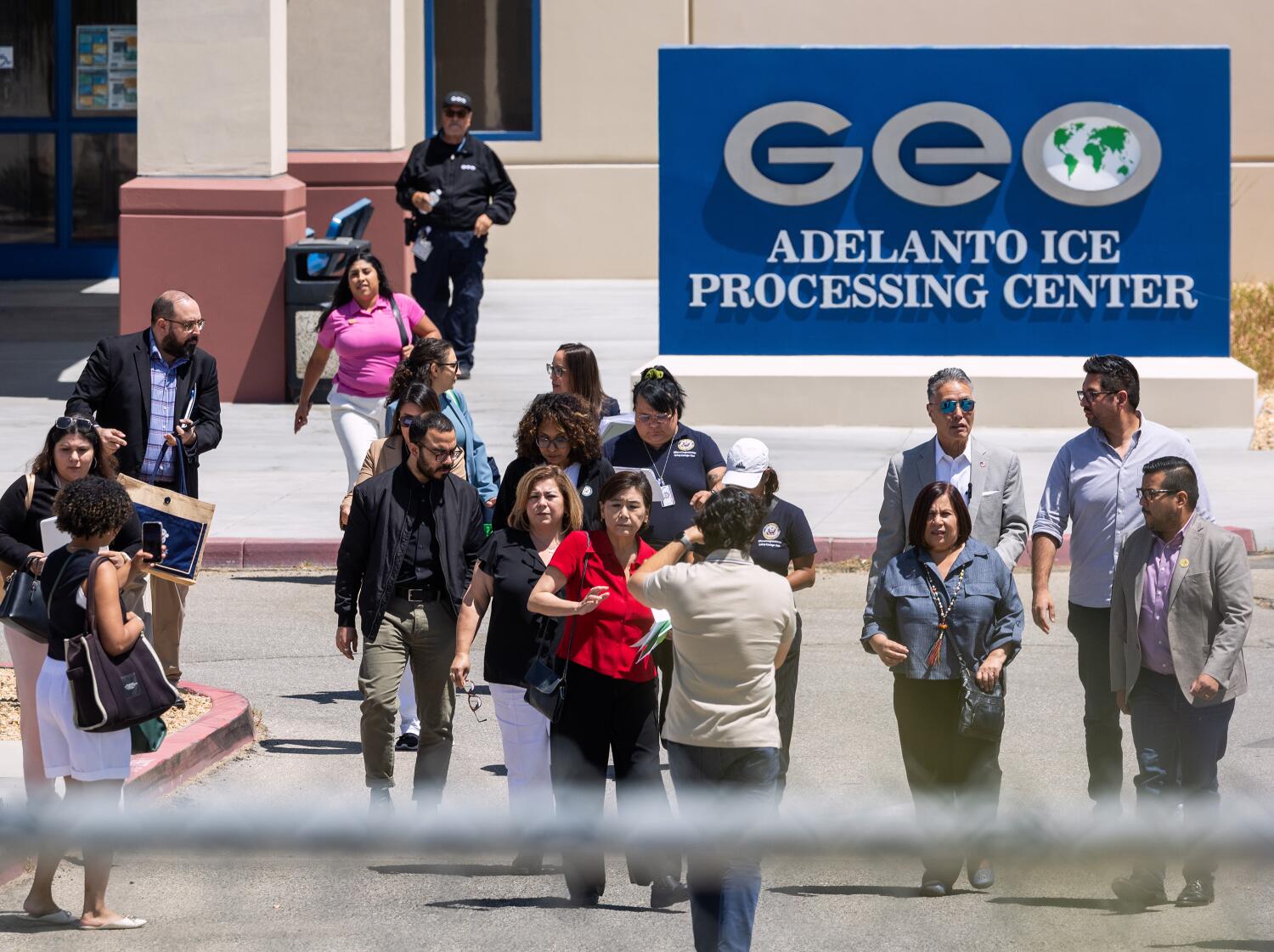
The federal government just handed a private prison giant $950 million for California detention real estate, and honestly, the math should make taxpayers blink.
When the Department of Homeland Security agreed to buy facilities from The GEO Group in Southern California's Inland Empire, headlines mostly treated it like another routine real estate transaction. Buy building. Sign paperwork. Move on. Except this isn't a strip mall in Riverside. It's a 2,644-bed immigration detention complex tied to U.S. Immigration and Customs Enforcement, and the backstory has layers most quick summaries skip right over.
Look closely at what happened in October 2026. GEO Group sold a three-property immigration detention complex in Southern California's Inland Empire—including Adelanto East ICE Processing Center, Adelanto West ICE Processing Center, and Desert View Annex—to the federal government for $950 million. That works out to roughly $359,000 per bed before you even factor in decades of operating expenses, staffing, and maintenance. And here's the kicker: GEO didn't walk away. The company stayed on to provide support services under its existing ICE contract, which runs through December 2029 with a five-year extension option reaching December 2034.
Wait. Think about that setup.
Private prison companies built their business model around owning brick-and-mortar lockups and collecting per-diem payments from Washington. Now the government is buying the concrete outright while still paying the seller to run operations. GEO expects to net around $705 million after taxes, transaction fees, and expenses. Its board immediately boosted share-buyback authorization by $750 million to $1.25 billion through 2029, while signaling talks to sell more company-owned facilities to ICE under long-term management agreements.
That's not an exit from private detention. It's a financial restructuring where Washington takes on real estate risk and GEO pockets cash.
What DHS Buying California Detention Centers Actually Signals
If you've watched immigration policy swing back and forth over the last decade, you know how volatile bed capacity gets. One administration pushes expansion. The next freezes contracts or faces state-level pushback.
California has been ground zero for that fight for years. State lawmakers passed restrictions aimed at phasing out private detention facilities inside California borders. Legal battles followed. Federal agencies argued over preemption, state authority, and detention capacity along the Southwest border corridor.
When DHS buys California detention centers outright instead of relying solely on private ownership, the legal chessboard shifts. A privately owned facility sitting on private land faces a very different set of state regulatory pressures than a federally owned property operated under federal contract. Advocates and legal observers have pointed out that federal ownership can change how oversight, public records, and local accountability work in practice. At the same time, federal officials and industry operators frame ownership as long-term capacity stability and cost control over multi-decade horizons.
Neither side is pretending this is small. Earlier in 2026, ICE paid roughly $1.5 billion for two detention facilities—including a nearly 2,000-bed facility near San Diego bought from CoreCivic, which kept operating them after closing. Add in a $1.2 billion DHS construction contract signed the prior month to expand a federally owned facility in El Centro that GEO operates for the U.S. Marshals Service, and you see a clear pattern. Washington isn't renting space anymore. It's building an owned federal footprint.
Why the $950 Million Price Tag Raises Hard Questions
Most coverage stops at the headline number. $950 million. Big round number. End of story.
But anyone who has ever looked at municipal budgets, federal procurement audits, or commercial real estate valuations knows the real story lives in the fine print.
First, compare acquisition cost to replacement cost. Building high-security or specialized processing facilities in California isn't cheap. Permitting, environmental reviews, seismic standards, and construction labor in Southern California push costs sky-high. Buying existing facilities—Adelanto East, Adelanto West, and Desert View Annex—saves years of construction delays. You get 2,644 beds immediately. Still, paying $950 million for 2,644 beds means taxpayers are committing nearly $360,000 per bed before a single detainee is fed, guarded, or transported.
Second, look at who gets paid twice. GEO gets a massive capital infusion—roughly $705 million net after taxes and transaction expenses—and turns around to expand share buybacks and pay down debt. Meanwhile, GEO continues providing support services under its ICE contract running to 2029, with a potential extension to 2034. Critics of private detention have argued for years that taxpayers end up subsidizing shareholder returns either way. This deal turns that critique into a balance-sheet reality.
Third, consider long-term lock-in. When DHS leases a facility, walking away after a political shift is painful, sure, because of lease break terms. When DHS owns the property outright, walking away means sitting on hundreds of millions of dollars in specialized government real estate that can't easily be converted into apartments or office space.
What Happened in Adelanto and the Inland Empire
To understand why this specific deal hits a nerve, you have to look at the Inland Empire.
Adelanto sits in San Bernardino County, high in the Mojave Desert, roughly eighty miles northeast of downtown Los Angeles. For years, the city leaned on prison and detention contracts to plug municipal budget holes. Local boosters saw jobs and tax revenue. Critics saw a town turning its economy into a detention hub.
Over time, Adelanto became a flashpoint. Community groups like the Shut Down Adelanto Coalition organized protests, public comment campaigns, and legal challenges. Reports on medical care, solitary confinement, and facility conditions sparked repeated scrutiny from lawmakers, journalists, and civil rights groups. GEO has consistently rejected allegations of mistreatment and maintained that its facilities meet required standards.
Meanwhile, Desert View Annex and the Adelanto East and West processing centers operated as key nodes in ICE's Southern California detention network. Moving those three properties from GEO ownership to federal ownership doesn't erase the local history. Neighbors still live nearby. Local clinics and courts still feel ripple effects. What changes is who holds the deed.
The Misconception About "Ending Private Prisons"
Here's a trap people fall into whenever a headline says the government bought detention facilities from a private company: assuming private prisons just went away.
They didn't.
GEO owns or provides services at roughly 97 facilities totaling around 76,000 beds worldwide. Selling three California properties for $950 million trims GEO's real estate exposure in a politically hostile state while keeping operational revenue flowing through long-term service contracts. Look at GEO's own words—or rather, its corporate filings and statements: management explicitly said it is in discussions to sell multiple other company-owned facilities to ICE while continuing to manage them under long-term contracts.
Think about what that means for investors and policymakers. For GEO, owning buildings in California carried political and legal baggage. Converting those buildings into cash—while keeping a service contract through 2029 or 2034—reduces balance-sheet friction. For DHS, buying the properties secures physical control over 2,644 beds in Southern California.
Both sides got something they wanted. Taxpayers are the ones holding the bill.
Oversight, Transparency, and What Changes Inside
When a private corporation owns a detention center, accountability flows through state licensing, civil lawsuits against the corporation, and contract terms. When DHS owns the facility, accountability runs through federal agency rules, congressional oversight, and federal statutory frameworks.
Some observers worry that federal ownership makes day-to-day visibility harder. Journalists and advocates have already raised alarms about how information flows out of federally owned facilities compared to private ones. Others argue that direct federal ownership gives DHS clearer authority to enforce standards without fighting a landlord over capital improvements.
In practice, the real test won't be who holds title to Adelanto East, Adelanto West, and Desert View Annex. It will be how contract oversight works while GEO remains on site providing support services. If a contractor runs daily support operations inside a federally owned building, who answers when something goes wrong? Finger-pointing between agency officials and private contractors is an old Washington pastime.
Comparing the Wave of Federal Detention Deals
This $950 million California purchase didn't happen in isolation. Put it next to other recent federal moves and you see a multi-billion-dollar shift:
- The October 2026 GEO deal brought 2,644 beds across Adelanto East, Adelanto West, and Desert View Annex under DHS ownership for $950 million.
- Earlier in 2026, ICE spent roughly $1.5 billion acquiring two facilities—including a nearly 2,000-bed site near San Diego from CoreCivic—while keeping CoreCivic on as operator.
- DHS also signed a $1.2 billion construction contract to expand a federally owned facility in El Centro operated by GEO for the U.S. Marshals Service.
Put those numbers together and federal spending on acquisition and expansion runs into the billions across California alone. Anyone tracking federal budgets should expect heated fights during appropriations cycles over maintenance backlogs, staffing shortages, and long-term obligations.
Practical Ways to Track What Happens Next
If you follow immigration policy, municipal finance, or federal procurement, don't stop at the press release. You can actually watch how this plays out in public records.
Start by checking federal procurement databases like SAM.gov and USAspending.gov for task orders tied to Adelanto East, Adelanto West, and Desert View Annex. Those filings show how much DHS pays GEO for ongoing support services after the sale closes.
Next, watch San Bernardino County board agendas and local California reporting. Even when the federal government owns the building, local infrastructure, emergency services, and community impacts still show up in county and city meetings.
Finally, keep an eye on GEO Group's quarterly SEC filings. Companies like GEO spell out net proceeds, debt paydowns, buyback execution, and facility sale discussions in plain accounting language. Watching how those numbers move tells you far more about the future of detention real estate than any political speech.


