The night does not announce its arrival with thunder. It comes quietly, swallowing the endless dunes of the Arabian Peninsula until the horizon blurs into an ink-stained void. Then, the silence splits.
A streak of white fire tears upward from the earth, tracing a violent arc against the stars. Seconds later, a concussive roar rolls across the desert floor, rattling windowpanes in suburban villas and waking sleeping children miles away. Another inbound projectile—part of a relentless barrage launched from across the southern border—has been intercepted mid-flight. High above the sleeping city, metal shrapnel rains down into empty sand, a silent reminder of a war that refuses to stay contained within territorial lines.
For years, this has been the grim choreography of modern conflict in the Middle East. Unmanned drones and ballistic missiles, engineered in shadow and launched by Houthi forces in Yemen, seek out civilian infrastructure, oil installations, and population centers with chilling regularity. But behind the glowing radar screens and the explosive counter-strikes lies a deeper, quieter diplomatic earthquake. When the skies over Riyadh light up with fire, the shockwaves travel far beyond the borders of the Kingdom. They echo through the ancient corridors of Cairo, bounce off the marble ministries of Ankara, and resonate deep within the military command posts of Islamabad.
Consider what happens when a regional anchor comes under sustained assault. The calculus of power shifts instantly.
In a command bunker buried deep beneath the limestone hills outside Riyadh, a hypothetical defense coordinator named Tariq watches the amber tracks crawl across his multi-monitor display. Tariq is not a politician; he is a man who measures time in milliseconds. When a low-flying delta-wing drone pops up on his sector, he has less than sixty seconds to assess its trajectory, calculate its likely target, and authorize a multi-million-dollar interceptor missile to meet it in the upper atmosphere. His hands are steady, but his eyes carry the permanent fatigue of a generation that has grown up waiting for the next siren. Every successful interception is a victory, yet every launch is also a confession of vulnerability. No nation can intercept its way to total peace. Defense is a shield, but a shield requires constant vigilance, immense economic expenditure, and an unwavering belief that the wall will hold against a rising tide of asymmetric warfare.
Yet, shields do not stand alone. They draw their strength from the invisible architecture of international alignment.
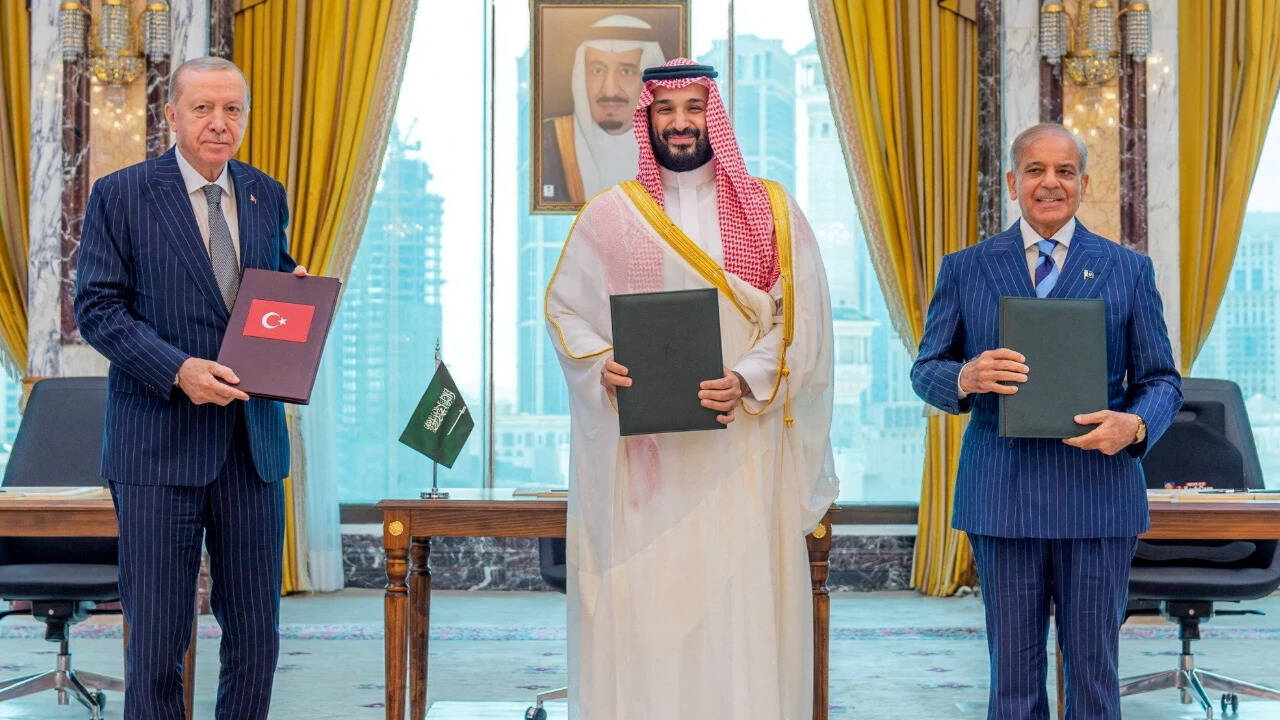
When Turkey, Egypt, Saudi Arabia, and Pakistan formally raise their voices to affirm Riyadh’s inherent right to self-defense, they are doing much more than issuing routine diplomatic communiqués. They are drawing a thick, unyielding line in the sand. To understand the gravity of this collective stance, one must look past the stiff handshakes of ministers and examine the raw geometry of regional survival.
Egypt views the security of the Red Sea and the Arabian Peninsula through an existential lens. The Bab el-Mandeb strait, located at the southern mouth of the Red Sea, is the economic jugular through which millions of barrels of oil and global commerce flow toward the Suez Canal. When Houthi artillery and drone boats threaten the stability of Saudi Arabia, they simultaneously threaten the economic lifeline of Cairo. A disrupted Riyadh is a destabilized Cairo. Egyptian military planners understand that a fire lit in the southern reaches of the Arabian Peninsula will inevitably scorch the Mediterranean coast.
Ankara’s posture tells a different story of calculated pragmatism and shared strategic dread. Turkey possesses one of the most advanced defense manufacturing sectors in the world, particularly in the domain of unmanned aerial systems. Turkish military strategists watch the proliferation of cheap, loitering munitions with acute alarm. When non-state actors acquire the capability to manufacture or assemble precision-guided strike weapons with impunity, the security architecture of every sovereign state in the wider region is compromised. By standing with Riyadh, Turkey signals that the normalization of cross-border missile attacks against recognized governments is an intolerable breach of international order. The message from Ankara is unmistakable: today it is a Riyadh oil refinery or a residential district; tomorrow it could be any capital whose borders happen to lie within range of a proxy militia.
Farther to the east, Pakistan’s alignment with Saudi security is forged in the crucible of decades-long military ties and profound geopolitical kinship. Islamabad’s defense establishment views the territorial integrity of the Kingdom as a cornerstone of stability from the Indus River to the Persian Gulf. Pakistan brings immense strategic depth, nuclear-armed deterrence credibility, and a seasoned military apparatus to the diplomatic table. When Pakistani leadership reiterates its absolute support for Saudi self-defense, it is not merely offering rhetorical comfort. It is reminding regional adversaries that the Kingdom is not isolated, and that an assault on Saudi sovereignty carries ripple effects that extend deep into South Asia.
Why do these four powers—each with its own distinct national interests, domestic pressures, and historical rivalries—find themselves speaking with one synchronized voice on this issue?
Because the proliferation of drone warfare by non-state actors represents a terrifying leveling of the playing field. For centuries, the monopoly on long-range precision destruction belonged strictly to nation-states with massive industrial bases, air forces, and space-based intelligence networks. Today, a militia group funded and armed by regional patrons can assemble a delta-wing suicide drone using commercial off-the-shelf microprocessors, GPS modules, and smuggled propulsion systems. They can program coordinates into a laptop in a dry riverbed and launch a weapon capable of traveling hundreds of miles to strike a fuel depot with pinpoint accuracy.
This democratization of destruction changes everything. It turns every civilian airport, every water desalination plant, and every residential skyscraper into a potential frontline trench.
When Riyadh asserts its right to self-defense, it is fighting not just against falling explosives, but against a dangerous new normal where sovereignty can be chipped away night by night, drone by drone, until the boundaries of international law dissolve into lawless anarchy. The joint affirmations from Turkish, Egyptian, Pakistani, and Saudi capitals serve as a collective firewall against this descent. They declare that borders still matter, that state-to-state sovereignty remains the organizing principle of international relations, and that unprovoked aggression from non-state proxies will meet a united diplomatic front.
Back in the command bunker, the amber tracks vanish from Tariq’s screen. The interceptor has done its work. High above the desert, a brief flash of light fades into the velvet dark, leaving behind a shower of invisible ash that drifts silently down toward the dunes.
Down below, the city stirs back to life. Traffic resumes on the multi-lane highways. Coffee shops open their shutters. Streetlights cut through the pre-dawn haze, casting long, clean shadows across concrete and glass. For a few hours, the sky is quiet. But everyone in the room knows the truth. The silence is only temporary. The drones are already being fueled in distant valleys, their navigation systems humming, waiting for the sun to drop below the horizon once more. And across four great capitals, leaders know that when the next wave rises into the night air, the response must remain as solid, unbroken, and unyielding as the desert stone.