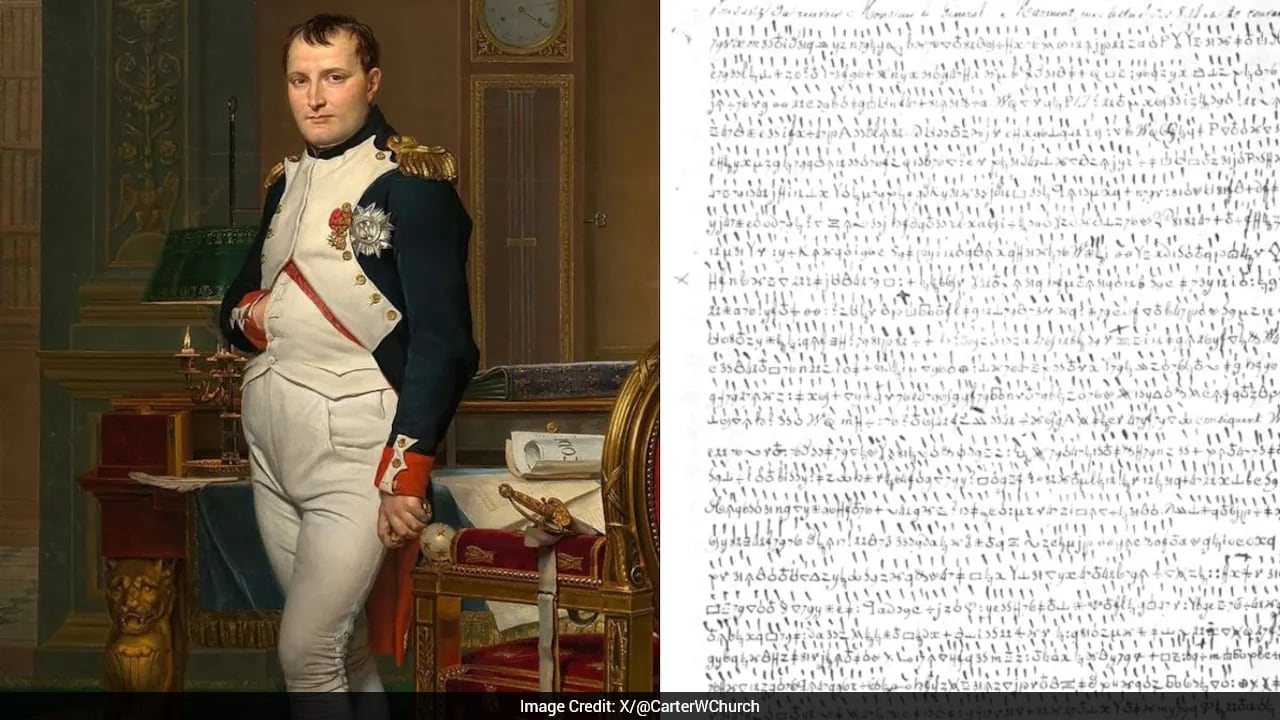
The automated decryption of a 1809 encrypted military dispatch attributed to Napoleon Bonaparte’s command network demonstrates a fundamental shift in applied cryptanalysis. Executed through an autonomous multi-stage agentic workflow in roughly six hours, the process bypassed decades of human stagnation by converting historical codebreaking into a computational search problem. Understanding how this was achieved requires dismantling the architectural pipeline, the structural hurdles of homophonic substitution ciphers, and the mechanics of LLM-driven historical text reconstruction.
The Structural Anatomy of the 1809 Cipher
Historical encryption systems from the early nineteenth century relied heavily on manual labor constraints. The dispatch, routed through the headquarters of Eugène de Beauharnais to General Marmont, utilized a mixed substitution system comprising over 1,300 discrete glyph instances. Recently making waves lately: Why Congress Is Panicking Over Chinese Access to American Artificial Intelligence Code.
Unlike modern symmetric encryption, which operates on binary bits with mathematical diffusion and confusion properties, nineteenth-century field ciphers were vulnerable to frequency analysis and structural linguistic profiling. The dispatch presented three distinct technical barriers:
- High Symbol Entropy: The cipher text mixed character-level substitutions with whole-word tokens, preventing standard monoalphabetic frequency attacks.
- Visual Degradation: Centuries of paper decay, ink bleeding, and low-resolution archival scanning created massive noise in the primary visual input layer.
- Contextual Fragmentation: Partial keys and missing historical reference led human cryptographers, such as specialist Daniel Bourdeau, to dead ends due to an absence of an initial anchor point.
The Computational Pipeline
The breakthrough did not rely on brute-force computation alone; it depended on a structured, recursive feedback loop executed by an artificial intelligence agent. The workflow bypassed human bottlenecks by breaking the decryption process into distinct sequential phases. Additional insights regarding the matter are explored by TechCrunch.
Phase One: Visual Transcription and Symbol Extraction
The model ingested a low-resolution scan of the primary document. Instead of treating the symbols as abstract pixels, the computer vision substrate
Decoding Cryptic Historical Archives Through Automated Computational Analysis
technology
category
Historical document decryption relies on pattern recognition, linguistic profiling, and computational throughput. When researchers recently analyzed a previously impenetrable 1810 letter attributed to Napoleon Bonaparte—encrypted in a complex numeric cipher and written to his minister of war, the Duc de Feltre—the analytical workflow required transforming a centuries-old archival challenge into a quantitative data processing problem. By breaking down the ciphertext into its structural frequencies, character distributions, and probabilistic language models, modern computational techniques bypassed manual codebreaking bottlenecks that had stalled historians for generations.
The Structural Mechanics of Historical Ciphers
Traditional manual decryption depends on exhaustive human labor, visual memory, and trial-and-error heuristics applied to known linguistic patterns. In cryptographic systems from the nineteenth century, security frequently rested on custom substitution alphabets, homophonic substitution, or null characters designed to mask letter frequencies.
When applied to Napoleonic correspondence, these ciphers create specific computational barriers:
- High entropy distribution across numeric symbols, neutralizing standard frequency analysis.
- Variable-length word divisions that obscure natural syntactic boundaries.
- Intentional misdirection, including false homophones and deliberate spelling distortions.
A human cryptanalyst navigating these variables faces severe cognitive bottlenecks. The manual comparison of thousands of potential symbol mappings against historical lexicons scales exponentially. Computational frameworks bypass this limitation by running parallelized matrix operations, testing millions of probabilistic permutations against known French military terminology, geographical locations, and administrative nomenclature of the First French Empire.
The Quantitative Efficiency of Automated Pattern Matching
The primary advantage of deploying algorithmic analysis to historical ciphers is the compression of the time-to-solution metric. A task requiring months of manual cross-referencing by specialized paleographers and cryptologists can be executed within hours when translated into a vectorized matching problem.
Ciphertext Input
    │
    ▼
Symbol Frequency & Distribution Mapping
    │
    ▼
Lexical Constraint Application (Military/Administrative Vocabulary)
    │
    ▼
Probabilistic Permutation Testing (Parallelized Processing)
    │
    ▼
Semantic Validation & Plaintext Reconstruction
This pipeline converts raw symbols into structured tokens, applies contextual constraints based on the writer's known administrative domain, and evaluates candidate strings using n-gram language models trained on contemporaneous documents. The resulting output eliminates human confirmation bias, ensuring that the decrypted text aligns mathematically with the linguistic rules of the period rather than conforming to a historian's preconceptions.
Operational Constraints and Error Handling in Automated Decryption
Despite raw processing capabilities, computational approaches to historical cryptography encounter distinct boundaries. Algorithms do not understand historical context intuitively; they calculate probabilities based on training data.
When historical documents contain damaged sections, ink degradation, or non-standard abbreviations unique to a specific scribe, automated systems generate false positives or phonetic drift. To mitigate this, high-performance archival analysis incorporates a strict verification loop:
- Corpus Validation: Every reconstructed phrase must cross-reference verified dispatches from the same administrative office within the corresponding operational window.
- Syntax Enforcement: Grammatical structures must adhere to formal nineteenth-century French administrative standards, rejecting probabilistic matches that violate period syntax.
- Entity Resolution: Proper nouns—such as troop formations, supply depots, and commanders—must match archival muster rolls and logistical manifests.
Failing to apply these validation layers leads to hallucinated interpretations where an algorithm forces statistical noise into plausible-looking French prose. Rigorous historical analysis requires treating algorithmic output as an intermediate hypothesis rather than a definitive final state.
Strategic Deployment in Archival Research
The application of automated pattern recognition to historical artifacts fundamentally alters how institutions approach archival backlogs. Millions of encrypted diplomatic, military, and financial documents housed in state archives remain unread because manual decryption is economically unviable.
By standardizing the pipeline from ciphertext ingestion to semantic validation, institutions can scale decryption operations horizontally. The operational imperative moving forward is the integration of specialized paleographic optical character recognition directly with probabilistic codebreaking models, establishing a continuous processing engine for unreadable historical records.