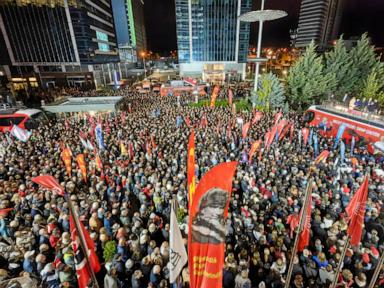
The Ankara Regional Court of Appeal’s decision to annul the November 2023 congress of the Republican People’s Party (CHP) represents a calculated deployment of lawfare designed to induce institutional paralysis. By legally removing party chair Özgür Özel and restoring his predecessor, Kemal Kılıçdaroğlu, the Turkish judiciary has not merely intervened in an internal leadership dispute; it has disrupted the operational equilibrium of Turkey’s primary opposition vehicle.
To evaluate this intervention objectively, analysts must bypass standard rhetorical descriptions of a "judicial coup" and instead analyze the structural, financial, and mechanical vectors through which this ruling neutralizes political competition ahead of potential early elections. If you liked this piece, you should look at: this related article.
The Tri-Pillar Architecture of Institutional Decapitation
The court’s decision operates on a precise operational mechanics framework. By targeting the legal validity of the 2023 congress, the ruling systematically uncouples the CHP’s executive authority from its electoral base. This institutional disruption functions via three distinct vectors:
1. The Executive Continuity Vacuum
The immediate effect of the ruling is the invalidation of all executive decisions, candidate appointments, and structural changes enacted under Özel’s tenure since late 2023. This includes the primary elections held in March 2025 that formalized the presidential candidacy of Istanbul Mayor Ekrem İmamoğlu—who remains incarcerated. By retroactively nullifying the mandate of the party assembly that approved these processes, the judiciary has thrown the legal validity of the CHP's entire national strategy into a state of severe ambiguity. For another look on this event, check out the latest update from Al Jazeera.
2. Legal Representation and Appeal Sabotage
The swift mechanics of the leadership reversal became apparent within 24 hours of the decision. Upon his court-ordered reinstatement, Kılıçdaroğlu dismissed the three primary CHP lawyers tasked with filing an appeal to the Court of Cassation. They were replaced with an alternative legal team that immediately petitioned to withdraw the appeal. This structural maneuver effectively blocks the party’s internal capacity to seek legal recourse, transforming an external judicial intervention into an internal operational deadlock.
3. The Financial and Capital Squeeze
The introduction of acute political uncertainty has immediate macroeconomic consequences. Following the ruling, trading on the Borsa Istanbul was briefly halted due to a 6% drop in share prices. This market volatility mirrors previous interventions; following İmamoğlu’s arrest in March 2025, the Central Bank of the Republic of Turkey expended an estimated $57 billion in foreign exchange reserves to stabilize the lira, driving net reserves down from over $60 billion to under $20 billion.
The renewal of leadership instability threatens to accelerate capital flight, complicating Turkey's broader economic stabilization program which relies on foreign investor predictability.
Macro-Political Dynamics: The Calculus of Early Elections
The timing of this judicial intervention correlates directly with the ruling Justice and Development Party’s (AKP) electoral vulnerabilities. While the next official presidential election is scheduled for 2028, President Recep Tayyip Erdoğan retains the constitutional prerogative to call for an early vote. The legal campaign against the CHP suggests a pre-emptive effort to configure an optimal competitive landscape.
The necessity of this intervention stems from the outcomes of the 2024 municipal elections, where the CHP emerged as the top-voted party nationally under Özel's modernized leadership. This victory created a dual-track threat to the incumbent administration:
- The Popular Front Line: Ekrem İmamoğlu, despite his 2025 imprisonment on corruption and security charges, continues to lead in national polling. The CHP's stated contingency plan to run İmamoğlu from a maximum-security facility established a durable political challenge that ordinary judicial detention could not fully neutralize.
- The Legislative Front Line: Özgür Özel successfully maintained party discipline and consolidated a diverse anti-Erdoğan coalition. His removal removes a highly effective operational manager who successfully converted local municipal victories into a coherent national platform.
By forcing the reinstatement of Kılıçdaroğlu—a 77-year-old leader who oversaw a 13-year tenure marked by consecutive national election losses—the judicial apparatus forces a regression in the CHP's leadership profile. Kılıçdaroğlu's recent rhetoric, including a public address accusing the current party structure of corruption and calling for a internal purification, aligns with state efforts to delegitimize the younger, more electorally viable faction of the opposition.
The Strategic Bottleneck: Operational Realities of the Standoff
The current standoff at the CHP headquarters in Ankara outlines the limits of pure legalism when confronted with physical institutional control. With Özel and the vast majority of current lawmakers refusing to vacate the party building, and rank-and-file members blocking the entry of the court-appointed leadership team, the crisis has moved into an asymmetric operational phase.
This standoff presents a profound strategic dilemma for both factions:
The Reinstated Faction's Constraints
Kılıçdaroğlu’s faction holds nominal legal authority but completely lacks institutional legitimacy among the party's active base and legislative delegation. Without physical control of the headquarters, access to the party’s financial accounts, and the cooperation of municipal mayors who control local patronage networks, this leadership exists purely on paper. Any attempt to enforce entry via state security forces would permanently alienate the party's core voters and cement accusations of direct state collaboration.
The Incumbent Faction's Constraints
Özel’s faction retains physical and psychological control of the party apparatus but faces an existential legal bottleneck. If the withdrawal of the appeal to the Court of Cassation stands, the current executive board operates outside of Turkish corporate and political party law. Any subsequent candidates selected by Özel’s team for public office risk immediate disqualification by the Supreme Electoral Council (YSK), rendering the party unable to field valid contenders in an early election scenario.
The Next Strategic Phase
The resolution of this deadlock will not occur through consensus, but through the exploitation of institutional leverage points. The immediate operational priority for the true opposition leadership is the bypass of the centralized party structure. Since national headquarters control is legally compromised, the operational center of gravity must shift to the metropolitan municipalities—specifically Ankara and Istanbul—which possess independent budgets, executive mandates, and direct democratic legitimacy.
The primary vulnerability for the opposition remains the upcoming decision of the Supreme Electoral Council regarding candidate eligibility. If the state successfully utilizes the court-ordered Kılıçdaroğlu leadership to alter the party's candidate selection rules, the CHP will face a structural split: choosing between running under a compromised, state-sanctioned ticket or forming a completely new independent political entity under tight time constraints. The speed with which Özel's faction can establish decentralized, parallel selection mechanisms will determine whether the opposition can survive this judicial intervention as a viable electoral force.