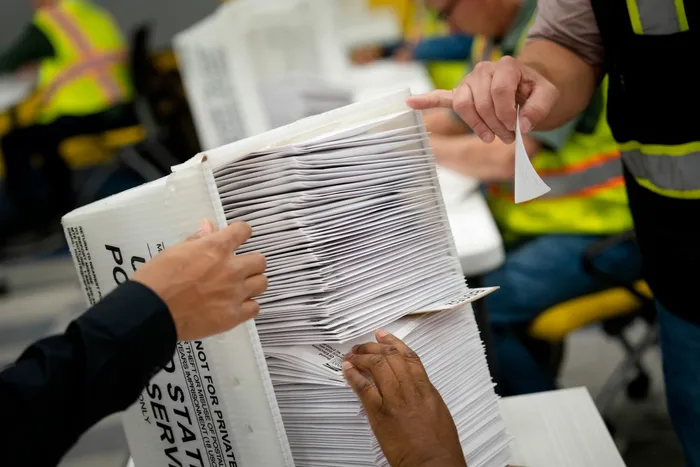
The American legal system is currently obsessed with a phantom menace: the "disenfranchised" voter who simply couldn't find a mailbox by Tuesday.
Mainstream media outlets are wringing their hands over the Supreme Court’s skepticism toward state laws that allow ballots to crawl in days—or even weeks—after Election Day. The "lazy consensus" suggests that every day we extend the deadline is a victory for democracy. They frame any hard cutoff as a "suppression" tactic designed to silence the masses.
They are dead wrong.
By prioritizing "flexibility" over finality, we aren't saving democracy; we are nuking its structural integrity. In the hunt for total inclusivity, we have sacrificed the one thing that actually makes an election legitimate: a shared, immutable timeline. When you blur the edges of the calendar, you don't invite more people into the process. You invite chaos, litigation, and a permanent cloud of suspicion that no "audit" can ever truly burn away.
The Myth of the Infinite Grace Period
The argument for late-arriving ballots rests on a shaky premise: that the postal service is a lawless void where ballots disappear for decades and only emerge once the clock strikes midnight on Tuesday. Activists argue that if a voter puts a ballot in the mail on Monday, it’s "unfair" if it doesn't arrive by Tuesday night.
Let's dismantle that.
Election Day isn't a surprise. It doesn't move. It isn't a pop quiz. Treating a national election like a college essay where you can beg the professor for an extension is an insult to the electorate. I have managed logistics for high-stakes operations where a three-second delay means a total system failure. In those environments, you learn a hard truth: Strict boundaries create predictable outcomes.
When a state allows ballots to arrive three, five, or nine days late, they aren't just "counting every vote." They are creating a "gray zone" of uncertainty. This is where the mischief happens. Not necessarily "fraud" in the cinematic sense of suitcases full of fake papers, but the administrative nightmare of trying to verify signatures and postmarks on a rolling basis while the entire world watches and waits.
The Postmark Problem is a Legal Trap
The Supreme Court isn't being "mean" when it questions these extensions. The justices are looking at the disaster of "subjective evidence."
Consider the postmark. In theory, it’s a timestamp. In reality, it’s a mess. Millions of pieces of mail are processed without legible postmarks. When a ballot arrives three days late without a clear date stamp, what does the election board do?
- They guess.
- They fight.
- They end up in court.
If the law says the ballot must be received by the time polls close, the rule is binary. It’s either in the box or it isn't. Zero subjectivity. As soon as you move the goalposts to "postmarked by," you introduce a massive layer of human discretion and technical error. I've seen back-end data systems collapse under far less ambiguity. Expecting 3,000+ different counties to uniformally interpret smeared ink on an envelope is a recipe for the exact "equal protection" lawsuits that gave us Bush v. Gore.
Finality is a Feature Not a Bug
The psychological impact of a "Week of Election" instead of an "Election Day" is catastrophic for public trust.
When the lead flips three days after the polls close because of a batch of late-arriving mail, half the country assumes the worst. You can cite every "process" and "statute" in the book, but you cannot legislate away the feeling of a rigged game when the rules are fluid.
Finality provides a psychological "hard reset" for a nation. We need to know who won so we can move on to the next phase of governance. By dragging out the count to accommodate the extreme outliers who couldn't hit a multi-week early voting window or a firm Tuesday deadline, we keep the entire country in a state of high-octane anxiety.
We are trading the stability of the entire republic for the convenience of the procrastinator. That is a bad trade.
The Administrative Burnout Nobody Talks About
I’ve spoken with election officials who are quite literally vibrating with exhaustion by Wednesday morning. Under the "late arrival" paradigm, their job doesn't end when the polls close; it enters a grueling, high-pressure second act.
- Continuous Chain of Custody: Every extra day a ballot is in transit is another day the chain of custody is technically "open."
- Signature Verification Fatigue: Workers are asked to maintain high-intensity scrutiny on signatures for a week straight. Accuracy drops as sleep deprivation climbs.
- Resource Drain: Keeping counting centers open and secure for an extra week costs millions that could be spent on better voting technology or more polling places.
If you want a secure election, you want it to be short, sharp, and decisive. The longer a ballot is "out there" in the wild, the higher the statistical probability of an error occurring.
The False Choice of Suppression
The "contrarian" take here isn't that we should make it hard to vote. It’s that we should make it disciplined.
States like Florida have largely figured this out. They have robust mail-in options, but they also have hard deadlines. The result? They count fast, they report fast, and the losers concede because there is no "mystery meat" left in the mail stream. Contrast that with states that allow a week-long trickle of ballots. Those states become the laughingstock of the democratic world every two to four years.
If you can't get a ballot into a mailbox or a drop box within a 30-day window, the problem isn't the law. The problem is your lack of planning. Harsh? Yes. Necessary? Absolutely.
The Cost of "Perfect" Democracy
We are chasing a "perfect" count that doesn't exist. There is no such thing as a 100% participation rate or a 0% error rate. In engineering, we call this the "law of diminishing returns." To get that last 0.5% of late ballots into the tally, we incur 90% of the political and social cost of the entire election.
We are burning down the house to make sure the drapes are perfectly straight.
The Supreme Court’s skepticism isn't a threat to your rights. It’s a desperate attempt to put some guardrails back on a system that is drifting toward permanent instability. We need to stop pretending that every procedural tweak is a human rights violation and start admitting that a system without deadlines isn't a system at all—it's a suggestion.
Standardize the cutoff. Kill the "grace period." If you want your voice heard, show up on time.
Stop asking for more time and start demanding more certainty.



