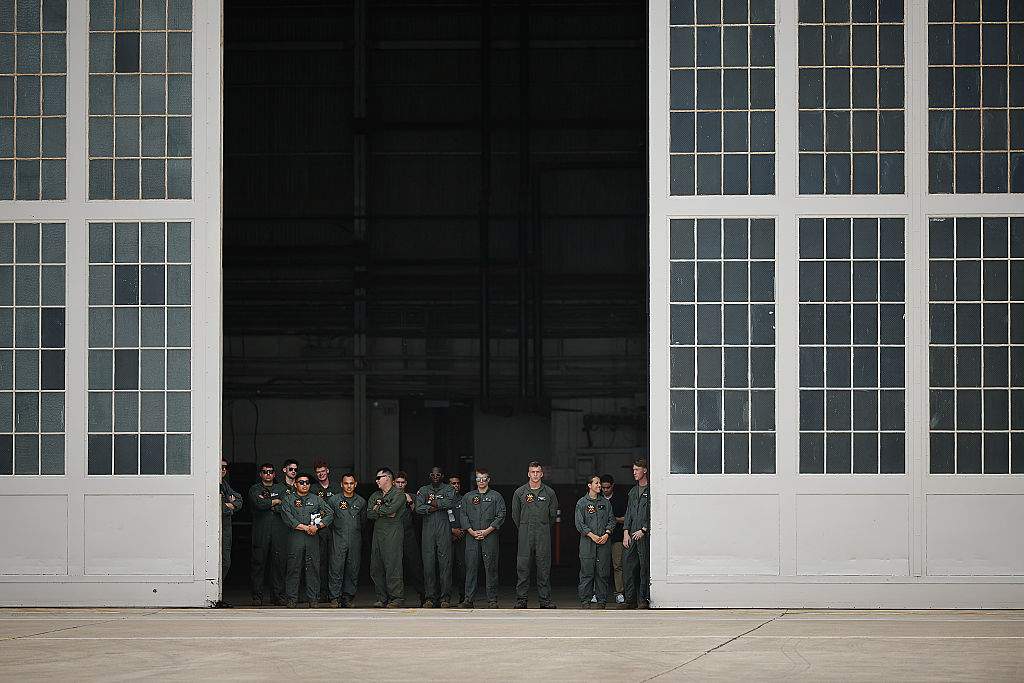
The heating in Barracks 412 always groaned before it died.
It started with a wet, metallic rattle deep in the pipes, followed by a sudden hiss that smelled faintly of rust and old wool. For the young airmen sitting on the edges of their perfectly made racks, that sound was the true beginning of the winter. Outside, the wind off the tarmac was brutal, whipping fine sheets of sleet against the reinforced glass. Inside, seventy people were breathing the exact same air, over and over again.
By midnight, the coughing started.
It wasn't the polite, throat-clearing click you hear in a library. This was deep. Barking. A rattling, collective echo that bounced off concrete walls and linoleum floors. Within forty-eight hours, the base clinic looked less like a medical facility and more like a field hospital during a strategic retreat.
Nearly 160 personnel down. In less than a week.
For a population trained to endure extreme environments, withstand high-G maneuvers, and maintain peak physical readiness, a microscopic strand of RNA had done what no adversary could manage on a standard Tuesday. It ground operations to a screeching halt. The reason wasn't a failure of security, a breach of the perimeter, or a breakdown in tactical discipline.
The defense line had simply been unstitched from the inside out, months before the first snowflake fell.
The Invisible Armor
To understand how a military installation loses an entire battalion’s worth of manpower to a seasonal bug, you have to look at how a base functions. It is a closed ecosystem. Airmen eat together in massive dining facilities. They share industrial-sized bathrooms. They sleep in close quarters, study in crowded classrooms, and work shoulder-to-shoulder in the cramped bellies of transport aircraft.
In this environment, health is not an individual choice. It is infrastructure.
For years, that infrastructure was reinforced by a strict, non-negotiable policy: everyone gets the shot. It was as routine as checking your boots or cleaning your sidearm. You stood in line, you bared your shoulder, a medic pressed a needle into your deltoid, and you moved on to the next station. The mandate acted as an invisible shield, a collective ceiling that kept the virus from finding enough dry tinder to spark a wildfire.
Then, the mandate ended.
The policy change was quiet, a bureaucratic pen stroke meant to align with broader shifting regulations. On paper, it looked like a nod toward individual autonomy, a minor adjustment in standard operating procedures. In reality, it was like removing a fundamental support beam from a suspension bridge and hoping the wind wouldn't blow too hard this year.
When the choice became optional, the numbers dropped. Not because of a massive ideological rebellion, but because of human nature. When you are twenty years old, feeling invincible, and already exhausted from twelve-hour shifts on a freezing flight line, an optional trip to the clinic falls off the priority list. You tell yourself you’ll get to it next week. You tell yourself you’ve never gotten that sick anyway.
The virus, however, does not care about your schedule.
The Chemistry of a Cascade
Imagine a row of dominoes spaced precisely two inches apart. If you knock the first one over, it falls flat, hitting nothing. This is what a fully vaccinated base looks like. The virus enters a barracks, finds a host whose immune system recognizes the threat, and dies there. The chain is broken before it even begins.
Now, move those dominoes closer together.
Remove the space.
When the vaccine uptake fell below that critical threshold of herd protection, those metaphorical dominoes were packed tight. Let's look at a hypothetical airman—we will call him Specialist Miller. Miller works in logistics. He handles crates coming off cargo planes, shaking hands with dozens of crew members a day. He catches a mild strain of the virus. Because he is young and fit, he assumes it is just a stubborn runny nose from the cold wind outside.
Miller goes to breakfast. He touches the serving utensils. He sits at a long table with eight other people from his squadron.
Two days later, three of those people are running temperatures of 103 degrees. One of them is a mechanic responsible for certifying the engines on a fleet of refueling tankers. Another is a communications specialist who monitors the base's secure networks. The third is a cook.
The virus expands exponentially. One becomes three. Three become nine. Nine become twenty-seven.
By the time the base command realized the scale of the outbreak, the clinic was overwhelmed. The waiting room ran out of chairs. Men and women in uniform sat on the floor, heads buried in their hands, shivering violently despite the heavy wool blankets draped over their shoulders. The air smelled of menthol, bleach, and exhaustion.
The True Cost of Readiness
The conversation around preventative medicine often gets bogged down in abstract debates, statistics, and political rhetoric. But on the ground, the reality is starkly practical.
When 160 people vanish from duty rotation simultaneously, the strain doesn't disappear; it gets redistributed. The airmen who managed to escape the infection are forced to pick up the slack. Twelve-hour shifts turn into sixteen-hour marathons. Double shifts become the norm.
Fatigue sets in. And in a high-stakes environment where people operate heavy machinery, manage millions of dollars of equipment, and handle lethal weapons, fatigue is the real danger. A tired mechanic forgets to torque a bolt correctly. A sleepy tower controller miscalculates an approach vector. The virus might not kill anyone, but the chaos it leaves in its wake creates a dangerous vulnerability.
The data from this specific outbreak tells a clear story, one that public health officials have been trying to explain for decades. The sudden surge in cases wasn't a fluke of nature or a particularly mutated super-strain. It was a direct, predictable consequence of a gap in the armor.
The Quiet Flight Line
Walk out onto the tarmac during the height of the outbreak, and the silence was deafening.
Usually, the flight line is a symphony of industrial noise—the high-pitched whine of auxiliary power units, the deep roar of jet engines testing, the shouts of ground crews navigating the concrete expanse. But with a significant portion of the maintenance squadron sidelined with aches, chills, and debilitating fatigue, the tempo slowed to a crawl.
Aircraft sat under heavy tarps, cold and still. The mission didn't stop entirely, but it limped.
This is the hidden face of modern security. We often think of threats in terms of hardware—missiles, cyberattacks, foreign aggression. We spend billions ensuring our technology is cutting-edge and our physical defenses are impregnable. Yet, the entire apparatus relies on the biological resilience of the human beings behind the machines.
The lesson learned in the freezing barracks and crowded clinics of that air force base isn't unique to the military. It applies to every school, every factory, every office tower, and every community. Protection isn't a permanent state of being; it is an active choice that requires continuous maintenance.
When the fever finally broke and the barracks fell silent again, the lesson remained printed on the empty duty rosters and the delayed flight schedules. Security is only as strong as its weakest link, and sometimes, that link is as small as a single, skipped needle poke on a cold afternoon.