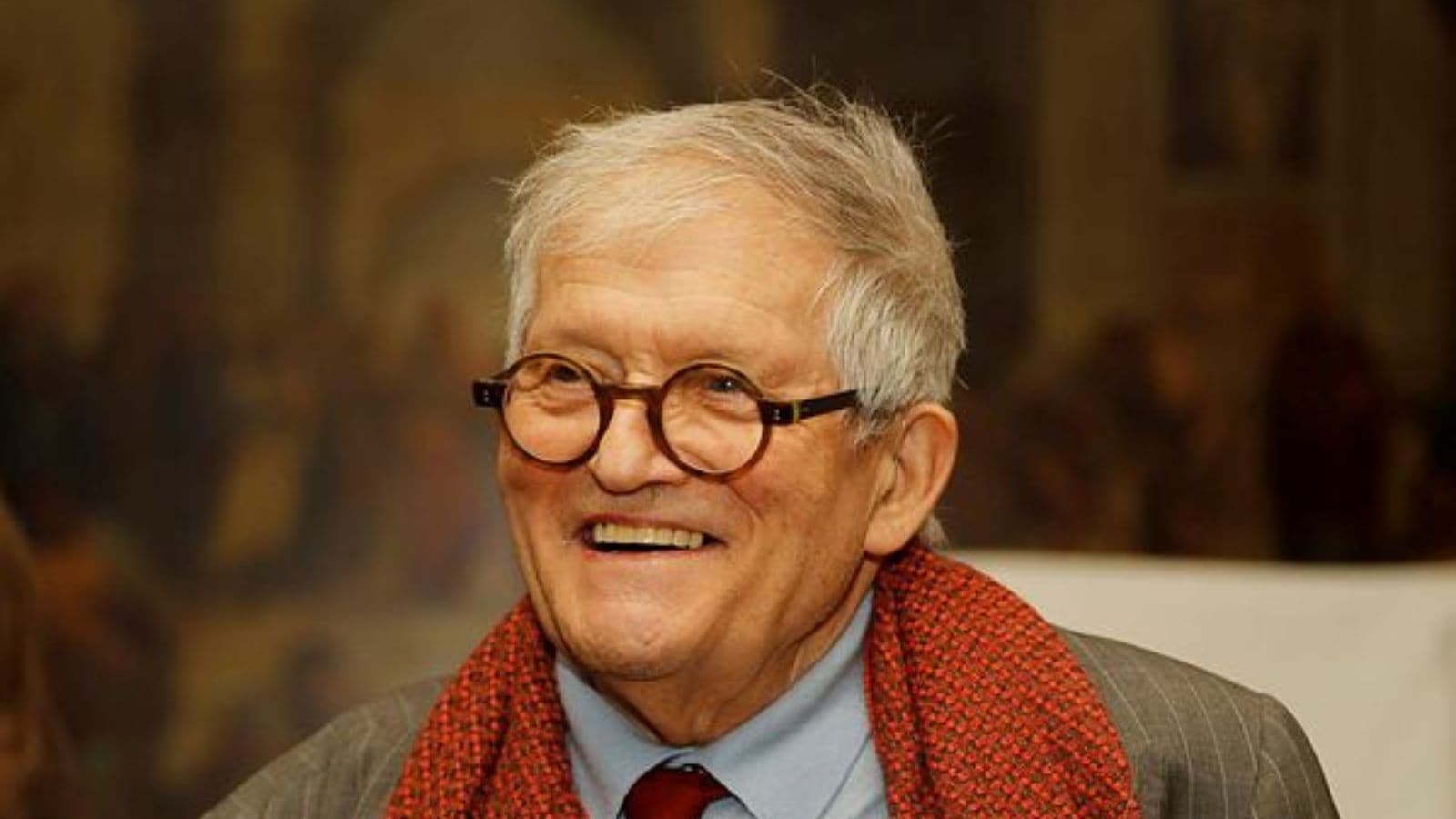
The art world obituaries are rolling out exactly as scripted, dripping with the predictable, lazy consensus. They all say the same thing: David Hockney, the boy from Bradford who died at 88, was a sun-drenched hedonist who went to Southern California in search of "color." They point to the turquoise swimming pools, the acrylic pinks, and the bright Los Angeles skies as evidence of a joyful, straightforward celebration of West Coast luxury.
They are entirely wrong.
To look at Hockney’s California paintings and see nothing but an appetite for sunshine is to completely misunderstand post-war British art, queer history, and the mechanics of human perception. Hockney did not move to Los Angeles because he fell in love with light. He moved to Los Angeles because he was suffocating under the crushing, puritanical grayness of mid-century Britain. His art was not an embrace of American reality; it was a radical, highly calculated rejection of English misery.
The standard narrative treats his transition from Yorkshire to California as a simple geographic upgrade. In reality, it was a profound psychological defection.
The Myth of the Carefree Splash
Let’s dismantle the crown jewel of the Hockney mythos: A Bigger Splash (1967).
The lazy critique views this canvas as the ultimate monument to Californian leisure. You see a diving board, a mid-century modern house, two palm trees, and a violent burst of water. It looks like a snapshot of a fleeting, wealthy moment.
But look closer at how it was actually made. Hockney didn’t snap a photograph and call it a day. He spent two weeks meticulously painting that splash with tiny, microscopic brushstrokes using acrylic paint.
Think about the sheer contradiction of that process. A splash happens in a fraction of a second. To spend fourteen days painting a two-second event is not an act of spontaneous joy. It is an act of rigid, almost obsessive control.
The painting is totally devoid of human presence. The diver is gone, swallowed by the water. The house is static, silent, and eerie. It is less a celebration of a pool party and more an exploration of profound stillness and isolation. I have spent decades watching art markets and museums reduce complex, deeply melancholic works into corporate lobby decoration. To call A Bigger Splash "cheerful" is like calling The Great Gatsby a book about great parties. It misses the entire undercurrent of alienation.
The British Grayness They Choose to Forget
To understand why Hockney painted the way he did in the 1960s, you have to understand what he left behind.
Britain in the late 1950s and early 1960s was bleak. Rationing had only ended in 1954. The physical landscape of northern towns like Bradford was dominated by soot, brick, and industrial smog. More importantly, the cultural landscape was repressed and dangerous. Homosexuality was a criminal offense in England and Wales until the Sexual Offences Act of 1967.
When Hockney was studying at the Royal College of Art in London, showing your true self could land you in prison. His early work from that period—like We Two Boys Together Clinging (1961)—is frantic, scratched, graffiti-like, and dark. It reflects a hidden, dangerous subculture.
Then he steps off a plane in Los Angeles in 1964.
He didn't just find sun. He found a place where young men could live openly, where the homes had glass walls instead of brick barriers, and where the light was so sharp it flattened perspective. The vibrant colors he adopted weren't a stylistic whim; they were a political statement. Using bright, synthetic acrylics—a brand new medium at the time—was a direct insult to the muddy, serious oil paintings favored by the British art establishment.
His California was an invented utopia. It was a constructed fantasy designed to cure his own displaced Yorkshire gloom. He painted an idealized, pristine version of LA that locals didn't even recognize, stripping away the traffic, the smog, and the racial tensions of the 1960s to create a clean, safe space for his own desires.
The Flawed Premise of the David Hockney Style
People often ask: How did David Hockney change the way we see the world?
The common answer is that he introduced a vibrant, accessible pop aesthetic to fine art. But this completely ignores his actual technical obsession: challenging the tyranny of the single-lens camera.
Hockney hated standard photography. He argued that a photograph sees the world all at once, in a single, frozen instant, from a single point of view. But that is not how human beings actually experience reality. When you look at a room, your eyes move. You look at a chair, then a face, then a window. Your brain stiches these multiple perspectives together over time.
This realization led to his massive photo-collages, or "joiners," in the 1980s, and later his multi-screen video works. He was trying to force a static medium to represent time and movement.
Look at his famous double portraits, such as Mr and Mrs Clark and Percy (1971).
The establishment praises it for its lifelike scale and luminous light. What they miss is the deep, structural discomfort built into the canvas. The traditional roles are entirely reversed. The woman (Celia Birtwell) stands dominant, while the man (Ossie Clark) sits, looking passive and detached. The cat on his lap stares directly at the viewer with an unsettling gaze. The light streams in from behind them, casting the subjects into a subtle shadow, making them look isolated from each other despite sharing the same room.
Hockney wasn't painting a happy marriage; he was documenting the slow, silent unraveling of a relationship. Yet, because the carpet is a soft green and the room is spacious, the casual observer marks it down as another piece of charming British realism.
The Downside of the Hockney Obsession
Admitting the brilliance of Hockney’s subversion requires admitting the failure of his late-stage work.
In his final decades, Hockney returned to the East Yorkshire landscape and eventually moved to Normandy, France. He swapped his paintbrushes for iPads. The art world cheered, praising the veteran artist for embracing digital technology.
But let's be brutally honest: many of the iPad drawings are garish, overly saturated, and lack the rigorous depth of his mid-century masterpieces. The technology removed the friction of the medium. When paint takes hours to dry, an artist is forced to think, deliberate, and fight the canvas. When you can change a color with a tap of a stylus, it becomes too easy to churn out superficial images.
The market doesn't care, of course. A late-period Hockney landscape sells for millions because it carries the brand name, but structurally, these works often lack the conceptual tension that made his early California work so dangerous and vital. They became the very thing he used to fight against: comfortable, pleasant, decorative art for the wealthy elite.
Stop Reading the Obituaries as Fact
The art historical industrial complex wants you to remember David Hockney as a colorful, eccentric old man with mismatched socks who painted pretty pools and Yorkshire trees. They want to sanitize him because a sanitized artist is easier to sell to tourists at Tate Britain.
Do not accept that watered-down legacy.
Hockney’s true value lies not in his cheerfulness, but in his defiance. He took the grey, repressed trauma of post-war England and weaponized color to build a world where he could finally breathe. His pools were not symbols of wealth; they were stages for an exiled artist staging a quiet, beautiful revolution against the country that refused to accept him.
The splash wasn't an invitation to join the party. It was the sound of someone breaking the surface to keep from drowning.